Introduction
Welcome back. In our last lesson, you added functools.partial, lru_cache, and singledispatch to your toolkit, mastering how Python uses higher-order functions to write clean, efficient, and flexible code.
This lesson continues our journey into functional programming patterns by tackling a common point of confusion for developers new to Python: how to best transform and filter data. You'll learn to choose between the classic map() and filter() functions and the more modern, Pythonic comprehensions and generator expressions. We will also define the precise, limited role of lambda functions.
Your background with Java's Stream API (.stream().filter(...).map(...)) provides an excellent point of comparison. While the concepts are similar, Python's idiomatic approach often favors a different syntax that is more deeply integrated into the language. By the end of this lesson, you will be able to:
- Choose decisively between
map/filterand comprehensions. - Use generator expressions for memory-efficient lazy processing.
- Identify the few scenarios where
lambdais appropriate and the many where it is not.
1. The Core Tools: A Quick Comparison
Python offers several ways to achieve the same goal of transforming or filtering a collection. Let's look at the main contenders for turning a list of numbers into a list of their squares.
a) The for loop: The explicit, imperative way.
numbers = [1, 2, 3, 4, 5]
squares = []
for n in numbers:
    squares.append(n**2)


# squares is [1, 4, 9, 16, 25]
b) map() with a lambda: A functional approach.
numbers = [1, 2, 3, 4, 5]


# map returns an iterator, so we wrap it in list()
squares = list(map(lambda n: n**2, numbers))


# squares is [1, 4, 9, 16, 25]
c) List Comprehension: The idiomatic, declarative Python way.
numbers = [1, 2, 3, 4, 5]
squares = [n**2 for n in numbers]


# squares is [1, 4, 9, 16, 25]
This side-by-side comparison makes the readability of the list comprehension immediately apparent.
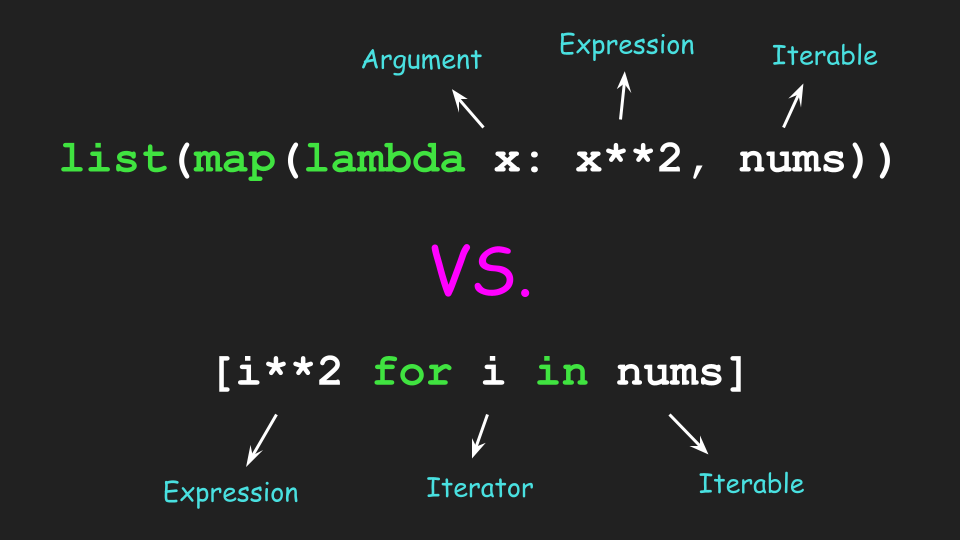
This preference isn't just a matter of style; it's a core part of the language's design philosophy.
2. Comprehensions and Generators: The Pythonic Default
List comprehensions (and their siblings, set and dict comprehensions) are the preferred tool for building a new collection from an existing one. They are often more readable and can be more performant than map() and filter().
For a direct contrast that should resonate with your Java experience, consider this image comparing Java's Stream API to a Python list comprehension.

The syntax [expression for member in iterable if condition] elegantly combines mapping (expression) and filtering (if condition) into a single, readable construct.
Memory Efficiency: Generator Expressions
A key feature of map() and filter() is that they are lazy: they produce items one by one and don't create the entire collection in memory. This is crucial for large datasets.
List comprehensions, by contrast, are eager: they build the entire list in memory. If you try to create a list with a billion items, you will run out of RAM.
Python's answer to this is the generator expression. It has almost the same syntax as a list comprehension, but uses parentheses instead of square brackets.
# List comprehension (EAGER - builds a huge list in memory)
large_list = [n**2 for n in range(1_000_000_000)] # DANGER: May crash!


# Generator expression (LAZY - produces values on demand)
large_generator = (n**2 for n in range(1_000_000_000)) # Safe: no memory issue


# You can iterate over it, and it calculates values as needed
total = sum(large_generator)
The article "When to Use a List Comprehension in Python" provides a great discussion on this exact topic.
When to Use a List Comprehension in Python
This article from Real Python clearly explains the trade-offs between list comprehensions and generators, especially concerning memory usage with large datasets.
Read the section titled "Choose Generators for Large Datasets". It perfectly illustrates why a list comprehension can be dangerous for huge ranges and how a generator expression solves the problem through lazy evaluation.
Rule of Thumb:
- If you're creating a list that will fit comfortably in memory, use a list comprehension.
- If you're working with a potentially huge dataset and will iterate over it just once (e.g., to sum it up or feed it into another function), use a generator expression.
3. When to Use map() and filter()
Given the power of comprehensions, why do map() and filter() still exist? They have their niche. Guido van Rossum, Python's creator, has stated that he prefers comprehensions, and map/filter were almost removed from Python 3.
Python - List comprehension vs map function TUTORIAL (speed, lambda, history, examples)
This video discusses the history of map and Guido's preference for comprehensions. It's a useful context for understanding why one is generally favored over the other.
Watch from 01:53 to 04:58. The key takeaway is that the language's designer considers map with a lambda a 'code smell' that should be replaced by a comprehension.
The most compelling reason to use map() is when you already have a pre-existing, named function you want to apply.
def process_log_entry(entry):


    # ... some complex logic ...
    return entry.upper()

log_entries = ["info: user login", "error: db connection failed", "info: user logout"]


# Using map can be clean and clear here
processed_logs = map(process_log_entry, log_entries)


# The comprehension version is also good, but some find `map` more direct
# when the function is complex and already defined elsewhere.
processed_logs_comp = (process_log_entry(entry) for entry in log_entries)
In this case, the choice is stylistic. However, combining map or filter with a lambda is almost always less readable than a comprehension.
# Un-Pythonic: map with lambda
names = ["alice", "bob", "charlie"]
upper_names = list(map(lambda name: name.upper(), names))


# Pythonic: list comprehension
upper_names_comp = [name.upper() for name in names]
4. The Trouble with map and filter
Forcing map and filter into situations with complex logic, side-effects, or error handling leads to unreadable and buggy code. A simple for loop is often the superior choice in these cases.
Stop Using map() and filter() Like This in Python
ArjanCodes provides an excellent breakdown of scenarios where map and filter make code worse, not better.
Watch from 04:40 to 13:59. Pay close attention to the four cases where a for loop is the clear winner: Complex Logic (04:40): map becomes a nested, unreadable mess. Exception Handling (07:48): try/except inside a lambda is an anti-pattern. Side Effects (10:35): Using map for I/O breaks its functional purpose. Early Exits (12:28): break and continue have no elegant equivalent in map.
The key insight is that functional purity is what makes map useful. When your logic is not pure (e.g., involves printing, writing to files, or complex error paths), a straightforward for loop is the most readable and maintainable solution.
5. Lambdas: Use Sparingly and for Trivial Tasks
A lambda expression is a syntactic shortcut for creating a small, anonymous function. Its use should be very limited.
Good uses:
- As the
keyfor sorting functions likesorted(),min(),max().
# Sort a list of tuples by the second element
data = [("a", 3), ("b", 1), ("c", 2)]
sorted_data = sorted(data, key=lambda item: item[1])


# sorted_data is [('b', 1), ('c', 2), ('a', 3)]
Bad uses:
- Assigning to a variable: If you're giving it a name, it's not anonymous anymore. Use
definstead.defgives you a proper name for tracebacks, the ability to add a docstring, and type hints. - Complex logic: If you can't read the lambda in a few seconds, it's too complex. Use
def.
The following article is perhaps the best guide on when and when not to use lambda.
Overusing lambda expressions in Python
Trey Hunner's article "Overusing lambda expressions in Python" provides a definitive guide on this topic. It argues for replacing lambdas with comprehensions, existing functions, or functions from the operator module.
Read the following sections: "Overuse: lambda with map and filter": This directly reinforces our main point about preferring comprehensions. "Overuse: using lambda for very simple operations": This introduces the operator module (itemgetter, attrgetter) as a cleaner alternative to simple lambdas. "Should you ever use lambda expressions?": This provides an excellent four-point checklist to decide if a lambda is appropriate.
Exercise: Refactor to Pythonic Style
You are given a list of dictionaries, each representing a product. Your task is to get the names of all products that are in stock and have a price greater than 20, formatted in uppercase.
products = [
    {"name": "Laptop", "price": 1200, "in_stock": True},
    {"name": "Mouse", "price": 15, "in_stock": True},
    {"name": "Keyboard", "price": 75, "in_stock": False},
    {"name": "Monitor", "price": 300, "in_stock": True},
    {"name": "Webcam", "price": 50, "in_stock": True},
]
Implement this logic in three different ways to compare the styles.
get_product_names_loop: Use a traditionalforloop withifstatements.get_product_names_map_filter: Use a chain offilterandmapcalls, likely withlambdafunctions.get_product_names_comprehension: Use a single list comprehension.
Solution
products = [
    {"name": "Laptop", "price": 1200, "in_stock": True},
    {"name": "Mouse", "price": 15, "in_stock": True},
    {"name": "Keyboard", "price": 75, "in_stock": False},
    {"name": "Monitor", "price": 300, "in_stock": True},
    {"name": "Webcam", "price": 50, "in_stock": True},
]


# 1. Using a for loop
def get_product_names_loop(data):
    result = []
    for product in data:
        if product["in_stock"] and product["price"] > 20:
            result.append(product["name"].upper())
    return result


# 2. Using map and filter
def get_product_names_map_filter(data):


    # First, filter for in_stock and price > 20
    filtered_products = filter(lambda p: p["in_stock"] and p["price"] > 20, data)


    # Then, map the names to uppercase
    mapped_names = map(lambda p: p["name"].upper(), filtered_products)
    return list(mapped_names)


# 3. Using a list comprehension
def get_product_names_comprehension(data):
    return [
        p["name"].upper()
        for p in data
        if p["in_stock"] and p["price"] > 20
    ]


# --- Verification ---
expected = ['LAPTOP', 'MONITOR', 'WEBCAM']
print(f"Loop version:          {get_product_names_loop(products)}")
print(f"Map/Filter version:    {get_product_names_map_filter(products)}")
print(f"Comprehension version: {get_product_names_comprehension(products)}")

assert get_product_names_loop(products) == expected
assert get_product_names_map_filter(products) == expected
assert get_product_names_comprehension(products) == expected
Notice how the list comprehension is the most concise and arguably the most readable version, as it keeps the transformation, iteration, and condition all in one place. The map/filter version is clunky due to the nested lambdas and multiple function calls.
Conclusion
You've just learned one of the most important distinctions in writing idiomatic Python. While map, filter, and lambda are part of the language, they are specialized tools, not everyday workhorses.
Key Takeaways:
- Prefer comprehensions and generator expressions for most mapping and filtering tasks. They are more readable, flexible, and deeply integrated into the language.
- Use
map()primarily when applying an existing, named function to an iterable. - Use
lambdasparingly, mostly for trivial key functions insorted()or similar functions. If it's not trivial,defis better. - For complex logic, error handling, or side effects, a simple
forloop is often the clearest and most robust solution.
This knowledge is a significant step away from thinking in Java streams and toward thinking in Python.
In our next lesson, we will synthesize these ideas by focusing on how to design small, testable, pure functions and structure your code to push side-effects to the edges of your application—a principle that makes all of these functional patterns more effective.