Introduction
Welcome to your first lesson on writing idiomatic Python! The goal of this course is to help you transition from thinking in Java to embracing the unique philosophy and power of Python. We'll start this journey not with syntax, but with a crucial mindset shift.
This lesson addresses the first learning outcome of our course: explaining the Pythonic philosophy. We'll define what "Pythonic" means, focusing on its core tenets: prioritizing readability over cleverness, using expressive high-level constructs, and avoiding the verbose "ceremony" that is common in languages like Java. Understanding this philosophy is the foundation upon which all the specific idioms and patterns in later lessons will be built.
What Does "Pythonic" Mean?
In many languages, if the code runs correctly, it's considered "good enough." Python has a different culture. There is a strong emphasis on a particular style of programming that is considered "Pythonic." This style isn't about arbitrary rules; it's about leveraging the language's design to write code that is not only correct but also clean, readable, and maintainable.
To understand this philosophy, let's start with a short video that introduces the concept.
Why Your Code Isn’t Pythonic (And How to Fix It)
Watch this introductory segment from ArjanCodes' video, 'Why Your Code Isn’t Pythonic'. He provides a great definition of 'Pythonic' code and introduces the 'Zen of Python' as its guiding principles.
Watch from the timestamp 00:15 to 02:00. Pay close attention to how he defines Pythonic code using the three pillars: readability, simplicity, and expressiveness.
As the video mentions, the closest we have to a formal definition of this philosophy is the Zen of Python, a collection of 19 guiding principles. You can access it directly from any Python interpreter by typing import this.
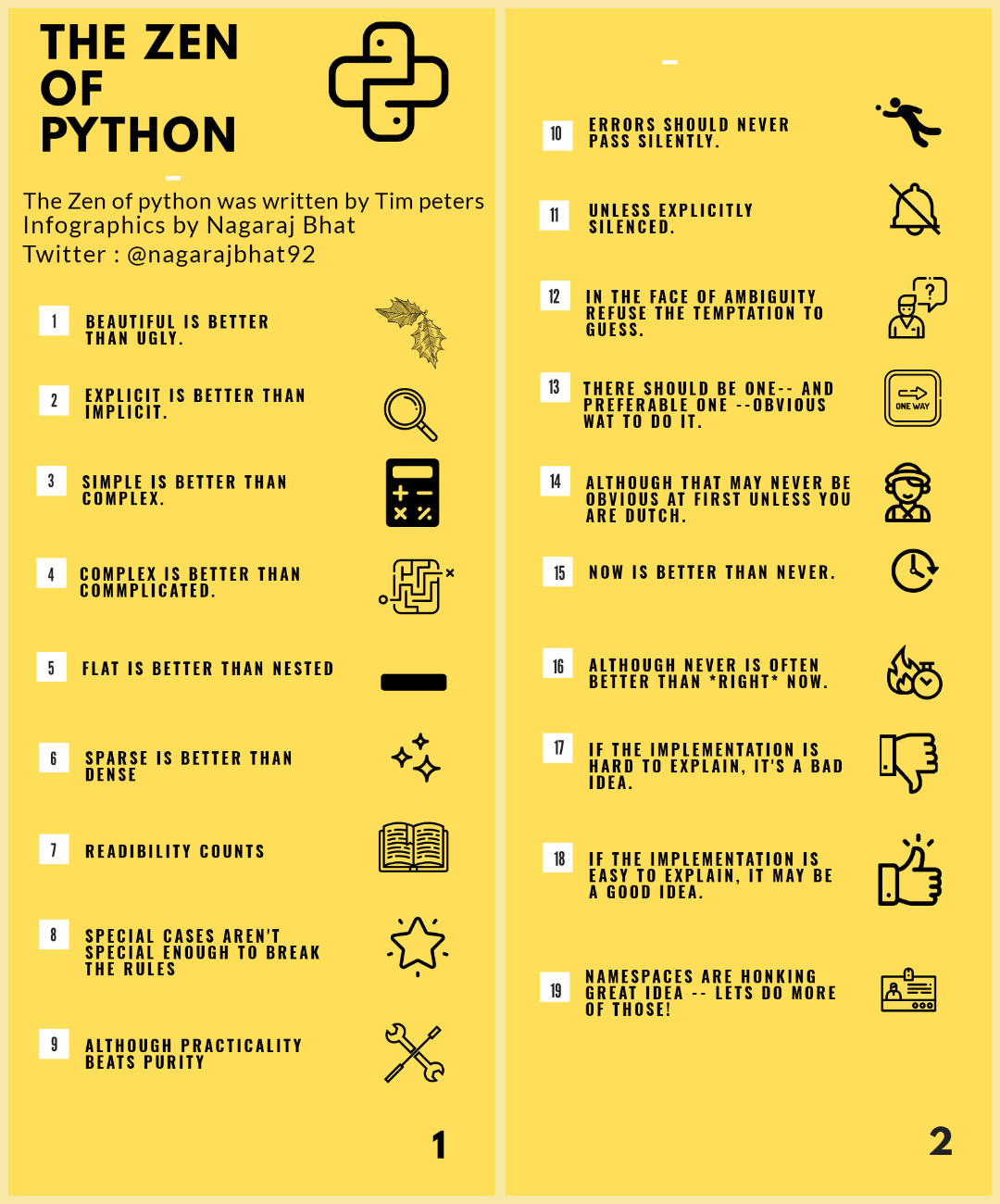
Let's break down three of the most important principles for our initial mindset shift.
1. Readability Counts
The Zen of Python states, "Readability counts." This is perhaps the most important principle. Python code is often read many more times than it is written. Therefore, the language is designed to be exceptionally clear and readable, sometimes even resembling pseudo-code.
This design choice creates a stark contrast with Java. Where Java uses curly braces {}, semicolons ;, and explicit type declarations for structure, Python uses whitespace (indentation) and simpler syntax. This reduces visual noise and enforces a consistent style across all Python code.
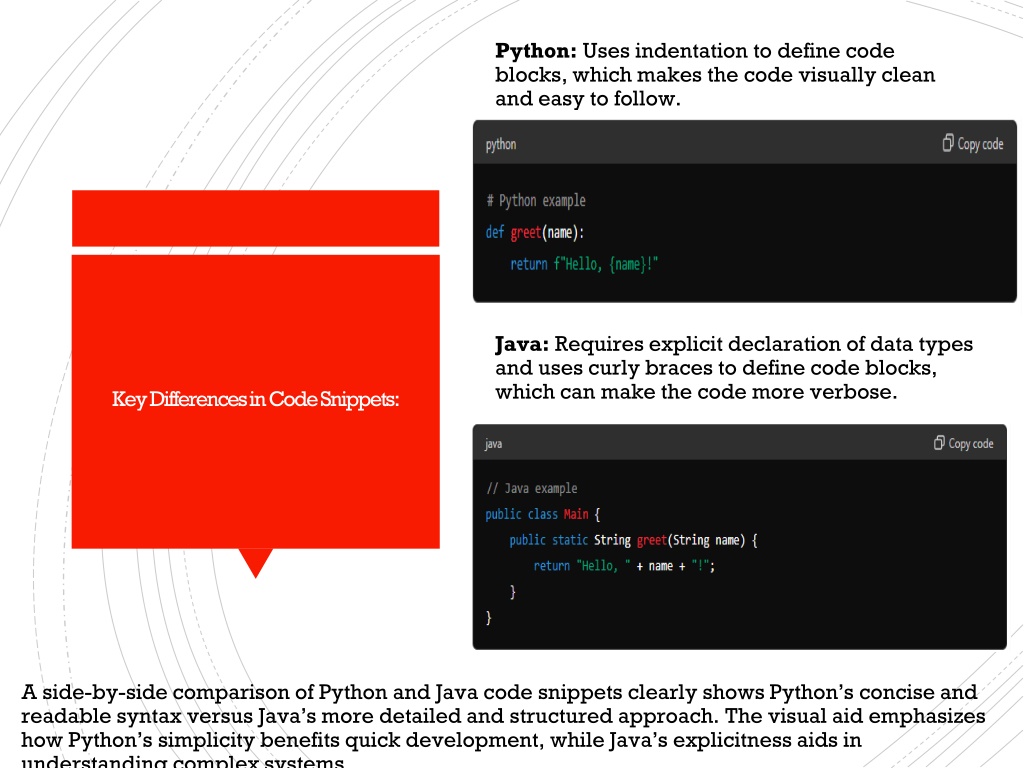
To get a deeper feel for this, please read the following section from an article written specifically for Java developers moving to Python.
Java vs Python: Basic Python for Java Developers
This section from the Real Python article 'Java vs Python' discusses Python's philosophy and how its syntax, particularly indentation, promotes readability.
Read the sections 'What Is the Philosophy of Python?', 'Python Code Is Readable', and 'Indentation for Code Block Grouping'. This will solidify your understanding of how Python's design choices directly impact code clarity.
A key part of readability is being explicit. A common "Java-ism" is to call functions with multiple positional arguments, forcing anyone reading the code to memorize the function signature. The Pythonic approach favors using keyword arguments to make the call self-documenting.
Watch this segment from a famous talk by Python core developer Raymond Hettinger. He makes a powerful case for prioritizing clarity, even if it has a minuscule performance cost.
Transforming Code into Beautiful, Idiomatic Python
In this clip from 'Transforming Code into Beautiful, Idiomatic Python', Raymond Hettinger explains why using keyword arguments is more Pythonic and readable than relying on positional arguments.
Watch from 00:30:48 to 00:32:09. Note the contrast he draws between code that is convenient for the computer and code that is clear for humans.
2. Expressive, High-Level Constructs
Another tenet is "Simple is better than complex." Python provides high-level constructs that allow you to express what you want to do, rather than getting bogged down in the low-level details of how to do it. Programmers coming from Java often write verbose, multi-line loops to accomplish tasks that Python can handle in a single, expressive line.
This tendency is so common it's been studied academically. Let's look at a paper that identifies these "Java-like verbosity anti-patterns."
[PDF] Java-Like Verbosity Anti-patterns in Python Codebases
This paper, 'Java-Like Verbosity Anti-patterns in Python Codebases', formalizes the exact anti-patterns you're trying to unlearn. We'll focus on the introduction and one key example.
Read '1 Introduction' to understand the problem, then examine '2.3 Anti-pattern #1: “Modifying a list with an unnecessary if statement”'. This provides a perfect 'bad vs. good' example of a verbose Java-style loop versus a concise Pythonic list comprehension.
The most classic example of this principle is how you iterate. A Java developer's instinct might be to use a C-style loop over indices. The Pythonic way is to iterate directly over the elements.
Let's see how Raymond Hettinger explains this fundamental difference.
Transforming Code into Beautiful, Idiomatic Python
Here, Hettinger explains the philosophical difference between a Python for loop and a C-style for loop, and why you should almost never use range(len(...)).
Watch the following three clips from his talk: 00:03:09 - 00:03:34: The fundamental nature of Python's for loop. 00:04:43 - 00:05:32: The anti-pattern of looping by index and the direct iteration alternative. 00:46:00 - 00:48:18: The idea of declarative code ('what you want') versus imperative code ('how to do it'), using comprehensions as an example.
These examples—direct iteration and list comprehensions—are perfect illustrations of using expressive, high-level constructs. They delegate the "boring" details of creating a list, managing indices, and appending items to the language itself, allowing you to focus on the logic.
3. Less Ceremony: The "Batteries Included" Philosophy
Finally, Pythonic code avoids unnecessary "ceremony"—the boilerplate code and rigid structures required by some other languages.
- In Java, everything must live inside a class. A simple script to print "Hello, world" requires a class definition and a
public static void mainmethod. In Python, you can simply writeprint("Hello, world")in a file and run it. - In Java, data is often encapsulated with private fields and public
getX()/setX()methods. Python takes a simpler approach: use public attributes and add logic later with@propertyonly if needed. We'll cover this in detail in Module 2.
This philosophy of "less is more" is complemented by the "batteries included" mentality. Python comes with a vast and powerful standard library. The Pythonic developer's first instinct is not to write a new function or class, but to ask: "Is this problem already solved in the standard library?"
Java vs Python: Basic Python for Java Developers
This article section explains the 'batteries included' philosophy, which is a key part of writing efficient and Pythonic code.
Read the section 'Python Comes With Batteries Included'. This reinforces the idea that you should look to the standard library before building your own solutions.
Modules like collections, itertools, pathlib, and functools provide robust, well-tested tools that eliminate the need to write verbose, error-prone code for common tasks. We will explore these modules throughout the course.
To see this principle in action, let's watch one more clip where an un-Pythonic script is refactored to remove unnecessary ceremony.
Why Your Code Isn’t Pythonic (And How to Fix It)
This clip from ArjanCodes shows the refactoring of a script that starts with an unnecessary class and manual file handling—both common Java-isms.
Watch from 00:02:00 to 00:06:42. Notice two key changes: The unnecessary FitnessTracker class is removed in favor of simple functions. Manual f.open() and f.close() calls are replaced with a with statement (a context manager), which is a more robust and less ceremonial way to handle resources.
Conclusion
In this lesson, we've taken the first step in your journey to writing Pythonic code by establishing a foundational mindset. We've moved from the abstract idea of "Pythonic" to concrete principles guided by the Zen of Python.
Key Takeaways:
- Pythonic philosophy is about writing code that is clear, readable, and leverages the language's strengths. It is guided by the principles in the Zen of Python.
- Readability Counts: Prefer clear, explicit code over clever but obscure one-liners. Use features like keyword arguments to make your code self-documenting.
- Use Expressive, High-Level Constructs: Let Python handle the low-level details. Favor direct iteration over index-based loops and use comprehensions to build collections declaratively.
- Avoid Unnecessary Ceremony: Start simple with functions and only use classes when you need to manage state. Trust Python's "batteries included" standard library to provide solutions for common problems.
This mindset is the lens through which you should view all future topics. In our next lesson, we will dive into a powerful and specific example of this philosophy in action: the EAFP (Easier to Ask for Forgiveness than Permission) coding style, and contrast it with the LBYL (Look Before You Leap) approach you may be more familiar with from Java.