Introduction
In our last few lessons, we've focused on optimizing single-threaded Python code. You've learned to speed up CPU-bound functions with memoization and to handle massive datasets with constant memory using generator-based streaming pipelines. These are powerful techniques for making a single stream of execution highly efficient.
However, modern processors don't have just one core; they have many. The logical next step in our performance journey is to figure out how to utilize all of them. This brings us face-to-face with one of the most discussed and often misunderstood concepts in Python: the Global Interpreter Lock (GIL).
This lesson is dedicated to demystifying the GIL. Our learning outcome is to explain the role of the Global Interpreter Lock (GIL) and its impact on Python concurrency. We will investigate what the GIL is, the engineering trade-offs that led to its creation, how it affects the performance of multi-threaded programs, and the standard ways to work with it. Understanding the GIL is not just an academic exercise; it's the prerequisite for choosing the correct concurrency model for any Python application.
1. What is the GIL and What is its Effect?
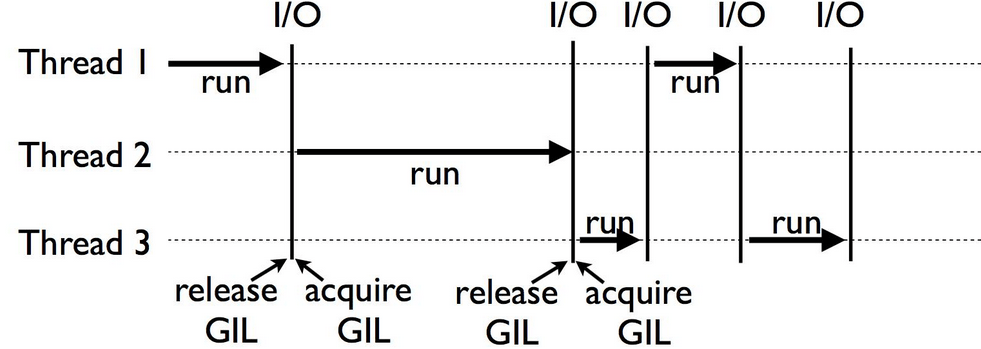
At its core, the Global Interpreter Lock is a mutex—a mutual exclusion lock—used by the standard CPython interpreter. Its rule is simple but has profound consequences: only one thread can execute Python bytecode at a time within a single process.
This means that even on a multi-core processor, a multi-threaded Python program that is purely CPU-bound will effectively run on a single core. To see this in action, let's watch a short demonstration.
Why Python Is Removing The GIL
The video 'Why Python Is Removing The GIL' from the Core Dumped channel starts with a perfect visual comparison. It pits a multi-threaded Python program against an equivalent C program to show the GIL's impact on CPU utilization.
Watch from the beginning to 02:10. Observe the resource monitor when the C program runs versus when the Python program runs. The video also introduces the critical distinction between concurrency (handling multiple tasks by switching between them) and parallelism (executing multiple tasks simultaneously).
As the video showed, the C program achieves true parallelism, utilizing all available CPU cores. The Python program, constrained by the GIL, only achieves concurrency, where threads take turns running on a single core, giving the illusion of simultaneous execution but providing no speed-up for CPU-bound work.
2. Why Does the GIL Exist? A Pragmatic Design Choice
Given this major limitation on parallelism, a natural question arises: why does the GIL exist? It wasn't an oversight but a pragmatic engineering decision made early in Python's history to solve a difficult problem: thread-safe memory management.
The Core Problem: Reference Counting
CPython manages memory using a technique called reference counting. Every object in Python has a counter that tracks how many variables or other objects refer to it. When this count drops to zero, Python knows the object is no longer needed and can deallocate its memory.
In a multi-threaded program, multiple threads could try to increase or decrease an object's reference count at the same time. This creates a race condition that can lead to two critical bugs:
- Memory Leaks: If decrements are missed, the count may never reach zero, and the memory is never freed.
- Crashes: If increments are missed, the count could prematurely hit zero, causing Python to deallocate memory that is still in use by another thread. Accessing this deallocated memory leads to crashes.
The "obvious" solution is to put a lock on every single object, but this would create a massive number of locks, introducing significant performance overhead and the risk of deadlocks. The GIL was a simpler, coarser solution: one giant lock on the entire interpreter.
This article from Real Python explains the problem and the GIL's role as a solution in detail.
What Is the Python Global Interpreter Lock (GIL)?
To solidify your understanding of the GIL's purpose, this article provides a clear explanation of reference counting and the race conditions the GIL was designed to prevent.
Read the sections 'What Problem Did the GIL Solve for Python?' and 'Why Was the GIL Chosen as the Solution?'. Focus on how reference counting works and why protecting it from concurrent modification is essential.
In addition to solving the memory management problem, the GIL had two other benefits that contributed to Python's early success:
- Increased single-threaded performance: No need to acquire/release multiple fine-grained locks.
- Easy C extension integration: Many C libraries were not thread-safe. The GIL made it trivial to write Python wrappers for them, as it guaranteed that only one thread would be executing in the C code at a time. This helped build Python's rich scientific computing ecosystem.
3. The Impact: CPU-Bound vs. I/O-Bound Workloads
The GIL's impact is not uniform across all types of programs. The critical distinction is whether your program is CPU-bound or I/O-bound.
-
CPU-Bound Programs: These are tasks limited by CPU speed, such as complex calculations, data compression, or image processing. For these tasks, the GIL is a significant bottleneck. Because only one thread can execute Python bytecode at a time, using multiple threads provides no speedup and can even be slightly slower due to the overhead of managing the threads and the lock.
-
I/O-Bound Programs: These tasks spend most of their time waiting for external operations to complete, like reading/writing files, making network requests, or querying a database. Python threads are highly effective for I/O-bound tasks because they release the GIL while waiting. This allows another thread to run, enabling the program to handle multiple I/O operations concurrently.
Let's examine a practical demonstration of this difference.
The Impact on Multi-Threaded Python Programs
The same Real Python article provides excellent code examples that benchmark the performance of single-threaded vs. multi-threaded code for both a CPU-bound task and (conceptually) an I/O-bound task.
Read the section 'The Impact on Multi-Threaded Python Programs'. Run the single_threaded.py and multi_threaded.py examples. You will observe that for the CPU-bound countdown, the multi-threaded version is not faster. Contrast this with the explanation of why I/O-bound programs benefit from threading.
4. Bypassing the GIL: The multiprocessing Module
So, if threading can't provide parallelism for CPU-bound tasks, what is the solution? The standard Python library provides the answer: the multiprocessing module.
Instead of creating threads, which share memory and are governed by a single GIL, multiprocessing creates separate processes. Each process gets its own Python interpreter, its own memory space, and, crucially, its own GIL. This allows your program to bypass the GIL and execute code in true parallel across multiple CPU cores.
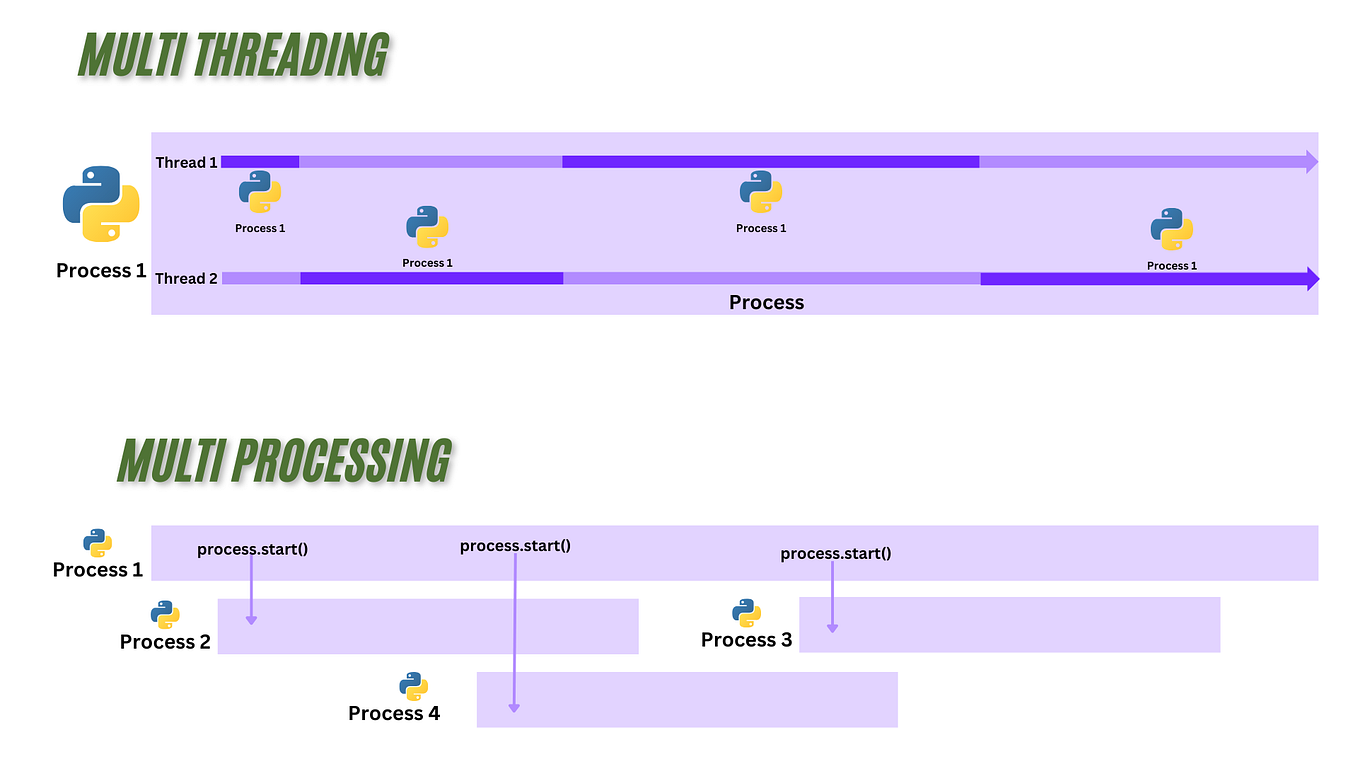
The trade-off is that processes have higher startup overhead and don't share memory by default, so communicating between them requires explicit mechanisms like queues or pipes (inter-process communication, or IPC).
The multiprocessing module provides an API that is deliberately similar to the threading module, making it relatively straightforward to switch between them.
Let's see how to use multiprocessing to achieve the parallelism that threading couldn't for our CPU-bound task.
Read the subsection 'Multi-processing vs multi-threading' within the 'How to Deal With Python’s GIL' section. Run the multiprocess.py example and compare its execution time to the threaded and single-threaded versions. You should see a significant performance increase.
This leads to a fundamental rule of thumb in Python concurrency:
- Use
threadingfor I/O-bound tasks. - Use
multiprocessingfor CPU-bound tasks.
5. Python vs. Java: A Familiar Comparison
Given your background in Java, it's useful to directly compare the two languages' approaches to threading. Java was designed from the ground up with true, pre-emptive multi-threading. It has no GIL.
| Feature | Python (CPython) | Java |
|---|---|---|
| Multi-threading Model | GIL-limited (one thread executes Python code) | True parallel threads |
| Thread Safety Burden | Lower for simple cases (GIL provides a baseline) | Higher (developer must use synchronized, locks, etc.) |
| Memory Management | Reference counting + cycle detector | Garbage collection (GC pauses) |
| CPU-Bound Parallelism | Achieved via multiprocessing (separate processes) |
Achieved via threading (shared memory) |
This comparison, drawn from the article "The Python GIL Controversy," highlights the different design philosophies. Python prioritized developer simplicity and easy C integration at the cost of threaded parallelism. Java prioritized true parallelism but placed a greater burden of managing thread safety on the developer.
6. The Future: An Optional GIL (PEP 703)
For decades, removing the GIL has been a holy grail in the Python community. Past attempts failed because they significantly slowed down single-threaded performance, a trade-off deemed unacceptable.
However, a recent proposal, PEP 703 — Making the Global Interpreter Lock Optional in CPython, has been accepted. Starting with Python 3.13, an experimental build of Python is available that can run without the GIL.
This is a monumental shift for the language, but it will be a long, careful transition.
How Much FASTER Is Python 3.13 Without the GIL?
The ArjanCodes video 'How Much FASTER Is Python 3.13 Without the GIL?' provides an excellent overview of the plan for the no-GIL future and the potential challenges.
Watch from 04:50 to 07:35. Pay attention to the three-stage roadmap (experimental, supported, default) and the 'dangers' discussed, particularly the impact on the vast ecosystem of C extensions that have long relied on the GIL for thread safety.
For now, multiprocessing remains the standard for CPU-bound parallelism. But it's important to know that the foundations are being laid for a future where Python threads can run in true parallel.
Conclusion
You now understand the what, why, and how of the Python Global Interpreter Lock. It is not merely a "flaw" but a long-standing design trade-off with a rich history and significant implications for concurrent programming.
Key Takeaways:
- The GIL is a mutex in CPython that ensures only one thread executes Python bytecode at a time.
- It exists primarily to simplify memory management (reference counting) and made it easy to integrate non-thread-safe C extensions.
- The GIL is a major bottleneck for CPU-bound multi-threaded code, preventing true parallelism.
- The GIL has little impact on I/O-bound code, as the lock is released during I/O waits, making
threadingan excellent choice for these tasks. - To achieve true parallelism for CPU-bound tasks, the standard Pythonic solution is to use the
multiprocessingmodule, which bypasses the GIL by using separate processes. - The future of Python includes an optional GIL (PEP 703), which is currently in an experimental phase.
What's Next?
We've established the fundamental rule: threading for I/O-bound work, multiprocessing for CPU-bound. In the next lesson, we will put this knowledge into practice. You will learn to choose the right concurrency model by analyzing different problems and implementing solutions using both threading and multiprocessing, solidifying your ability to write performant, concurrent Python applications.