Introduction
Welcome to the final lesson of our module on performance. In the last few lessons, we've built a powerful toolkit for how to make Python code faster. We've covered:
- Profiling to find bottlenecks with
cProfileandtimeit. - Improving algorithms and choosing correct data structures.
- Using
threadingandmultiprocessingfor concurrency. - Offloading heavy numeric work to NumPy, Numba, and Cython.
Today, we address the most important question of all: when should you optimize? The most common mistake developers make is premature optimization—making code faster before they even know if it's necessary, often at the cost of clarity and maintainability.
This lesson is about adopting the professional mindset for performance. You will learn to avoid the premature optimization trap by focusing on readable, correct code first, and only optimizing when you have measured a clear, impactful bottleneck. This principle is the capstone of writing effective, production-ready Python.
As the famous computer scientist Donald Knuth stated, "premature optimization is the root of all evil." Let's explore what that means in practice.
1. The Cost of Unnecessary Optimization
Optimization is not free. When you optimize code, you are often making it more complex, harder to read, and more difficult to maintain. This is a direct trade-off.
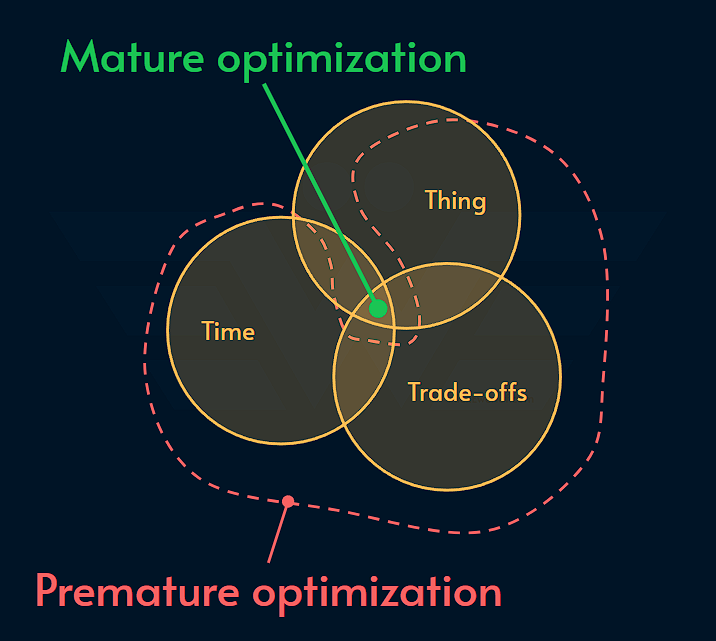
To understand this trade-off, it's helpful to think of a project as balancing three concerns: development velocity (how fast you can add features), code adaptability (how easy it is to change), and performance.
The video 'Premature Optimization' from CodeAesthetic provides an excellent mental model for these trade-offs.
Watch the first part of this video (00:00 - 03:38). Pay close attention to the 'trade-off triangle' and the Facebook/PHP example. It makes a compelling case that for many projects, especially early on, prioritizing velocity over raw performance is the correct strategic decision.
As the video argues, performance is a problem, but it's rarely the first problem. Focusing on it too early can waste development time and add complexity that hinders your ability to adapt to new requirements. The Pythonic philosophy values readability and simplicity, so any optimization that sacrifices these qualities must provide a substantial, measured benefit.
2. A Systematic Framework for Optimization
Your intuition about what makes code slow is often wrong. Modern hardware and compilers are incredibly complex. An operation that seems faster in theory might be slower in practice due to factors like CPU caching, memory access patterns, or interpreter overhead.
The only way to optimize effectively is to follow a systematic, data-driven process.
Step 0: Is Optimization Even Necessary?
Before you write a single line of benchmark code, ask yourself if the performance of a particular piece of code actually matters.
When (and When Not) to Optimize Data Pipelines
The article 'When (and When Not) to Optimize Data Pipelines' provides a superb, pragmatic framework for deciding whether to invest time in optimization.
Read the sections 'The Decision Tree: Should You Even Optimize?' and the 'Case Study 3: The Premature Multiprocessing'. These sections provide a checklist of questions to ask and a concrete example of wasted effort.
The key questions from the article are:
- Business Impact: Is this slowness causing a real problem (e.g., missing a Service-Level Agreement (SLA), blocking users)?
- Frequency: How often does this code run? Optimizing a script that runs once a month has a much lower return on investment than one that runs every five minutes.
- Actual Runtime: Is it truly slow in context? A job that takes 4 hours but runs overnight and finishes on time is not a problem. A 15-second process that a user is actively waiting for is a problem.
If you can't identify a clear, negative impact, your time is better spent elsewhere.
Step 1: Measure, Don't Guess
If you've determined that a performance problem exists, the next step is to measure. Do not start changing code based on a hunch.

The following video segment powerfully demonstrates why measurement is non-negotiable.
Let's return to the 'Premature Optimization' video to see concrete examples of how our intuition can lead us astray.
Watch the segment from 03:38 to 07:56. Note the C++ i++ vs. ++i example, where optimizations make them identical. Also, note the Python example where using a set (theoretically faster for lookups) is actually slower than a list for a small number of items. This reinforces the principle: always measure.
For a quick, high-level measurement, you can wrap sections of your code in a simple timing context manager, as suggested in the Dagster article (LINK). This can often reveal the major bottleneck without a full profiling session.
Step 2: Identify the Real Bottleneck
Your measurements will point you to the "hotspot"—the part of the code that consumes the most time. In real-world applications, especially those dealing with data, the bottleneck is often not where you think. The Dagster article (LINK) makes a crucial point: 80% of data pipeline performance problems are I/O, query, or architecture problems, not Python problems.
Your hierarchy for investigation should be:
- Algorithmic / Data Structure Choice: Are you using an algorithm where an exists? Are you repeatedly searching a list instead of using a set for lookups? (As we saw, this depends on
n!) These "80% moves" yield the biggest gains. - I/O Operations: Is your program waiting on the network, disk, or a database? In data-intensive applications, optimizing a database query or switching to batch I/O will almost always yield more benefit than micro-optimizing a Python loop.
- CPU-bound Python Code: Only after ruling out the above should you use
cProfileto dig into specific Python functions.
This final clip from 'Premature Optimization' summarizes the strategic approach to finding and fixing bottlenecks.
Watch from 09:30 to 12:07. This section outlines a professional workflow: identify a real problem, measure, make big '80% moves' with data structures or algorithms, and then use a profiler to find hotspots.
Step 3: Optimize the Bottleneck and Verify
Once you have identified the bottleneck, apply the appropriate technique from our previous lessons. After making a change, measure again to confirm that it had the desired effect and didn't introduce new problems.
It's also critical to ensure your optimization doesn't break the code's correctness.
L&L Ep.1: High Performance Python - Profiling to Find Bottlenecks
The 'High Performance Python' video highlights essential professional practices to maintain code quality during optimization.
Watch the segment from 21:50 to 24:47. The key takeaways are: always run your unit tests during optimization to prevent correctness regressions, and use version control (like Git) to create branches for your optimization experiments. This allows you to easily discard changes that don't work.
3. The "Do Not Optimize" Checklist
To make this practical, here is a checklist of things you should generally avoid optimizing, based on common anti-patterns.
When (and When Not) to Optimize Data Pipelines
The Dagster article provides a fantastic, actionable list of what to optimize and what to ignore. We'll use it as our guide.
Read the sections 'The Optimize/Don't Optimize Matrix', 'The Anti-Checklist: Signs You're Optimizing Wrong', and 'The Performance Mindset Shift'. This is the core of a pragmatic approach to performance.
Here is a summary of the key "don'ts":
Don't Bother Optimizing These:
- Code that runs infrequently or is not on a critical path.
- Micro-optimizations like
+vs."".join()for a small number of strings, orlistcomprehension vs.map(). The performance difference is negligible, so choose based on readability. - Function call overhead. In most Python applications, this is insignificant compared to the actual work done by the function.
- Code that is already "fast enough" and meets its requirements.
Stop Optimizing If You're:
- Optimizing before you have measured.
- Optimizing Python code when the profiler shows the bottleneck is a database or API call.
- Adding significant complexity (e.g.,
multiprocessing) for a minor percentage gain. - Making a change because it feels more "clever" or "elegant," not because it solves a measured problem.
Conclusion
This lesson concludes our exploration of Python performance. The ultimate mark of a senior developer is not just knowing how to make code fast, but knowing when and if it's worth the cost.
Key Takeaways:
- Readability First: Prioritize writing clear, simple, and correct code. Only sacrifice readability for a significant, measured, and necessary performance gain.
- Measure, Don't Guess: Never optimize based on intuition. Use
timeitand profilers likecProfileto identify real bottlenecks. - Follow a Framework:
- Determine if a performance problem truly exists and has a business impact.
- Measure to find the hotspot.
- Look for high-impact fixes first (algorithms, data structures, I/O).
- Apply targeted optimizations.
- Measure again to verify the improvement and run tests to ensure correctness.
- Pragmatism over Perfection: "Fast enough" is fast enough. The goal is to build reliable, maintainable systems that meet their requirements, not to write the fastest possible code at all costs.
What's Next?
You have now completed all the core instructional modules of this course! You've journeyed from unlearning Java-isms to mastering Python's idioms, data model, control flow, real-world I/O, and performance strategies.
The final part of this course will be the Appendix & Extras. It will provide you with consolidated resources to support your continued journey, including:
- A "Java-isms to Delete from Your Brain" cheat sheet.
- A list of common Pythonic one-liners and idioms.
- Complete solutions and
pytesttest cases for all exercises. - A curated list of further reading.
This will equip you to apply what you've learned and continue developing your Pythonic coding skills.