Hello! Welcome to your next lesson.
In our last few lessons, we've focused on generating 3D objects using an implicit representation—the Neural Radiance Field (NeRF)—guided by a 2D diffusion model via Score Distillation Sampling (SDS). You learned how to implement the core training loop and, crucially, how to debug common artifacts like the Janus problem.
While implicit methods are powerful for generating high-quality renderings from text, the resulting NeRFs can be cumbersome to use in standard 3D workflows like game engines or animation software. This lesson pivots to a different paradigm: applying diffusion models to generate explicit 3D representations like point clouds and voxels.
By the end of this lesson, you will understand how to train diffusion models directly on 3D data. This approach offers a different set of trade-offs, often resulting in much faster generation and producing assets that are immediately editable and usable in traditional 3D pipelines.
1. From Implicit to Explicit Generation
So far, our process has been:
Text Prompt → 2D Diffusion Model (Guidance) → NeRF (Implicit Rep)
This is an indirect method that cleverly repurposes 2D models. Today, we explore a more direct approach:
Text Prompt → 3D Diffusion Model → Point Cloud / Voxels (Explicit Rep)
The main advantage of explicit representations is that they define the geometry of a shape directly.
- Point Clouds: A set of vertices in 3D space, often with color attributes.
- Voxel Grids: A 3D grid where each cell (voxel) can be occupied or empty, similar to pixels in a 2D image.
These formats are standard in 3D scanning, robotics, and computer graphics, making them easier to edit, convert to meshes, and import into other applications.
2. Diffusion on Point Clouds
How can we apply a diffusion process to a point cloud? A point cloud is an unordered set of 3D coordinates. We can treat a cloud of points as a single tensor of shape and apply the diffusion process you're already familiar with.
The forward process involves gradually adding Gaussian noise to the coordinates of each point until the structured shape dissolves into a random cloud. The reverse process involves training a neural network to denoise this cloud, step-by-step, back into a coherent object.

The main architectural challenge is that the denoising network must be permutation-invariant. The order of points in the input tensor doesn't change the object they represent, so the network's output shouldn't change if the points are shuffled. This is a classic problem in 3D deep learning, and networks like PointNet or specialized convolutions are often used.
Point-Voxel Diffusion (PVD)
One of the key challenges is choosing a representation that is amenable to the diffusion process. Pure point clouds require permutation-invariant networks, while pure voxel grids can be sparse and memory-intensive. The "Point-Voxel Diffusion" (PVD) paper proposes a hybrid approach.
3D Shape Generation and Completion through Point-Voxel ...
To understand the theoretical foundation, let's examine the 'Point-Voxel Diffusion' paper. It clearly articulates the challenges and presents a robust formulation for applying diffusion to 3D shapes.
Please read the following sections of the PVD paper: Section 1 (Introduction): Focus on the discussion of why extending 2D diffusion models to 3D is non-trivial. The authors explain the problems with pure voxel (binary nature) and pure point cloud (permutation-invariance) representations. Section 3 (Point-Voxel Diffusion): Pay attention to the formulation in Section 3.1. Notice that the core equations (1, 2, 4, 6) are exactly the same as in the DDPMs you've studied for images. The innovation here is applying this process to a tensor of 3D point coordinates and using a suitable network (a point-voxel CNN) as the denoiser ϵ_θ.
As you read, you'll see that PVD models the problem as denoising a tensor of point coordinates . The loss function is the familiar L2 loss between the true and predicted noise:
The key difference from 2D diffusion is that is a noised point cloud and is a network designed for 3D data.
Latent Point Diffusion
Another powerful strategy, similar to latent diffusion for images, is to first encode the point cloud into a more compact latent space and then run the diffusion process there. This is the approach taken by models like LION.
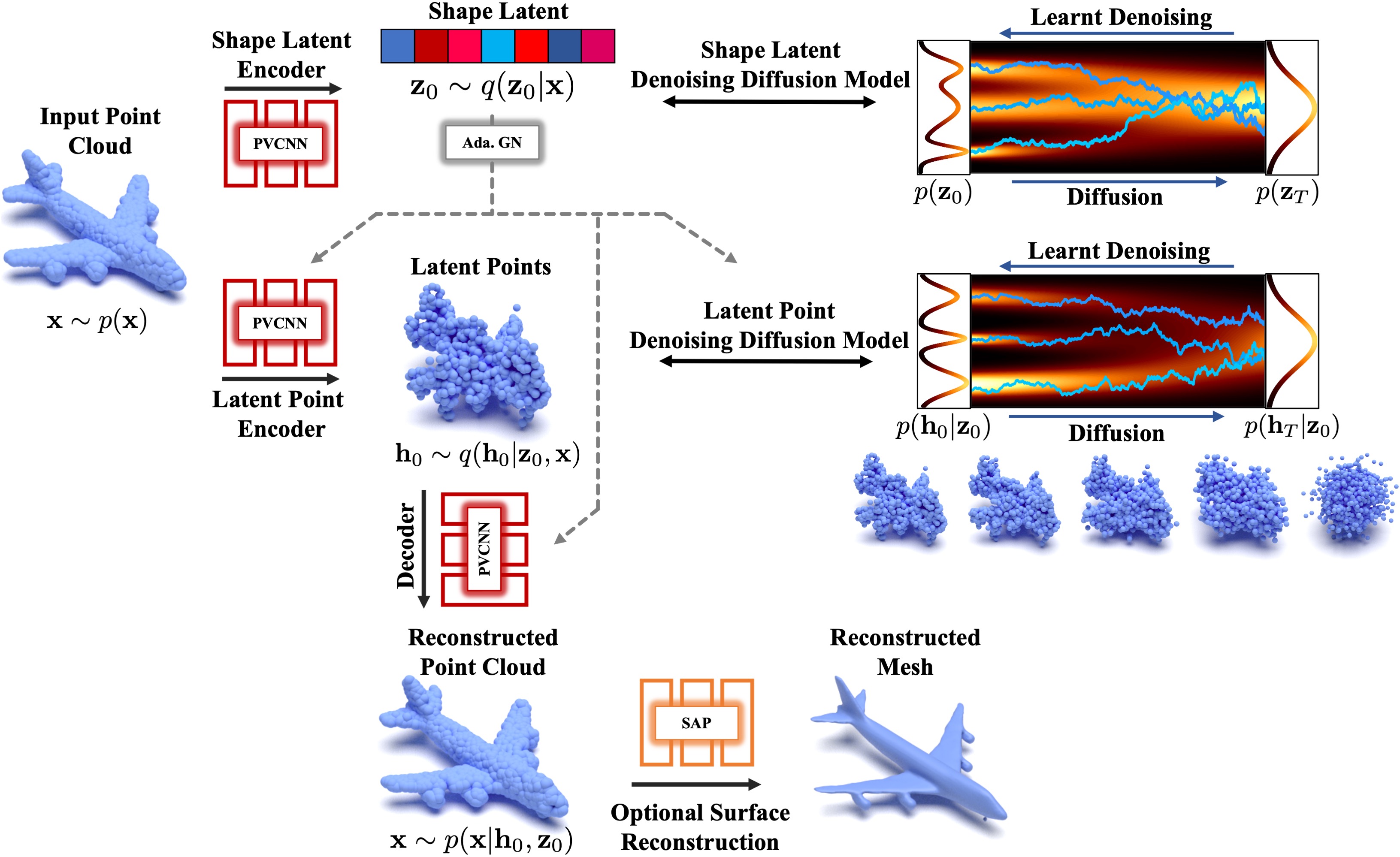
This latent-space approach is computationally efficient and allows the model to focus on the high-level structure of the object during the diffusion process.
Practical Example: OpenAI's Point-E
Point-E is a well-known model that generates point clouds from text prompts. It uses a two-stage diffusion process:
- A text-to-point-cloud model generates a low-resolution (1,024 points) point cloud.
- An upsampling diffusion model takes this low-resolution cloud and generates a high-resolution (4,096 points) version.
This cascaded approach allows for efficient generation of detailed shapes. The following video demonstrates how you can use Point-E.
How You can run Point-E and create any 3d object for free !?
Let's see how this works in practice. This video from Blender Smoothie 3d shows you how to generate 3D objects using Point-E through a simple web interface or a Colab notebook.
Watch the following segments to understand the practical workflow: Hugging Face Demo (00:43 - 01:03): See how a point cloud is generated from a simple text prompt. Google Colab Usage (01:03 - 02:33): This shows the standard workflow in a notebook: set a prompt, run the cells, and download the output. Point Cloud to Mesh (06:54 - 08:53): This part is crucial. It shows how the generated .npz point cloud file is converted into a .ply mesh file, making it usable in 3D software like Blender.
This practical workflow—generate points, then convert to mesh—is a common pattern for models that output explicit point cloud representations.
Test your understanding!
You are training a diffusion model directly on point clouds. You notice that your model's performance is poor, and after some debugging, you realize your denoising network is a standard 2D U-Net applied to an image-like representation of the points. Why is this a flawed approach, and what should you be using instead?
Show answer
A standard 2D U-Net expects a grid-like input where the spatial relationship between pixels is fixed. A point cloud is an unordered set of points. Representing it as an image would impose an arbitrary order, and the model would not be permutation-invariant. Shuffling the points would change the input "image" and thus the output, even though the 3D object is identical.
Instead, you should use a network architecture designed for point clouds, such as PointNet++, a Point-Voxel CNN (as in PVD), or a transformer-based model that can handle unordered sets. These architectures are designed to be permutation-invariant.
3. Diffusion on Voxel-Based Representations
Voxel grids are another popular explicit representation. However, a naive dense voxel grid suffers from the curse of dimensionality: a grid contains over 134 million voxels, making it computationally infeasible for diffusion models.
The solution is to use sparse and/or hierarchical representations that only store information where the geometry actually exists.
Hierarchical Latent Diffusion with XCube
XCube is a model that uses a sparse voxel hierarchy. It's a great example of a modern, efficient approach.
XCube: Large-Scale 3D Generative Modeling using Sparse Voxel Hierarchies
This short video from NVIDIA Developer introduces XCube and the concept of generating 3D objects using a hierarchical latent diffusion model over sparse voxels.
Watch the first two parts of this video: Introduction (00:00 - 00:49): Pay attention to the definition of a 'sparse voxel hierarchy'—a sequence of coarse-to-fine grids. Core Mechanism (00:49 - 01:45): Focus on how the model works. It's a hierarchical latent diffusion model. Notice the two key steps: (1) a VAE encodes the sparse grids into a latent space, and (2) diffusion models generate new shapes level-by-level in this latent space.
The core idea is to generate the shape coarse-to-fine. A diffusion model first generates a low-resolution base structure, and subsequent models add detail at higher resolutions, conditioned on the previous levels. This is much more efficient than trying to generate the entire high-resolution grid at once.
Octree-based Diffusion with OctFusion
Octrees are a classic data structure for efficiently representing sparse 3D data. They are trees where each node has up to eight children, corresponding to the eight octants of a 3D space. A region is recursively subdivided until a desired level of detail is reached or a voxel is empty.
Recent models like OctFusion have combined octrees with latent diffusion to achieve state-of-the-art results.
Octree-based Diffusion Models for 3D Shape Generation
The OctFusion paper presents a cutting-edge method for efficient 3D shape generation. We won't dive into the full implementation, but understanding its high-level architecture is very instructive.
Skim these sections to grasp the main ideas: Abstract: This gives a concise summary. Note the key components: 'octree-based latent representation' and a 'unified multi-scale U-Net'. Section 3, 'Method' (Overview paragraph only): This paragraph clearly lays out the two-stage pipeline: (1) Train a VAE to learn an 'octree-based latent representation'. (2) Train a diffusion model to generate this latent representation. Section 3.2, 'Octree-based Diffusion Model' (First two paragraphs): This explains what is being diffused. The model adds noise to both the octree structure (splitting signals) and the latent features stored at the nodes. The U-Net then learns to predict the clean signals.
The OctFusion architecture is a prime example of modern trends in generative 3D modeling:
- Find an efficient representation: Instead of dense grids, use a smart, sparse structure like an octree.
- Compress it: Use a VAE to map this structure into a compact latent space.
- Diffuse in latent space: Train a diffusion model to generate novel latents. This is much cheaper than diffusing in the raw data space.
- Decode the result: Use the VAE's decoder to turn the generated latent back into a high-resolution 3D shape.
4. Summary: Implicit vs. Explicit 3D Generation
Let's summarize the trade-offs between the SDS-based implicit methods and the direct diffusion-based explicit methods we've covered today.
| Feature | Implicit Generation (e.g., DreamFusion via SDS) | Explicit Generation (e.g., Point-E, OctFusion) |
|---|---|---|
| 3D Data Requirement | None. Relies on a pre-trained 2D model. | Requires a large-scale 3D dataset for training. |
| Generation Speed | Slow (minutes to hours per object). | Fast (seconds per object). |
| Core Mechanism | Per-shape optimization via score distillation. | Single-pass denoising of a random variable. |
| Output Representation | Implicit (e.g., NeRF). | Explicit (e.g., Point Cloud, Voxels, Mesh). |
| Editability | Low. Hard to edit a NeRF directly. | High. Point clouds and meshes are standard formats. |
| Common Failure Modes | View-consistency artifacts (Janus problem). | Limited by dataset quality and diversity. |
Conclusion
In this lesson, you've learned how diffusion models can be applied to generate explicit 3D representations. This is a powerful alternative to the SDS-based methods we studied previously.
Key Takeaways:
- Diffusion models can be trained directly on 3D data like point clouds and voxel grids.
- For point clouds, the denoising network must be permutation-invariant.
- For voxel grids, sparse and hierarchical representations (like octrees) are essential to overcome the curse of dimensionality.
- A common and effective architectural pattern is to use a VAE to learn a compact latent space for the 3D data, and then apply the diffusion process within that latent space.
- Explicit generation is typically much faster than implicit generation via SDS and produces editable assets, but it requires large 3D training datasets.
Next Lesson Preview:
We've now seen two distinct paradigms: text-to-3D using 2D priors (SDS) and direct generation from 3D datasets. The next module will explore techniques that bridge these worlds. In the next lesson, we will focus on setting up a framework for single-view 3D reconstruction, where the goal is to optimize a NeRF to represent an object shown in a single input image. This is a fundamental task that moves us closer to creating 3D content from specific visual inputs.