Hello! Welcome back to our journey into advanced 3D generation.
In our last lesson, we focused on generating consistent novel views of a single object by integrating camera conditioning into diffusion models. We explored how models like SV3D and SEVA use camera pose information to create a 3D-aware prior.
Today, we're taking the next logical step: moving from a single object to composing an entire scene. Our learning outcome is to apply diffusion models for object placement and spatial arrangement in 3D scenes. We'll investigate how these models can decide not just what an object looks like, but where it should go and how it should be oriented in a complex environment.
We will explore three distinct methods that achieve this:
- A practical, workflow-based approach where a diffusion model generates the environment, enabling a user to place objects effectively.
- A direct generation method (DiffuScene) where the model learns to diffuse and denoise the explicit attributes of a scene, including object locations, sizes, and rotations.
- A layout optimization method (Layout Learning) that uses a 2D diffusion prior to optimize the arrangement of multiple, distinct 3D objects represented as NeRFs.
1. A Practical Workflow for Scene Composition
Before diving into models that automate placement, let's look at a powerful human-in-the-loop workflow. Here, the diffusion model acts as an incredibly sophisticated texturing and lighting assistant, creating a plausible 3D environment into which a human artist or engineer can place objects. The AI doesn't decide the object's position, but it generates the context that makes the final composition believable.
This workflow typically involves:
- Creating simple, low-poly 3D geometry for the basic structure of the scene.
- Rendering control passes, like depth maps or line art, from a panoramic camera.
- Using a ControlNet-enabled diffusion model to generate a high-quality panoramic texture based on the control passes and a text prompt.
- Projecting this AI-generated texture back onto the 3D geometry.
- Placing new 3D assets (e.g., characters, furniture) into the scene.
- Adjusting lighting and shadows so the new assets integrate seamlessly with the AI-generated environment.
Generate ENTIRE 3D SETS For Your Projects FAST! [FREE Blender + SDXL/FLUX Workflow]
The following video from Mickmumpitz provides an excellent demonstration of this entire workflow. We will focus on the final steps, where a new 3D character is added to the AI-generated scene and integrated.
Please watch from 11:41 to 14:57. Pay close attention to how the newly added character is made to look like it belongs in the scene by having the environment cast light on it and by having the character cast shadows back onto the environment. This demonstrates a practical application of spatial arrangement, albeit a manual one.
This approach is highly effective for artistic control but relies on manual placement. Now, let's explore methods where the model itself learns to perform the arrangement.
2. Direct Generation of Scene Layouts with DiffuScene
The first fully generative approach we'll study is DiffuScene, which treats scene synthesis as a denoising diffusion process over a set of object attributes.
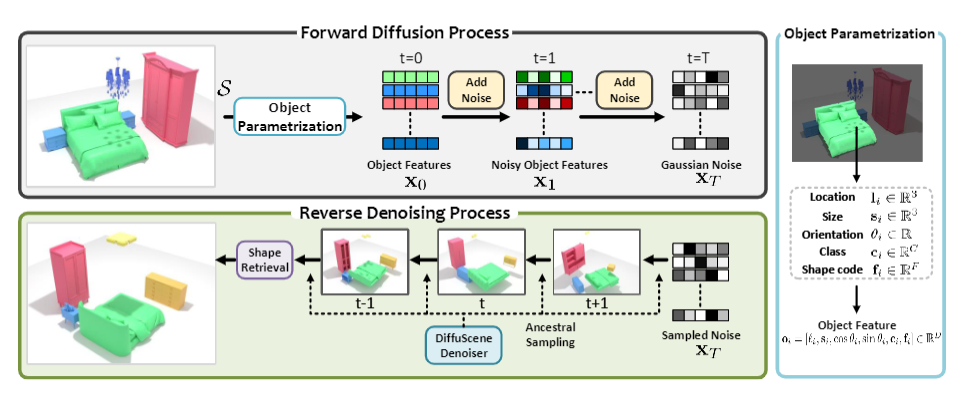
Instead of diffusing image pixels or latent vectors, DiffuScene operates on a structured representation of the scene. Each scene is defined as an unordered set of objects, where each object o_i is a vector containing its properties:
where:
- is the location (translation).
- is the size.
- is the rotation angle around the vertical axis (represented by its sine and cosine).
- is the one-hot encoded class category.
- is a shape code from a pre-trained autoencoder, representing the object's geometry.
The diffusion process then adds Gaussian noise to this collection of vectors, and the denoising network learns to predict the noise, thereby restoring the structured scene.
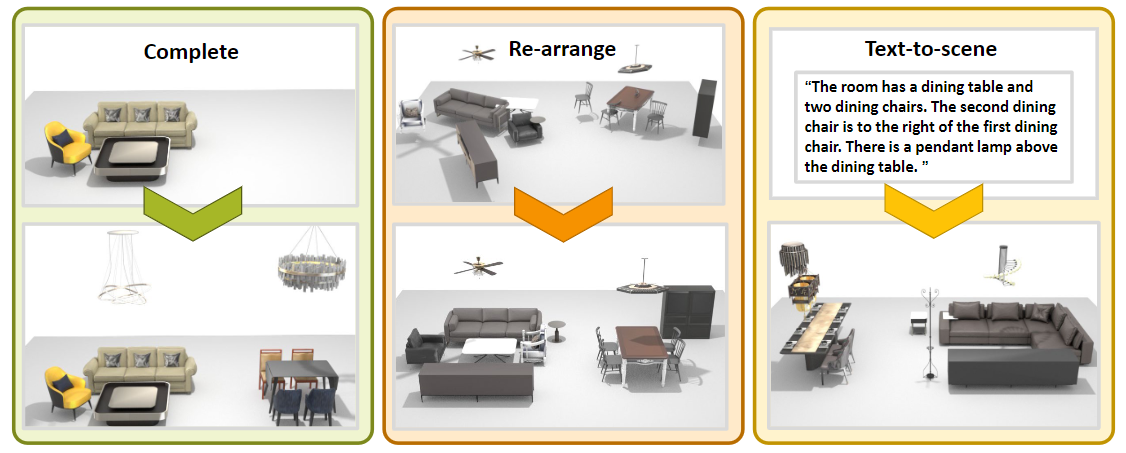
This model can be used for several tasks, including generating a scene from scratch, completing a partial scene, or, most relevant to us, rearranging a misplaced collection of objects into a plausible configuration.
DiffuScene: Denoising Diffusion Models for Generative Indoor Scene Synthesis
To understand this model in more detail, let's read key sections from the DiffuScene paper.
Please read the following sections: Section 1 (Introduction): Focus on how the paper frames the problem and introduces the idea of representing a scene as an unordered set of objects. Section 3 (DiffuScene): Read the first paragraph to understand the object attribute vector in detail. Section 3.2 (Applications): Read the paragraphs on 'Scene re-arrangement' and 'Text-conditioned scene synthesis'. These directly describe how the trained model is applied for object placement and arrangement.
As described in the paper, the "Scene re-arrangement" task is a powerful demonstration. The model takes a set of objects with defined shapes and sizes but random positions and orientations, and iteratively denoises their spatial attributes until they form a coherent arrangement.
3. Layout Optimization via Score Distillation
A second, fundamentally different approach is to use the knowledge embedded in a large 2D text-to-image model to guide the placement of 3D objects. This method, exemplified by the Layout Learning paper, doesn't diffuse the object coordinates directly. Instead, it optimizes them.
The core ideas are:
- Disentangled Representation: A 3D scene is represented by multiple, independent NeRFs—one for each object.
- Learnable Layouts: Each NeRF is associated with a learnable affine transformation . The set of all these transformations for a scene is called a "layout."
- Optimization with SDS: The NeRFs and their layouts are jointly optimized. The scene is rendered from a random camera angle, and the Score Distillation Sampling (SDS) loss is used to push the rendered image to be something the 2D diffusion model would expect, given a text prompt.
- The Key Insight: Instead of learning just one layout, the model learns a set of multiple valid layouts. By forcing the model to find different arrangements that are all plausible (e.g., a chair can be on the left or right of a table), it learns to treat the individual NeRFs as coherent, movable objects.
This approach effectively turns the 2D diffusion model into a "scene critic" that provides gradients to arrange the 3D objects.
Disentangled 3D Scene Generation with Layout Learning
The 'Layout Learning' paper details this elegant approach. We'll focus on the methodology and the pseudocode, which aligns well with your practical focus.
Please read the following sections: Section 3.2 (Layout learning): Focus on understanding how learnable affine transforms are introduced and the motivation for learning multiple layouts. Section 4.3 (Applications of layout learning): Read the paragraph and look at Figure 6, which describes using this method to arrange off-the-shelf 3D assets. This is a direct application of object placement. Appendix A.2 (Pseudo-code): Carefully review the pseudocode in Figure 9. It provides a concise implementation overview of the core logic: transforming rays for each object's NeRF, compositing them, and the main training loop.
The pseudocode in the appendix is particularly valuable. It shows how, in each training step, a random layout n is chosen, the camera rays are transformed for each NeRF k, the outputs are composited, and the final image is used to compute the SDS loss. The gradients from this loss flow back not only to the NeRFs' weights but also to the layout parameters (quaternions, translations, scales), thus optimizing the arrangement.
Test your understanding!
You are tasked with building a system to automatically arrange furniture in an empty virtual room. You are considering two primary strategies: one based on DiffuScene and one based on Layout Learning.
- What is the direct, final output you would expect from each model to describe the arrangement?
- What kind of ground-truth data is essential for training the core DiffuScene model?
- What critical pre-trained component does the Layout Learning approach rely on to function?
Show answer
-
Model Outputs:
- DiffuScene: The model would directly output a set of vectors. Each vector would contain the specific location (), orientation (), and size for each piece of furniture in the room.
- Layout Learning: The model would output a set of learnable affine transformations (rotation matrices, translation vectors, and scale factors), one for each piece of furniture (which are represented as NeRFs).
-
DiffuScene Training Data: To train DiffuScene, you would need a large dataset of existing 3D scenes (like 3D-FRONT) where each object is already labeled with its ground-truth attributes: location, orientation, size, and class. The model learns the statistical distribution of these attributes from this data.
-
Layout Learning Prerequisite: The Layout Learning approach fundamentally relies on a pre-trained 2D text-to-image diffusion model (like Stable Diffusion). This model provides the supervisory signal via the Score Distillation Sampling (SDS) loss, acting as a "critic" to judge whether a rendered 2D view of the 3D scene arrangement is plausible.
Conclusion
Today we explored how diffusion models can be masterfully applied to the complex task of object placement and spatial arrangement in 3D scenes. We've seen a spectrum of techniques, from practical human-in-the-loop workflows to fully autonomous generative models.
Key Takeaways:
- Scene Composition Spectrum: Object arrangement can be tackled manually with AI-assisted texturing, or automated through generative models.
- Direct Attribute Diffusion (DiffuScene): One powerful approach is to define a scene as a set of object attribute vectors (location, rotation, etc.) and use a diffusion model to directly generate these attributes. This requires a large dataset of structured 3D scenes for training.
- Layout Optimization with 2D Priors (Layout Learning): An alternative is to represent objects as individual NeRFs and use the knowledge from a 2D diffusion model (via SDS) to optimize their positions, rotations, and scales. Learning multiple valid layouts is key to ensuring object disentanglement.
- Engineering Choice: The best method depends on the task. DiffuScene excels when you have structured scene data and need direct generation of layouts. Layout Learning is powerful for text-prompted generation and arranging assets without needing a pre-existing dataset of complete scenes.
Next Lesson Preview:
We have now generated and placed complex 3D representations like NeRFs. However, for use in most standard 3D applications (like game engines or animation software), these volumetric representations need to be converted into a more traditional format. In our next lesson, we will tackle this final step and implement mesh extraction from a volumetric representation using the marching cubes algorithm.