Hello! Welcome to the fifth module of our course.
In the previous module, we focused on establishing a high-quality latent space by training and debugging a Variational Autoencoder (VAE). We learned that a good VAE is the foundation of a latent diffusion model, ensuring that the information the diffusion process works with is both compact and faithful to the original data.
Now, we pivot from unconditional generation to the exciting world of conditional generation. Specifically, we're starting our journey into text-to-image synthesis. The learning outcome for this lesson is to analyze the impact of different text encoders (e.g., CLIP, T5) on generation quality and prompt following.
This lesson will explore the "translator" that sits between your text prompt and the diffusion model: the text encoder. We'll dissect how the choice of encoder architecture is a critical design decision that profoundly influences how the model interprets language, handles complexity, and ultimately renders an image. For an ML engineer like yourself, understanding this component is key to debugging prompt alignment issues and making informed architectural choices when building or fine-tuning models.
The Text Encoder's Role in the Pipeline
At its core, a text-to-image model needs a way to convert a sequence of words into a numerical representation that can guide the diffusion model's denoising process. This is the job of the text encoder.
The general flow is:
- Prompt: "A photorealistic portrait of an astronaut riding a horse."
- Tokenizer: The prompt is converted into a sequence of numerical tokens.
- Text Encoder: A large, pre-trained transformer model processes these tokens and outputs a sequence of embedding vectors.
- Diffusion Model (U-Net/Transformer): These embeddings are injected into the diffusion model, typically via cross-attention layers, to condition the denoising at each step.
To get a high-level overview of how these components fit together, let's watch a brief segment from a Stanford lecture.
Stanford CS25: V5 I Transformers in Diffusion Models for Image Generation and Beyond
This video, 'Transformers in Diffusion Models for Image Generation and Beyond' from Stanford Online, provides an excellent infographic of a modern text-to-image pipeline. It will help us build a clear mental model.
Please watch from 02:39 to 07:33. Focus on the diagram presented around the 04:35 mark. Note the distinct roles of the text encoders, the noisy latents, and the core diffusion network.
As the video highlights, the diffusion model is only as good as the instructions it receives. The quality and nature of the text embeddings are paramount. Let's dig into the two most influential families of text encoders used today: CLIP and T5.
A Tale of Two Encoders: CLIP vs. T5
The choice of text encoder isn't arbitrary. Different encoders are pre-trained on different data with different objectives, giving them unique strengths and weaknesses for the task of guiding image generation.
CLIP: The Visual-Semantic Specialist
- What it is: CLIP (Contrastive Language-Image Pre-training) is a model trained on hundreds of millions of (image, text caption) pairs from the internet.
- Training Objective: Its goal is to learn a shared embedding space where the vector for an image is close to the vector for its corresponding text description, and far from others. It's trained to "match" images and text.
- Strengths for Diffusion:
- Strong Visual Grounding: By its very nature, CLIP learns rich associations between words and visual concepts. It excels at capturing the style, mood, and objects in a prompt.
- Zero-Shot Capability: Its robust visual-semantic alignment makes it powerful for generalization.
- Weaknesses:
- Linguistic Simplicity: CLIP's training objective doesn't require a deep understanding of grammar or syntax. It often treats prompts like a "bag of words," understanding the concepts but not always their relationships.
- Limited Context: Standard CLIP models have a relatively short context length (e.g., 77 tokens), which can be a bottleneck for long, descriptive prompts.
T5: The Language Scholar
- What it is: T5 (Text-to-Text Transfer Transformer) is a large language model trained on a massive text-only corpus (like C4, the "Colossal Clean Crawled Corpus").
- Training Objective: It's trained on a versatile text-to-text framework, learning tasks like translation, summarization, and question answering. For diffusion, we typically use its powerful encoder component.
- Strengths for Diffusion:
- Deep Linguistic Understanding: T5 has a sophisticated grasp of grammar, syntax, and complex sentence structures. This allows it to follow intricate prompts with multiple clauses and relationships.
- Longer Context & Text Rendering: T5 encoders (like T5-XXL) can handle much longer prompts and are significantly better at accurately rendering text within an image, as this requires a precise understanding of character sequences.
- Weaknesses:
- No Inherent Visual Knowledge: T5 is trained only on text. It knows the meaning of "red" and "cube" in a linguistic sense, but has no innate knowledge of what they look like. This visual grounding must be learned from scratch during the diffusion model's training.
Probing the Encoder's Mind with Diffusion Lens
These differences aren't just theoretical. A fascinating research paper introduces a method called DIFFUSION LENS to visualize how a text encoder builds its representation layer by layer.
The method involves taking the intermediate hidden states from each layer of the text encoder, feeding them to the diffusion model, and generating an image. This lets us "see" what the encoder is thinking as it processes the prompt.
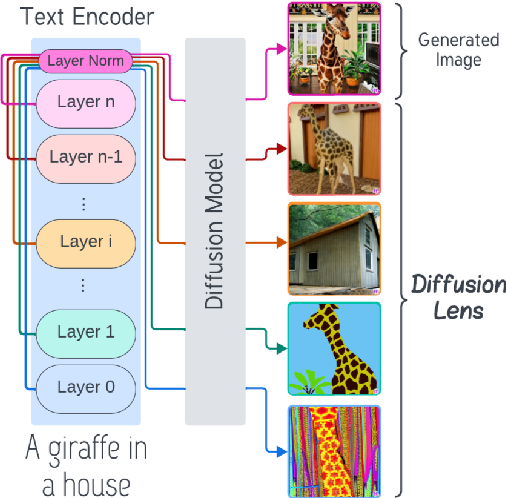
Let's dive into this paper to see the concrete differences it reveals between CLIP and T5.
Diffusion Lens: Interpreting Text Encoders in Text-to-Image ...
The paper 'Diffusion Lens: Interpreting Text Encoders in Text-to-Image Pipelines' provides a rigorous analysis comparing the internal workings of CLIP (used in Stable Diffusion) and T5 (used in Deep Floyd).
Please read the following parts: The Introduction (Section 1) to understand the motivation and main findings. Section 4.2 'Syntactic dependencies': Focus on the findings summarized in Table 1 and Figure 7. This directly compares how CLIP and T5 handle sentence structure. Section 5 'Memory Retrieval': Pay attention to the comparison between T5's gradual retrieval and CLIP's refinement process described in Section 5.2 and shown in Figure 10. Concentrate on the conclusions drawn about the differences in behavior between the two models.
The key takeaways from the paper confirm our analysis:
- Syntax vs. Linear Order: T5 (in Deep Floyd) shows greater sensitivity to the syntactic structure of a prompt, correctly prioritizing antecedent nouns. CLIP (in Stable Diffusion) tends to follow the linear order of words, reflecting a more "bag-of-words" approach.
- Gradual vs. Refined Retrieval: T5 builds its understanding of concepts gradually across its layers, starting general and getting specific. CLIP tends to form a representation of the concept early on and then spends its layers refining the details.
This difference in processing directly impacts prompt following. For a prompt like "a red cube on a blue sphere," a T5-based model is more likely to correctly assign the colors and spatial relationship, while a CLIP-based model might initially struggle.
Test your understanding!
You are tasked with generating an image for the highly complex prompt: "A photorealistic wide-angle shot of a chrome robot meticulously painting a detailed mural of a galaxy on a brick wall, while a small calico cat watches from a nearby wooden crate."
You have two diffusion models available: one uses a single CLIP encoder, and the other uses a single, large T5 encoder. Which model would you expect to perform better at capturing all the specified relationships and details, and why?
Show answer
You would expect the T5-based model to perform better.
Reasoning: This prompt contains numerous specific objects (robot, mural, wall, cat, crate), materials (chrome, brick, wood), and a complex action with a subject-object relationship (robot painting mural).
- The T5 encoder, with its superior understanding of syntax and linguistic structure, is better equipped to parse these complex relationships correctly. It can distinguish that the robot is doing the painting, the mural is the object being painted, and the cat is merely an observer.
- The CLIP encoder, while excellent at capturing the 'vibe' of "robot," "galaxy," and "cat," would be more likely to struggle with the precise composition. It might, for example, produce an image of a robot and a galaxy mural as separate concepts, or misinterpret the action, due to its tendency to treat prompts more like a "bag of concepts."
The Best of Both Worlds: Combining Encoders
Given that CLIP and T5 have complementary strengths, a natural evolution was to use them together. Modern, state-of-the-art text-to-image models often use multiple text encoders to provide the diffusion model with a richer, more diverse conditioning signal.
Models like Stable Diffusion 3 and FLUX are prime examples of this philosophy.
Diffusers welcomes Stable Diffusion 3
This Hugging Face blog post, 'Diffusers welcomes Stable Diffusion 3', provides a concise architectural overview of this powerful model.
Please read the first section, 'What’s New With SD3?'. Note the specific text encoders it employs.
As the post confirms, SD3 uses three different text encoders: two different CLIP models (L/14 and bigG/14) and a large T5 model (T5-XXL). This allows it to leverage the strong visual semantics of CLIP and the deep linguistic power of T5 simultaneously.
Why is this combination so effective? The following video segment provides a clear, intuitive explanation.
Stanford CS25: V5 I Transformers in Diffusion Models for Image Generation and Beyond
Let's return to the Stanford lecture. In this Q&A segment, the speaker directly addresses why using multiple text encoders is beneficial.
Watch the discussion from 36:55 to 38:22. The key insight is in the answer to the question about why multiple encoders are used.
The speaker's conclusion is key: "the richer the representations are, the diverse the representations are, the better it is for the generation backbone." By feeding the diffusion model embeddings from both CLIP (with its contrastive nature) and T5 (with its linguistic nature), you provide a more robust and multifaceted guide for the denoising process.
Practical Impact and Engineering Trade-offs
The impact of using a powerful encoder like T5 is not just theoretical; it's visually striking. Let's see a practical comparison.
How to Prompt FLUX. The BEST ways for prompting FLUX.1 SCHNELL and DEV including T5 and CLIP.
The YouTube channel Next Tech and AI provides a great hands-on comparison in the video 'How to Prompt FLUX.' It contrasts generations from FLUX (which uses T5) with an older Stable Diffusion 1.5 model (which uses only CLIP).
Watch from 02:44 to 05:51. Observe the qualitative difference in how the two models handle a prompt with specific positional instructions ('a red dragon on the left and a green dragon on the right').
This demonstration makes the difference tangible. The CLIP-based model fails to follow the spatial and attribute instructions, while the T5-powered FLUX model executes them correctly.
However, this power comes at a cost. Large language models like T5-XXL are computationally expensive and memory-intensive. This introduces a classic engineering trade-off between performance and resource consumption.
Diffusers welcomes Stable Diffusion 3
Let's revisit the Hugging Face blog post on SD3 to see the practical engineering implications.
Read the sections 'Dropping the T5 Text Encoder during Inference' and the table under 'Summary of Memory Optimizations'. This highlights the very real trade-offs involved.
The table in the blog post is particularly illuminating for an engineer. Dropping the T5 encoder reduces VRAM usage from ~18.8 GB to just ~4.3 GB (with offloading), a massive saving, but it comes at the cost of performance and prompt-following ability. This is a critical decision point when deploying a model in a production environment with resource constraints.
Conclusion
In this lesson, we've analyzed the pivotal role of the text encoder in text-to-image diffusion models. You now understand how the architectural choice and pre-training objective of an encoder dictate its ability to interpret prompts and guide generation.
Key Takeaways:
- Encoder Choice is an Architectural Pillar: The text encoder isn't just a minor component; its characteristics (CLIP vs. T5, etc.) fundamentally shape how a diffusion model understands and executes a prompt.
- CLIP Excels at Visual-Semantic "Vibes": Trained on image-text pairs, it's a specialist in associating words with visual styles and objects.
- T5 Excels at Linguistic "Instructions": Trained on text, it has a deep grasp of syntax and structure, enabling it to follow complex, compositional prompts.
- Synergy is State-of-the-Art: Modern models like SD3 combine multiple encoders (e.g., two CLIPs and a T5) to leverage their complementary strengths, achieving superior prompt adherence and quality.
- Performance vs. Cost: Using powerful encoders like T5-XXL significantly improves results but introduces substantial memory and computational overhead, a key trade-off for practical deployment.
Next Lesson Preview:
We now understand what text embeddings are and why they differ. The next logical question is how are these embeddings actually used by the diffusion model? In the next lesson, we will implement text conditioning using cross-attention mechanisms. This will connect the output of the text encoder directly to the U-Net's denoising process, completing the bridge from language to image.