Hello! Welcome to the sixth lesson in our module on the Hypothalamic-Pituitary-Ovarian (HPO) axis.
Introduction
In our last lesson, we explored the powerful positive and negative feedback loops controlled by estrogen and progesterone. We saw how these steroid hormones act as the primary drivers of the menstrual cycle, causing both the stability of the luteal phase (negative feedback) and the dramatic LH surge that triggers ovulation (positive feedback).
However, the HPO axis has an additional layer of fine-tuning, especially when it comes to regulating Follicle-Stimulating Hormone (FSH). Today, we will focus on two other crucial ovarian hormones. Our learning outcome is to describe the role of inhibin and activin in regulating FSH secretion. These hormones provide a more targeted control mechanism, working alongside estrogen and progesterone to precisely sculpt the hormonal environment required for a healthy cycle.
Let's begin by meeting these two hormones.
1. Introducing Activin and Inhibin: The Opposing Pair
Activin and inhibin are peptide hormones produced primarily by the granulosa cells of the ovarian follicles. They belong to a large family of signaling proteins called the transforming growth-factor beta (TGF-β) superfamily. As their names suggest, they have opposing effects on the pituitary gland:
- Activin activates or stimulates the synthesis and secretion of FSH.
- Inhibin inhibits the synthesis and secretion of FSH.
This simple opposition is the key to their function. To understand them fully, let's look at their structure and discovery.
Activins and Inhibins: Roles in Development, Physiology, and Disease
This research article, 'Activins and Inhibins: Roles in Development, Physiology, and Disease,' provides an excellent introduction. We will start by understanding their structure and how they were first identified.
Please read the 'INTRODUCTION, HISTORY AND NOMENCLATURE' section. Focus on how these hormones were discovered as regulators of FSH, and pay close attention to the description of their subunit structure. Note how they are both formed from a common pool of subunits.
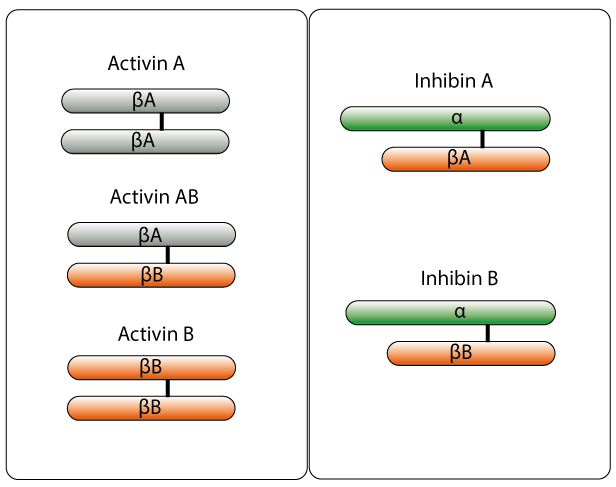
As you've just read, the structural relationship between activin and inhibin is fascinating. They are all dimers, built from three types of subunits: one alpha (α) and two beta (βA and βB).
- Inhibins are heterodimers, always containing one α subunit and one β subunit.
- Inhibin A = α + βA
- Inhibin B = α + βB
- Activins are dimers of β subunits.
- Activin A = βA + βA
- Activin B = βB + βB
- Activin AB = βA + βB
This structural relationship is key to their function, as they compete for the same receptors at the pituitary.
2. Inhibin: The Selective FSH Brake
The primary role of inhibin is to act as a negative feedback signal to the pituitary, specifically targeting FSH secretion. This makes it different from estrogen and progesterone, which affect both LH and FSH. This selective action is crucial for controlling follicular development.
The two forms of inhibin, A and B, are produced at different times in the menstrual cycle, giving them distinct roles.
The Hypothalamic-Pituitary-Ovarian Axis and Control of ...
Let's read a section from the clinical textbook resource, 'The Hypothalamic-Pituitary-Ovarian Axis and Control of the Menstrual Cycle', to understand the specific roles of Inhibin A and Inhibin B.
First, read the subsection 'Inhibin and Activin' for an overview. Then, read the paragraph that starts 'Inhibin B levels begin to rise almost immediately...'. Finally, read the paragraph that starts 'In granulosa-lutein cells inhibin production switches...'. These sections detail the timing and function of Inhibin B in the follicular phase and Inhibin A in the luteal phase.
Let's summarize the key points from your reading:
Inhibin B and the Follicular Phase
- Source: Small, growing (antral) follicles.
- Stimulus: Its production is directly stimulated by FSH.
- Action: Inhibin B levels rise in the early-to-mid follicular phase. This creates a classic negative feedback loop: FSH stimulates inhibin B, which in turn travels to the pituitary and suppresses further FSH release.
- Purpose: This drop in FSH, along with the negative feedback from rising estrogen, is critical for the selection of a single dominant follicle. As FSH levels fall, only the largest follicle with the most FSH receptors can continue to grow, while the smaller ones undergo atresia (degeneration).
You can see this process animated in the following clip.
Pharmacology – MENSTRUAL CYCLE AND HORMONAL CONTRACEPTIVES (MADE EASY)
Let's watch a brief segment from the 'Pharmacology – MENSTRUAL CYCLE' video by Speed Pharmacology. It visualizes the role of inhibin during the follicular phase.
Watch from 01:19 to 02:20. Pay attention to how the granulosa cells of the growing follicle are shown to produce inhibin, which then acts on the pituitary to suppress FSH.
Inhibin A and the Luteal Phase
- Source: The corpus luteum.
- Stimulus: Its production is stimulated by LH.
- Action: Inhibin A levels rise after ovulation and peak in the mid-luteal phase, mirroring the progesterone curve.
- Purpose: Along with high levels of progesterone and estrogen, inhibin A provides a powerful suppressive signal to the pituitary. This strong, multi-hormonal inhibition of FSH is essential to prevent any new follicles from starting to develop while the body is preparing for a potential pregnancy.
This clip reinforces the role of inhibin in the second half of the cycle.
Female Reproductive System - Menstrual Cycle, Hormones and Regulation
Let's watch a clip from 'Female Reproductive System' by Armando Hasudungan, which we've used before. This time, focus on the corpus luteum's secretions.
Watch from 10:26 to 11:15. The video clearly states that the corpus luteum secretes inhibin, and explains its negative feedback role in preventing further follicle maturation during the luteal phase.
3. Activin: The FSH Accelerator
While inhibin puts the brakes on FSH, activin does the opposite.
- Source: Also produced by granulosa cells in the ovary and gonadotroph cells in the pituitary itself.
- Action: Activin stimulates the synthesis and release of FSH from the pituitary. It also has local (paracrine) effects within the ovary, enhancing the actions of FSH on follicular development.
- Purpose: Activin's role is most apparent during the luteal-follicular transition—the period at the very end of the cycle.
Let's see what our textbook resource says about this critical transition.
The Hypothalamic-Pituitary-Ovarian Axis and Control of ...
Returning to 'The Hypothalamic-Pituitary-Ovarian Axis' resource, let's examine the events that kick off a new cycle.
Please read the section titled 'Luteal–Follicular Transition', specifically the subsection 'Gonadotropins'. Note the descriptions of what happens to inhibin and activin levels as the corpus luteum fails.
As the corpus luteum degenerates, levels of progesterone, estrogen, and inhibin A all plummet. This removes the powerful negative feedback. At the same time, activin levels begin to rise. This combination—the removal of the "brake" (inhibin) and the pressing of the "accelerator" (activin)—is what allows FSH levels to rise and initiate the recruitment of a new cohort of follicles for the next cycle.
4. The Modulator: Follistatin
To complete the picture, we must introduce one more player: follistatin. It is not a hormone in the traditional sense but rather a binding protein.
The Hypothalamic-Pituitary-Ovarian Axis and Control of ...
Our textbook resource has a concise explanation of this molecule.
Read the short subsection titled 'Follistatin'. Focus on its specific function: what it binds to and what it doesn't.
As you read, follistatin's job is to bind to activin and neutralize it. By sequestering activin, it prevents it from stimulating FSH. Therefore, follistatin acts as an indirect inhibitor of FSH. Importantly, it does not bind to inhibin, leaving inhibin free to act directly on the pituitary.
So, the net stimulus for FSH secretion at the pituitary depends on the balance between:
- Stimulatory signals: Activin
- Inhibitory signals: Inhibin and Follistatin
Test your understanding!
A 30-year-old woman is diagnosed with a granulosa cell tumor of the ovary. These tumors are known to secrete large amounts of inhibin B. Her blood tests show very low FSH, normal LH, and irregular menstrual cycles. Based on your understanding of the HPO axis, explain this specific hormonal profile.
Show answer
The granulosa cell tumor is producing an excessive amount of inhibin B, independent of normal cycle regulation. This high level of inhibin B exerts a powerful and constant negative feedback specifically on the pituitary's FSH-secreting cells. This leads to the suppression of FSH to very low levels. Because inhibin does not affect LH, LH levels remain normal. The chronically low FSH prevents the normal recruitment and development of follicles, leading to anovulation and irregular cycles.
5. Mechanism of Action: How it Works at the Molecular Level
Since your goal is to gain deep theoretical knowledge, let's briefly look at the molecular mechanism. How do inhibin and activin exert their opposing effects?
Both hormones target the same family of receptors on the pituitary gonadotroph cells.
- Activin's Action: Activin binds to a complex of two receptors (Type II and Type I). This binding triggers a phosphorylation cascade inside the cell involving proteins called Smads. The activated Smads move into the nucleus and promote the transcription of the gene for the FSH-beta subunit, leading to more FSH production.
- Inhibin's Action: Inhibin acts as a competitive antagonist. It binds to the activin Type II receptor but cannot activate it. By occupying the receptor, it blocks activin from binding and initiating the signaling cascade. This effectively shuts down FSH production.

Conclusion
Today, we've added a crucial layer of detail to our model of the HPO axis. We've moved beyond the broad strokes of estrogen and progesterone to see how inhibin and activin provide a targeted system for fine-tuning FSH secretion.
Key Takeaways:
- Inhibin and activin are peptide hormones from the ovarian granulosa cells that act in opposition to regulate FSH.
- Inhibin selectively inhibits FSH secretion.
- Inhibin B is dominant in the follicular phase and helps select the dominant follicle.
- Inhibin A is dominant in the luteal phase and helps prevent new follicular growth.
- Activin stimulates FSH secretion and is particularly important for initiating the FSH rise that starts a new cycle.
- Follistatin is a binding protein that neutralizes activin, thus acting as an indirect inhibitor of FSH.
- The precise level of FSH at any point in the cycle is determined by the complex interplay and balance between these stimulatory and inhibitory signals from the ovary.
Preview of the Next Lesson:
We have now met all the key hormonal regulators. But how does the ovary actually produce these hormones? In our next lesson, we will explore the two-cell, two-gonadotropin theory of ovarian steroidogenesis. This concept will explain how theca and granulosa cells cooperate under the influence of LH and FSH to synthesize androgens and convert them into estrogens, tying together everything we've learned in this module.