Hello! Welcome to the fourth lesson in our module on the Hypothalamic-Pituitary-Ovarian (HPO) axis.
In our previous lesson, we focused on Follicle-Stimulating Hormone (FSH), establishing its role in initiating follicular growth and driving estrogen production. We saw how FSH recruits a cohort of follicles and stimulates the granulosa cells to prepare for the main event of the cycle.
Today, we turn our attention to the other key gonadotropin, Luteinizing Hormone (LH). Our learning outcome is to describe the synthesis, secretion, and physiological actions of luteinizing hormone (LH). LH is the hormone responsible for the dramatic climax of the follicular phase—ovulation. It also plays a vital role in hormone production that is directly relevant to the hyperandrogenism seen in PCOS.
1. Synthesis and Structure of LH
Just like FSH, Luteinizing Hormone is produced by the gonadotroph cells in the anterior pituitary gland. It is also a glycoprotein hormone composed of two subunits.
To get a precise description of LH's structure, please read the following excerpt.
Physiology, Luteinizing Hormone
This text from the medical reference StatPearls describes the cells that produce LH and the hormone's chemical structure. This will sound familiar after our lesson on FSH.
Please read the section titled 'Cellular Level.' Pay attention to the description of the alpha and beta subunits and notice the similarity and key difference compared to FSH.
As you've read, the structure of LH mirrors that of FSH in a crucial way:
- The alpha (α) subunit is identical to the one found in FSH, TSH, and hCG.
- The beta (β) subunit is unique to LH and confers its specific biological activity, allowing it to bind to LH receptors on target cells in the ovary.
This structural similarity and difference is a recurring theme in endocrinology, allowing for a diversity of functions from a common molecular template.
2. Secretion and Regulation of LH
The secretion of LH is a dynamic process governed by signals from the hypothalamus and feedback from the ovaries.
GnRH Stimulation and Pulsatility
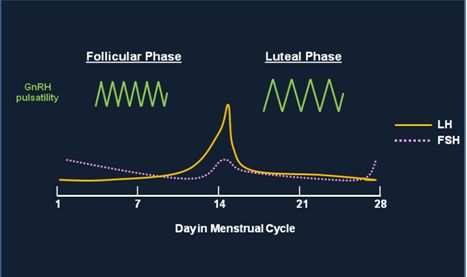
Like FSH, LH is secreted in response to Gonadotropin-Releasing Hormone (GnRH) from the hypothalamus. As we discussed previously, the frequency of GnRH pulses is key:
- Slow-frequency pulses favor FSH secretion.
- Fast-frequency pulses favor LH secretion.
Throughout the menstrual cycle, the frequency of GnRH pulses changes, which in turn alters the ratio of LH to FSH being released. This differential regulation is fundamental to the orderly progression of the cycle.
The Feedback Loop: A Tale of Two Effects
LH secretion is tightly regulated by feedback from ovarian hormones, primarily estrogen and progesterone. Estrogen, fascinatingly, can exert both negative and positive feedback on LH, depending on its concentration and the duration of exposure.
This video provides an excellent visual narrative of how LH levels change throughout the cycle in response to these feedback signals.
Female Reproductive System - Menstrual Cycle, Hormones and Regulation
This animation by Armando Hasudungan beautifully illustrates the feedback control of LH throughout the menstrual cycle. It will help you visualize the concepts of negative and positive feedback.
Please watch from 00:05:42 to 00:06:20 to see how low levels of estrogen provide negative feedback on LH. Then, watch from 00:08:18 to 00:09:18 to see the dramatic switch to positive feedback that causes the LH surge.
Let's break down this dual-action feedback:
-
Negative Feedback:
- During the early to mid-follicular phase, the moderate levels of estrogen produced by the growing follicles suppress LH secretion from the pituitary. This helps keep LH levels relatively stable.
- During the luteal phase (after ovulation), the high levels of progesterone (along with estrogen) from the corpus luteum strongly inhibit GnRH release from the hypothalamus, leading to decreased LH and FSH secretion.
-
Positive Feedback and the LH Surge:
- This is the most critical event for ovulation. As the dominant follicle reaches maturity, it produces very high and sustained levels of estrogen (typically >200 pg/mL for about 50 hours).
- This high estrogen level flips a switch in the HPO axis, turning the feedback from negative to positive.
- This positive feedback causes a massive, rapid release of LH from the pituitary, known as the LH surge. This surge is the direct trigger for ovulation.
3. Physiological Actions of LH
LH has three principal actions in the female reproductive cycle, each essential for fertility.
Action 1: Androgen Production (The Two-Cell, Two-Gonadotropin Theory)
In the last lesson, we learned that FSH stimulates granulosa cells to make estrogen, but we noted that the raw material—androgens—had to come from somewhere. LH provides the answer.
LH receptors are located on the theca cells of the ovarian follicle. LH stimulates these cells to take up cholesterol and convert it into androgens, primarily androstenedione and testosterone. These androgens then diffuse a short distance to the adjacent granulosa cells, where the aromatase enzyme (stimulated by FSH) converts them into estrogen.
This elegant cooperation is called the "two-cell, two-gonadotropin" theory. It requires two cell types (theca and granulosa) and two gonadotropins (LH and FSH) to produce the final product, estradiol.
The following video explains this crucial concept very clearly.
Hypothalamic Pituitary Ovarian Axis | Female Reproductive System
Let's watch this clip from Dr. Matt & Dr. Mike for a clear, step-by-step explanation of how LH and FSH cooperate to produce ovarian hormones.
Watch the segment from 00:05:53 to 00:10:13. The presenters do an excellent job of mapping which hormone acts on which cell (LH on theca, FSH on granulosa) and what the biochemical result is.
Action 2: Triggering Ovulation
The LH surge is the undisputed hormonal trigger for ovulation. It initiates a complex cascade of events within the dominant follicle, culminating in its rupture and the release of the mature oocyte. This typically occurs about 10-12 hours after the LH peak.
The LH surge accomplishes several things to enable ovulation:
- It stimulates the re-initiation of meiosis in the oocyte, pushing it through the final stages of maturation.
- It causes the granulosa cells to begin producing progesterone (a process called luteinization).
- It increases the activity of enzymes, like collagenase, that digest and weaken the follicle wall, facilitating rupture.
The Normal Menstrual Cycle and the Control of Ovulation
For more detail on this critical event, this excerpt from the medical textbook 'Endotext' describes the specific actions of the LH surge.
Please read the paragraph that begins 'Ovulation occurs approximately 10-12 hours after the LH peak...'. This text provides precise timing and details the key events initiated by the surge.
Action 3: Formation and Maintenance of the Corpus Luteum
After the follicle ruptures and releases the egg, what remains of the follicle is transformed into a new, temporary endocrine gland called the corpus luteum ("yellow body"). This transformation is initiated by the LH surge.
For the next 10-14 days, the corpus luteum's survival and function depend on continued, low-level pulsatile support from LH. Under LH stimulation, the corpus luteum becomes a progesterone-producing factory. This progesterone is essential for preparing the uterine lining for potential implantation of an embryo. If pregnancy does not occur, the corpus luteum eventually degenerates due to declining LH support, leading to a fall in progesterone and the onset of menstruation.
Test your understanding!
Imagine a clinical scenario where a woman's estrogen levels rise appropriately, but the LH surge fails to occur. What would be the immediate consequence for her menstrual cycle?
Show answer
If the LH surge fails to occur, ovulation will not be triggered. The mature follicle would not rupture and release the oocyte. This condition is a form of anovulation (lack of ovulation), specifically "luteinized unruptured follicle syndrome" in some cases. The cycle would be disrupted, and she would not be able to conceive during that cycle.
4. Mechanism of Action at the Cellular Level
How does LH actually cause these effects within the theca and granulosa cells? The mechanism involves a common signaling pathway.
Physiology, Luteinizing Hormone
This final reading from StatPearls explains the intracellular signaling cascade that occurs after LH binds to its receptor.
Please read the short section titled 'Mechanism'. This explains how the signal from LH is transmitted inside the target cell.
As described, LH binds to a G-protein coupled receptor on the cell surface. This binding activates an enzyme called adenylyl cyclase, which produces a "second messenger" molecule called cyclic AMP (cAMP). The rise in intracellular cAMP activates another enzyme, Protein Kinase A (PKA), which then phosphorylates various target proteins within the cell, leading to the final physiological effects like steroid hormone production and ovulation.
Conclusion
In this lesson, we have explored the multifaceted role of Luteinizing Hormone, the second key gonadotropin of the HPO axis.
Key Takeaways:
- LH is a glycoprotein hormone, synthesized in the anterior pituitary, with a unique beta subunit that defines its function.
- Its secretion is stimulated by fast-frequency GnRH pulses.
- LH secretion is controlled by a dual-feedback system: it is inhibited by moderate estrogen and progesterone but dramatically stimulated (the LH surge) by high, sustained estrogen levels.
- LH has three critical physiological actions:
- Stimulating androgen production in theca cells (the "two-cell theory").
- Triggering ovulation via the mid-cycle surge.
- Forming and maintaining the corpus luteum after ovulation.
Preview of the Next Lesson:
We have now examined FSH and LH individually, touching on how estrogen and progesterone regulate their release. In the next lesson, we will synthesize this information and take a more focused look at these feedback mechanisms. We will formally explain the negative and positive feedback mechanisms of estrogen and progesterone on the HPO axis, creating a complete and integrated model of how the ovarian cycle is controlled.