Hello! Welcome to the first lesson in our new module on Androgen Physiology and Metabolism.
Introduction
In our previous module, we constructed a detailed understanding of the normal menstrual cycle, culminating in the hormonal and cellular events of menstruation. We saw how the intricate dance of hormones from the hypothalamus, pituitary, and ovaries governs female reproductive function.
Today, we shift our focus to androgens. Often called "male hormones," androgens are, in fact, crucial for normal female physiology, serving as precursors for estrogens and having their own direct effects. Understanding where these hormones come from is the first essential step toward understanding hyperandrogenism (excess androgen), a core feature of Polycystic Ovarian Syndrome (PCOS).
This lesson will address the learning outcome: Describe the sources of androgens in females, including ovarian and adrenal production. We will identify the key androgens circulating in the female body and trace their origins to two primary production sites—the ovaries and the adrenal glands—as well as to peripheral tissues.
1. What Are Androgens?
Androgens are a group of steroid hormones. While they are responsible for the development of male characteristics, they are present and active in both sexes. In women, they play vital roles in bone health, libido, and, most importantly for our course, as the essential building blocks for estrogen synthesis.
To begin, let's get acquainted with the main players and their origins. The following text provides a clear and concise overview.
The role of androgen and its related signals in PCOS
The article 'The role of androgen and its related signals in PCOS' provides an excellent introduction. It lists the five key androgens in women and clearly outlines where each comes from.
Please read the section titled '2.1. Physiological sources and classifications of androgen in women'. Pay close attention to the five types of androgens mentioned (DHEAS, DHEA, A4, T, DHT) and the brief description of their origins.
From the reading, we can summarize the key androgens in women, listed from highest to lowest serum concentration:
- Dehydroepiandrosterone sulfate (DHEA-S): A weak androgen precursor.
- Dehydroepiandrosterone (DHEA): Another weak androgen precursor.
- Androstenedione (A4): A key precursor that can be converted to either testosterone or estrogen.
- Testosterone (T): A potent, biologically active androgen.
- Dihydrotestosterone (DHT): The most potent androgen, converted from testosterone in target tissues.
Notice the inverse relationship between concentration and biological activity. The most abundant androgens (DHEA-S, DHEA) are the weakest, acting as a large reservoir of precursors for the more potent but less concentrated androgens (Testosterone, DHT).
Now, let's explore the two primary factories for these hormones in detail.
2. The Ovarian Source
As we learned in our study of the menstrual cycle, the ovaries are dynamic hormone-producing organs. Their androgen production is a direct consequence of the Two-Cell, Two-Gonadotropin theory we discussed in Module 3.
To recap:
- The developing ovarian follicle contains two key cell types: theca cells on the outside and granulosa cells on the inside.
- These cells are stimulated by two different gonadotropins from the pituitary gland: LH and FSH.
The following video provides an excellent visual explanation of how this system works to produce androgens.
Hypothalamic Pituitary Ovarian Axis | Female Reproductive System
This video from 'Dr Matt & Dr Mike' clearly illustrates how LH stimulates theca cells to produce androgens as part of the normal process of making estrogen.
Please watch from 03:39 to 08:20. Focus on how Luteinizing Hormone (LH) acts on the theca cells to convert cholesterol into androgens (testosterone and DHEA).
As the video explains, Luteinizing Hormone (LH) from the pituitary gland stimulates the theca cells of the ovarian follicle. This stimulation drives the theca cells to take up cholesterol and, through a series of enzymatic reactions, convert it into androgens, primarily androstenedione and testosterone.
These ovarian-produced androgens then have two fates:
- Most are immediately transferred to the adjacent granulosa cells. There, under the influence of Follicle-Stimulating Hormone (FSH), the enzyme aromatase converts them into estrogens (like estradiol). This is the primary pathway for estrogen production.
- A portion "escapes" this conversion process and enters the bloodstream, contributing to the total circulating pool of androgens.

3. The Adrenal Source
The second major production site for androgens in females is the adrenal glands. These are small, pyramid-shaped glands that sit atop each kidney.
Each adrenal gland consists of an outer layer, the adrenal cortex, and an inner part, the adrenal medulla. The adrenal cortex itself has three distinct zones, each responsible for producing different types of steroid hormones. The innermost zone, the zona reticularis, is the adrenal androgen factory.
The following reading explains this process.
Differentiating Polycystic Ovary Syndrome from Adrenal ...
Let's return to the review article 'Differentiating Polycystic Ovary Syndrome from Adrenal...'. The section on adrenal steroidogenesis details how the adrenal gland contributes to the androgen pool.
Please read the first three paragraphs of the section '2.2. Adrenal Steroidogenesis and Androgen Excess of Adrenal Origin'. Focus on: Which zone of the adrenal cortex produces androgens? Which pituitary hormone stimulates this production? What are the main androgens produced by the adrenal glands?
To summarize the key points:
- Androgen synthesis in the adrenal cortex's zona reticularis is stimulated by Adrenocorticotropic Hormone (ACTH) from the pituitary gland. This is analogous to how LH stimulates the ovaries.
- The primary androgens produced by the adrenal glands are DHEA and its sulfated form, DHEA-S.
- DHEA-S is almost exclusively produced by the adrenal glands, making it a very useful clinical marker to assess the adrenal contribution to a person's androgen status.
4. Synthesizing the Sources
Now that we've identified the two main production centers—the ovaries and the adrenal glands—we can put it all together. The total amount of each androgen in a woman's bloodstream is a sum of contributions from these sources, plus a third critical component: peripheral conversion. This refers to the conversion of weaker androgen precursors into more potent ones in tissues outside the ovaries and adrenals, such as fat, skin, and the liver.
Here is a breakdown of the approximate contributions for the major androgens in a healthy woman:
| Hormone | Ovarian Production | Adrenal Production | Peripheral Conversion |
|---|---|---|---|
| Testosterone (T) | ~25% | ~25% | ~50% |
| Androstenedione (A4) | ~50% | ~50% | Negligible |
| DHEA | ~20% | ~50% | ~30% (from DHEA-S) |
| DHEA-S | Negligible | ~100% | Negligible |
These percentages are approximations and can vary. They are based on information from the resources provided (LINK and LINK).
The following image provides a simple visual summary for testosterone, the most well-known androgen.
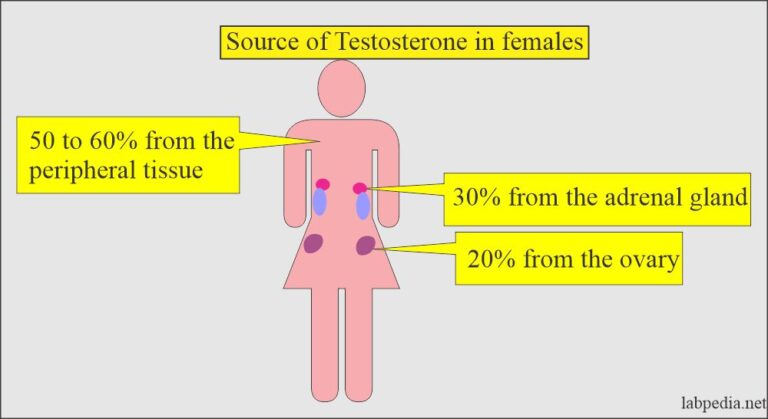
The large contribution from peripheral conversion is a critical concept in PCOS. Conditions like obesity can increase the amount of peripheral tissue (fat), which can then lead to greater conversion of precursors into potent androgens, exacerbating hyperandrogenism.
Test your understanding!
A clinician is evaluating a female patient for androgen excess. A blood test reveals a significantly elevated level of DHEA-S, while her testosterone and androstenedione levels are only borderline high. Based on what you've learned about the specific origins of these hormones, which organ is the most likely primary source of the excess androgens?
Show answer
The adrenal gland. Since DHEA-S is produced almost exclusively by the adrenal glands, a markedly high level strongly points to an adrenal source of overproduction, rather than an ovarian one. This is a key principle in the differential diagnosis of conditions causing hyperandrogenism.
Conclusion
In this lesson, we have mapped out the origins of androgens in the female body, a crucial foundation for understanding the pathology of PCOS.
Key Takeaways:
- Androgens are a group of steroid hormones essential for female physiology, with five main types: DHEA-S, DHEA, androstenedione, testosterone, and DHT.
- There are two primary production sites: the ovaries and the adrenal glands.
- In the ovaries, theca cells, stimulated by LH, produce androstenedione and testosterone.
- In the adrenal glands, the zona reticularis, stimulated by ACTH, produces primarily DHEA and DHEA-S.
- A significant portion of potent testosterone (~50%) is not secreted directly but is created via peripheral conversion of weaker androgen precursors in tissues like fat and skin.
Preview of the Next Lesson:
We've answered the question of where androgens come from. In our next lesson, we will delve deeper to answer how they are made. We will explore the specific biosynthetic pathways that convert cholesterol into the various androgen molecules within the cells of the ovaries and adrenal glands. Understanding this biochemical assembly line will allow us to later pinpoint exactly where defects can occur to cause the hyperandrogenism seen in PCOS.