Welcome to the first lesson of your course on Polycystic Ovarian Syndrome (PCOS). I'm here to guide you through the modern medical understanding of this condition, starting from the most fundamental principles.
This first module, "Fundamentals of the Endocrine System," lays the essential groundwork for everything we will cover later. Today, we will begin with the most basic question: What are hormones? Our goal is to define what a hormone is and learn how to distinguish between the three main chemical classes: peptide, steroid, and amine hormones.
Understanding the chemical structure of a hormone is the key that unlocks its entire story. It tells us how the hormone is made, how it travels through the body, and how it communicates with its target cells. This knowledge is absolutely critical for understanding the hormonal disruptions that occur in PCOS.
1. What Are Hormones?
In modern physiology, a hormone is defined as a chemical messenger produced by an endocrine gland and released into the bloodstream. It travels throughout the body but only affects specific target cells—cells that have a receptor designed to recognize and bind to that particular hormone.
Think of it like a radio broadcast. A radio station (the endocrine gland) sends out a signal (the hormone) in all directions through the air (the bloodstream). However, you only hear the broadcast if your radio (the target cell) is tuned to the correct frequency (has the specific receptor).
2. The Three Major Classes of Hormones
Hormones are categorized into three main groups based on their chemical structure. Let's begin with a video that provides an excellent overview of these three types.
Types of hormones | Endocrine system physiology | NCLEX-RN | Khan Academy
This video from Khan Academy provides a clear and structured explanation of each of the three major hormone classes.
Please watch from 00:21 to 09:46. Pay close attention to: The building blocks of each hormone type (amino acids vs. cholesterol). The key structural differences. The examples given for each class (e.g., insulin, testosterone, thyroid hormones).
As you saw in the video, the three classes are:
-
Peptide and Protein Hormones:
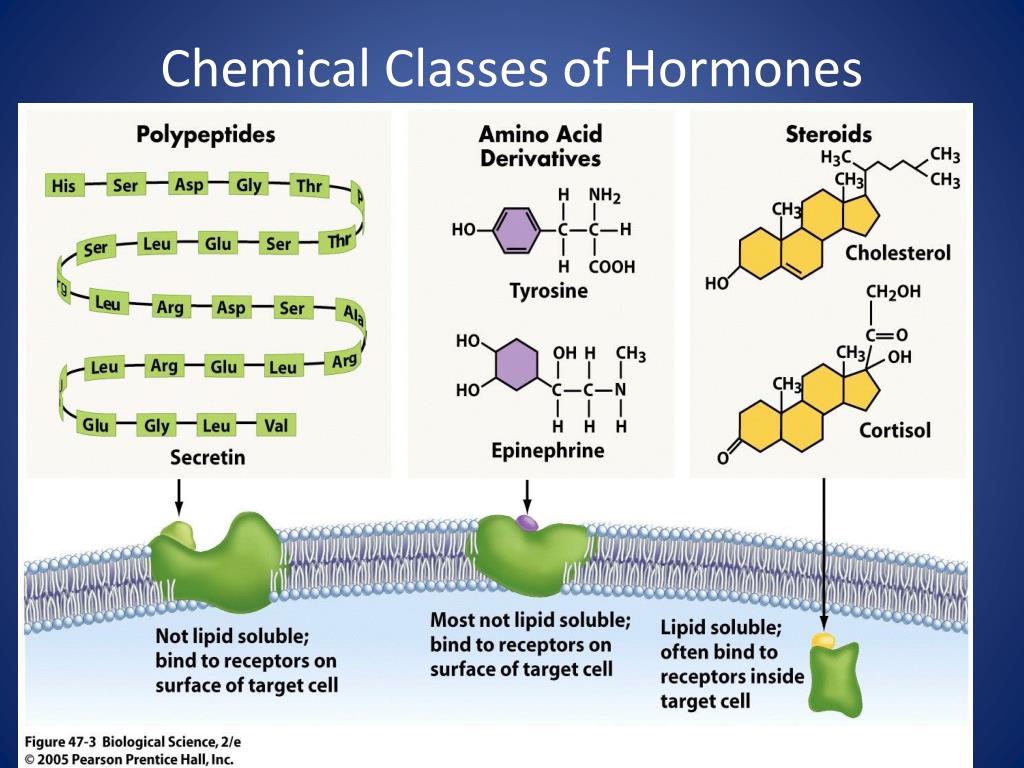
- Structure: They are made from chains of amino acids. Peptides are shorter chains, while proteins are longer chains (typically over 100 amino acids).
- Key Property: They are water-soluble.
- Examples: Insulin, Growth Hormone (GH), and the key reproductive hormones Follicle-Stimulating Hormone (FSH) and Luteinizing Hormone (LH).
-
Steroid Hormones:
- Structure: They are derived from a lipid molecule called cholesterol. Their hallmark is a four-ring carbon structure.
- Key Property: They are lipid-soluble (fat-soluble), meaning they do not dissolve in water.
- Examples: Cortisol from the adrenal glands, and the sex hormones like testosterone and estrogen from the gonads.
-
Amine Hormones:
- Structure: They are the simplest class, derived from a single amino acid, most commonly tyrosine or tryptophan.
- Key Property: This is a mixed group. Some are water-soluble (like the catecholamines epinephrine/adrenaline), while others are lipid-soluble (like the thyroid hormones T3 and T4).
- Examples: Epinephrine (adrenaline), norepinephrine, and thyroid hormones.
The image below provides a great visual summary of these structures and how they interact with a target cell.
Test your understanding!
A newly discovered hormone is found to be a large molecule composed of 150 amino acids linked together. It dissolves easily in water. Which class of hormone does it most likely belong to?
Show answer
It belongs to the protein hormone class. Protein (and peptide) hormones are made of amino acid chains and are water-soluble. Steroid hormones are derived from lipids, and amine hormones are derived from a single amino acid.
3. Why Solubility Matters: Transport and Receptors
Now for the crucial question: why do we care if a hormone is water-soluble or lipid-soluble? This property dictates its entire journey and mechanism of action. The fundamental challenge is this:
- Blood is mostly water.
- Cell membranes are made of lipids (fats).
This creates a "like-dissolves-like" problem. Water-soluble hormones are happy in the blood but can't get through the cell membrane. Lipid-soluble hormones can't dissolve in the blood but can easily pass through the cell membrane.
The following video explains these functional differences very effectively.
Hormone Biochemistry (Genomic vs Non-genomic Actions)
Now that we know the chemical classes, let's explore how their structure affects their function. This video explains the crucial differences between water-soluble and lipid-soluble hormones.
Please watch the segments from 03:23 to 04:39 and from 05:00 to 06:45. Focus on how a hormone's solubility determines: Whether it needs a carrier protein to travel in the blood. Whether its receptor is on the cell surface or inside the cell.
Let's summarize those key points:
Water-Soluble Hormones (Peptides & Catecholamines)
- Transport: They dissolve easily in the water-based blood and travel freely.
- Receptors: Because they cannot pass through the lipid cell membrane, their receptors must be located on the outer surface of the cell. They act like a person ringing a doorbell—they deliver the message without entering the house.
Lipid-Soluble Hormones (Steroids & Thyroid Hormones)
- Transport: They are not soluble in blood. To travel, they must bind to transport proteins. These carrier proteins act like a chauffeur, escorting the hormone through the bloodstream.
- Receptors: They can easily diffuse across the cell membrane and bind to intracellular receptors (receptors located inside the cell, either in the cytoplasm or the nucleus). They walk right into the house to deliver their message directly.
An important consequence of this is the hormone's half-life—the time it takes for half of the hormone in the blood to be degraded. Lipid-soluble hormones, protected by their transport proteins, have a much longer half-life (hours to days) than water-soluble hormones, which are exposed and broken down quickly (seconds to minutes).
4. Summary and Reference
To consolidate everything we've covered, let's review a text resource that lays out these classifications clearly. It also includes a useful table summarizing the major hormones.
Hormones | Anatomy and Physiology II
This resource from Lumen Learning provides a concise, text-based summary of the hormone classes. The table is especially useful as a quick reference for the major hormones, their chemical class, and their function.
Read the sections titled 'Types of Hormones', 'Amine Hormones', 'Peptide and Protein Hormones', and 'Steroid Hormones'. You can skim the initial table for now; we will encounter many of these hormones later in the course.
Here is a summary table that brings together all the concepts from this lesson:
| Characteristic | Peptide/Protein Hormones | Steroid Hormones | Amine Hormones |
|---|---|---|---|
| Structure | Chains of amino acids | Derived from cholesterol | Derived from a single amino acid |
| Solubility | Water-soluble | Lipid-soluble | Mixed (some water, some lipid) |
| Transport | Free in blood | Bound to carrier proteins | Varies with solubility |
| Receptor Location | On cell surface | Intracellular (inside cell) | Varies with solubility |
| Speed of Action | Fast (seconds to minutes) | Slow (hours to days) | Varies |
| Half-life | Short | Long | Varies |
| Examples | Insulin, FSH, LH | Testosterone, Estrogen, Cortisol | Epinephrine, Thyroid Hormone |
Test your understanding!
Testosterone is a steroid hormone. Based on what you've learned about this class, would you expect it to travel freely in the blood or bound to a carrier protein? And where would you expect to find its receptor?
Show answer
As a steroid hormone, testosterone is lipid-soluble and not soluble in the water-based blood. Therefore, it needs to be bound to a carrier protein (like Sex Hormone-Binding Globulin, which we will discuss later in the course). Because it is lipid-soluble, it can pass through the cell membrane and bind to an intracellular receptor (a receptor inside the target cell).
Conclusion
In this lesson, we established the foundational concept of hormone classification.
Key Takeaways:
- Hormones are chemical messengers classified by their structure into three main groups: peptide/protein, steroid, and amine.
- This chemical structure determines a hormone's solubility (whether it dissolves in water or lipids).
- Solubility, in turn, dictates how a hormone is transported in the blood (freely vs. on a carrier protein) and where its receptor is located on the target cell (surface vs. inside).
This framework is essential. As we move forward and discuss hormones like LH, FSH, insulin, and androgens in the context of PCOS, you will now be able to predict their behavior based on their chemical class.
Preview of the Next Lesson:
In our next lesson, we will build directly on this foundation by exploring how these different hormone types actually "deliver their message" once they bind to their receptors. We will examine the specific mechanisms of action for steroid hormones that directly regulate genes and for peptide hormones that use "second messenger" systems to amplify their signal inside the cell.