Hello! Welcome to our next lesson.
In our previous session, we took a detailed look at the 2003 Rotterdam criteria, breaking down each of its three components: oligo/anovulation, hyperandrogenism, and polycystic ovarian morphology. We established that these criteria, based on a "2 out of 3" rule, are the most widely used standard for diagnosing PCOS today.
Today, we will build directly on that knowledge to address the learning outcome: Compare the Rotterdam criteria with the NIH and Androgen Excess & PCOS Society criteria. Understanding these different diagnostic frameworks is crucial. It not only reveals the historical evolution of how PCOS is defined but also explains why you might see different prevalence rates in research and highlights the ongoing expert discussion about the core features of this complex syndrome.
The Evolution of a Diagnosis
Diagnosing a syndrome like PCOS, which has varied presentations, is a complex task. Over the past few decades, expert groups have convened to create standardized criteria. We will examine the three most influential sets of criteria in chronological order to understand how the definition of PCOS has been debated and refined.
1. The 1990 NIH Criteria: The "Classic" Definition
The first major effort to create a standardized definition for PCOS came from a 1990 conference sponsored by the U.S. National Institutes of Health (NIH). These criteria defined what is often considered the "classic" or most severe form of PCOS.
The NIH criteria require the presence of both of the following for a diagnosis:
- Ovulatory dysfunction (OD), typically manifesting as oligomenorrhea or amenorrhea.
- Clinical and/or biochemical hyperandrogenism (HA).
Crucially, polycystic ovarian morphology (PCOM) on ultrasound was not part of the NIH diagnostic criteria. The experts at the time recognized that many women had polycystic-appearing ovaries without any other signs of the syndrome, so they did not consider it a core diagnostic feature. As with all PCOS criteria, other conditions that could cause these symptoms must be excluded first.
Diagnosis of Polycystic Ovary Syndrome: Which Criteria to ...
To understand the context and reasoning behind this first set of criteria, let's read the relevant section from the paper 'Diagnosis of Polycystic Ovary Syndrome' by Andrea Dunaif.
In this paper, please read the subsection titled 'NIH Criteria'. Focus on which two features were chosen as essential and the reason why PCOM was explicitly excluded.
Because the NIH criteria are the most restrictive, they identify a smaller group of women compared to other criteria. Studies using the NIH definition report a PCOS prevalence of about 5–8%. This group, defined by both irregular cycles and high androgens, generally has the most significant metabolic risks.
2. The 2003 Rotterdam Criteria: A Broader Net
As we covered in the last lesson, the 2003 Rotterdam workshop broadened the definition significantly. Let's briefly recap to set up the comparison.
The Rotterdam criteria require at least two of the following three features:
- Ovulatory dysfunction (OD)
- Hyperandrogenism (HA)
- Polycystic Ovarian Morphology (PCOM)
The key changes were the inclusion of PCOM as a diagnostic feature and the shift to a "2 out of 3" rule. This had a major consequence: it created two new combinations, or phenotypes, of PCOS that were not recognized under the stricter NIH criteria:
- Women with hyperandrogenism and PCOM, but with regular ovulation (HA + PCOM).
- Women with ovulatory dysfunction and PCOM, but without hyperandrogenism (OD + PCOM).
By including these milder or different presentations, the Rotterdam criteria nearly doubled the estimated prevalence of PCOS to as high as 15-20% of reproductive-age women.
3. The 2006 AE-PCOS Society Criteria: A Return to Androgens
Some experts felt that the Rotterdam criteria had become too broad, particularly by allowing for a diagnosis of PCOS without the presence of hyperandrogenism. In 2006, the Androgen Excess Society (now the Androgen Excess & PCOS Society, or AE-PCOS) proposed a compromise.
Their criteria are built on the principle that hyperandrogenism is the fundamental and indispensable feature of PCOS.
The AE-PCOS criteria require the presence of:
- Hyperandrogenism (HA)
PLUS one of the following: - Ovulatory dysfunction (OD) OR
- Polycystic Ovarian Morphology (PCOM)
Essentially, the AE-PCOS criteria include all the Rotterdam phenotypes that involve hyperandrogenism but exclude the non-hyperandrogenic phenotype (OD + PCOM). It represents a middle ground between the strict NIH definition and the broad Rotterdam definition.
Polycystic Ovary Syndrome (PCOS) | Overview of Associated Conditions, Diagnosis & Treatments
The video 'Polycystic Ovary Syndrome (PCOS)' by JJ Medicine offers a very brief but clear explanation of the Rotterdam and AES criteria, highlighting the main difference.
Please watch from 11:56 to 13:59. The video first explains the Rotterdam criteria and then contrasts it with the Androgen Excess Society (AES) criteria, emphasizing what AES requires.
While the AE-PCOS criteria are respected for their strong pathophysiological argument, they have not been as widely adopted in clinical practice and research as the Rotterdam criteria.
Synthesizing the Criteria: A Head-to-Head Comparison
Now, let's bring it all together. The following table and image provide a clear visual summary of the differences.
| Criteria Set | Hyperandrogenism (HA) | Ovulatory Dysfunction (OD) | Polycystic Ovarian Morphology (PCOM) | Diagnostic Rule |
|---|---|---|---|---|
| 1990 NIH | Required | Required | Not considered | HA + OD |
| 2003 Rotterdam | Optional | Optional | Optional | Any 2 of the 3 |
| 2006 AE-PCOS | Required | Optional | Optional | HA + (OD or PCOM) |
This image provides another excellent visual summary of the requirements for each set of criteria.
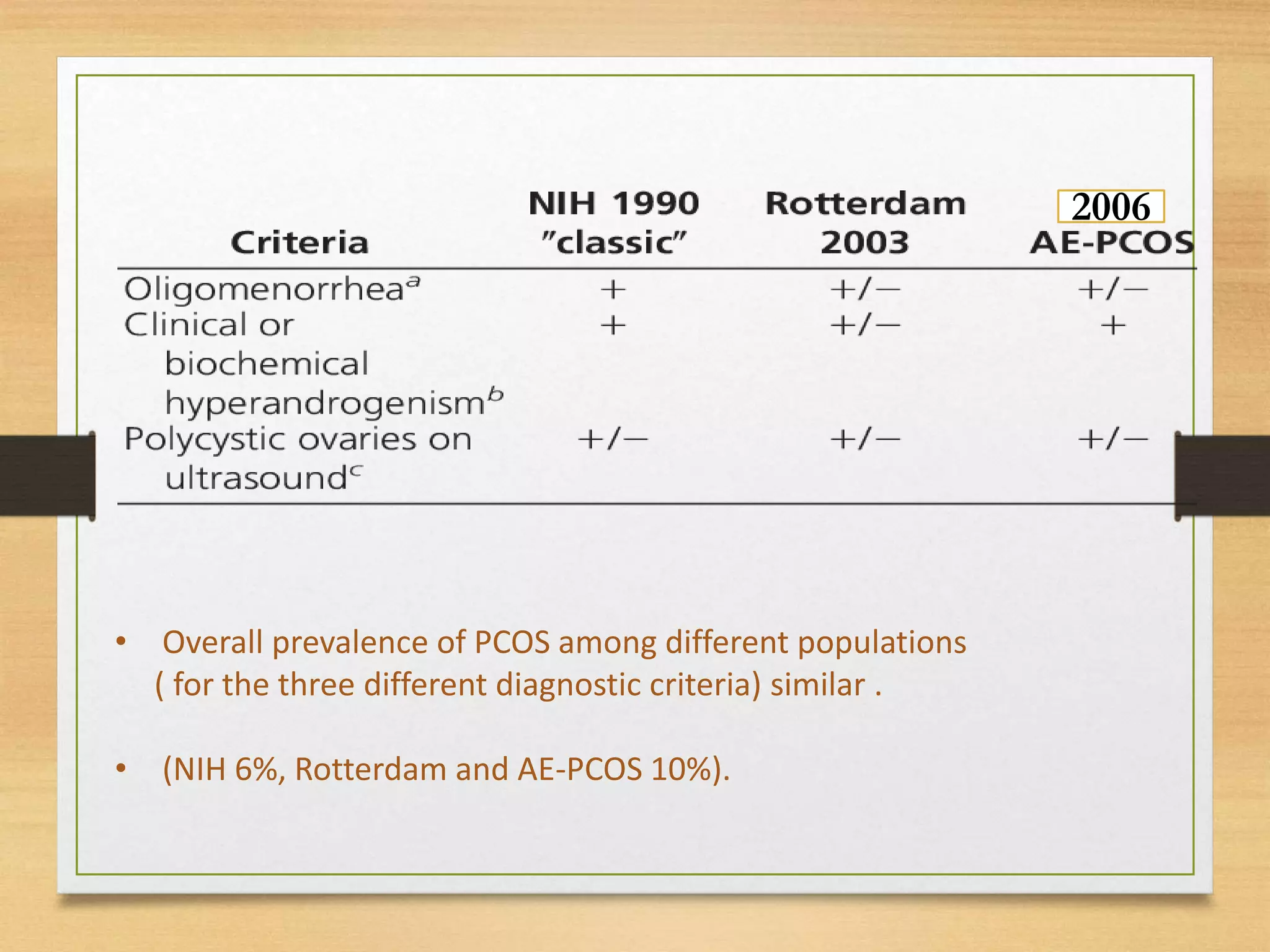
The core debate that these different criteria highlight is: What is the defining feature of PCOS?
- The NIH and AE-PCOS camps argue that hyperandrogenism is the essential, non-negotiable cornerstone of the syndrome.
- The Rotterdam criteria take a broader view, acknowledging that the combination of ovulatory dysfunction and polycystic ovaries, even without high androgens, constitutes a form of the syndrome.
Today, the 2012 NIH evidence-based workshop and subsequent international guidelines recommend using the Rotterdam criteria, but with an important addition: that the specific phenotype of the patient should always be clearly stated. This acknowledges the diversity of the syndrome while maintaining a unified diagnostic framework.
Test your understanding!
A patient has oligomenorrhea (OD) and her ultrasound shows polycystic ovarian morphology (PCOM). Her blood tests for androgens are normal, and she has no clinical signs of hyperandrogenism.
According to which set(s) of criteria would she be diagnosed with PCOS?
- NIH only
- Rotterdam only
- AE-PCOS only
- NIH and AE-PCOS
- Rotterdam and AE-PCOS
Show answer
The correct answer is 2. Rotterdam only.
- She does not meet the NIH criteria because she does not have hyperandrogenism (HA). NIH requires HA + OD.
- She does meet the Rotterdam criteria because she has 2 of the 3 features (OD + PCOM).
- She does not meet the AE-PCOS criteria because she does not have hyperandrogenism (HA), which is a mandatory requirement for this set of criteria.
Conclusion
You have now compared the three major diagnostic systems for PCOS. This deeper understanding of the "why" behind the diagnosis is fundamental for critically evaluating research and understanding the full spectrum of the syndrome.
Key Takeaways:
- The 1990 NIH criteria are the strictest, requiring both hyperandrogenism (HA) and ovulatory dysfunction (OD). They define the "classic" PCOS phenotype.
- The 2003 Rotterdam criteria are the broadest and most commonly used, requiring any two of three features (HA, OD, or PCOM). This created new, milder phenotypes.
- The 2006 AE-PCOS criteria offer a middle ground, insisting that hyperandrogenism (HA) is mandatory, plus either OD or PCOM.
- The evolution of these criteria reflects an ongoing debate about the core pathophysiology of PCOS, with hyperandrogenism at the center of the discussion.
Preview of the Next Lesson:
Our comparison today has naturally led us to the concept of "phenotypes." In our next lesson, we will formally describe the different phenotypic variations of PCOS based on the diagnostic criteria. We will explore the four main phenotypes (A, B, C, and D) that arise from the Rotterdam framework and discuss how their clinical features and long-term health risks can differ.