Hello! Welcome to our next lesson.
In our last lesson, we learned how to make positive sentences like, "I am a student," and negative sentences like, "She is not from here." This is a great foundation for expressing facts.
Today, we will learn how to talk about things that belong to people. This is a very important step for your goal of having conversations and making friends. You will learn to use words like my, your, his, her, our, and their. These are called possessive adjectives. After this lesson, you'll be able to say things like, "My name is...," talk about "his job," or ask about "your family."
1. What Are Possessive Adjectives?
Possessive adjectives are words that show who owns something or has a relationship with something. They answer the question "Whose?" (Whose book is this? It's my book).
In our previous lessons, you learned the subject pronouns (I, you, he, she, it, we, they). Each subject pronoun has a matching possessive adjective.
Look at this chart. It shows the subject pronoun and the possessive adjective that goes with it.
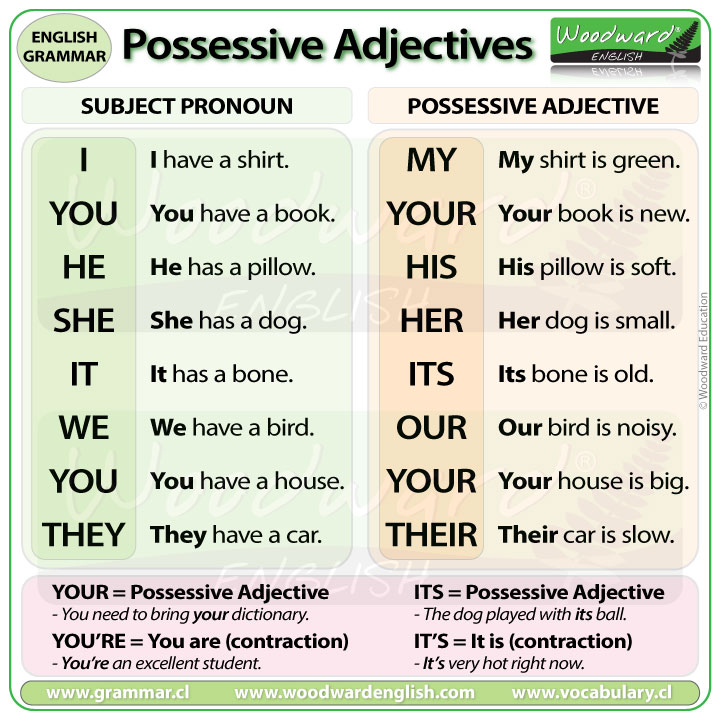
Here is a summary:
- I → my (My name is...)
- You → your (What is your name?)
- He → his (His car is new.)
- She → her (Her dog is small.)
- It → its (The cat is eating its food.)
- We → our (This is our house.)
- They → their (Their teacher is friendly.)
To hear the pronunciation and see more examples, let's watch a short video.
Possessive Adjectives in English | My, Your, His, Her, Its, Our, Your, Their | Learn English Grammar
This video from Woodward English clearly explains each possessive adjective with a simple sentence. Listen carefully to the pronunciation.
Watch the video from the beginning (00:00) until 02:01. Pay attention to how each possessive adjective connects to a subject. For example, 'I have a shirt. My shirt is green.'
2. Important Rules for Possessive Adjectives
Using these words is simple, but there are a few important rules to remember. Let's look at them in a textbook extract.
Unit2 Possessive Adjectives (my, your, his, her, its, our, ...
This document from the University of Michigan Press gives a clear explanation of the rules for using possessive adjectives. It will help you use them correctly.
Please read the section titled '2: Possessive Adjectives and Demonstratives' on page 39. Focus on the chart that connects Subject Pronouns to Possessive Adjectives and the three rules listed just below it.
Let's summarize the two most important rules you just read:
-
Possessive adjectives always come before a noun. A noun is a person, place, or thing (like friend, city, or book).
- Correct: This is my book.
- Incorrect: This book is my.
-
Possessive adjectives do not change for plural nouns. The word stays the same whether you are talking about one thing or many things.
- Her car is blue. (one car)
- Her cars are blue. (many cars)
Test your understanding!
Choose the correct possessive adjective for each sentence.
- I have a brother. ___ name is Ali. (My / His / Her)
- She is a student. ___ school is in the city center. (His / Her / Our)
- We are a family. ___ house is small. (My / Our / Their)
- They have a new car. ___ car is red. (His / Your / Their)
Show answer
- I have a brother. His name is Ali.
- She is a student. Her school is in the city center.
- We are a family. Our house is small.
- They have a new car. Their car is red.
3. Common Confusions: your/you're, its/it's, their/they're
Some possessive adjectives sound exactly like other common English words. This can be confusing, but it's easy once you learn the difference.
| Possessive Adjective (shows ownership) | Contraction (is two words) | Example |
|---|---|---|
| your | you're (you are) |
Is this your bag? You're a good student. |
| its | it's (it is) |
The dog wagged its tail. It's a sunny day. |
| their | they're (they are) |
That is their house. They're very happy. |
You already know you are, it is, and they are from our lessons on the verb 'to be'. Just remember that when you want to show something belongs to someone, you use the possessive adjective without the apostrophe (').
This next video explains these differences very clearly.
Possessive Adjectives in English | My, Your, His, Her, Its, Our, Your, Their | Learn English Grammar
This part of the video from Woodward English will help you understand the difference between these similar-sounding words.
Watch from 02:41 to 04:46. The video first explains 'its' vs. 'it's', and then 'your' vs. 'you're'. Listen for the example sentences.
4. Practice Makes Perfect
Now it's time to practice using possessive adjectives. This will help you feel more confident using them in conversation.
Complete the sentences below with the correct possessive adjective: my, your, his, her, our, or their.
- He is my friend. _______ name is Omar.
- I am a student. _______ teacher is from Canada.
- You have a nice phone. Is this _______ phone?
- Maria and I are in the same class. _______ class is at 10 a.m.
- My parents have a dog. _______ dog is very friendly.
- A: What is _______ name? B: My name is Fatima.
Show answers
- He is my friend. His name is Omar.
- I am a student. My teacher is from Canada.
- You have a nice phone. Is this your phone?
- Maria and I are in the same class. Our class is at 10 a.m.
- My parents have a dog. Their dog is very friendly.
- A: What is your name? B: My name is Fatima.
Conclusion
Excellent work today! You have learned a very important part of English grammar that will help you talk about yourself, your friends, and your family.
Here are the key takeaways:
- Use possessive adjectives (
my,your,his,her,its,our,their) to show who owns something. - They always go before a noun (e.g.,
my friend). - They do not change for singular or plural nouns (
his book/his books). - Be careful not to confuse them with contractions like
you're,it's, andthey're.
In our next lesson, we will build on what you know about the verb 'to be' to start asking simple questions. You know how to say, "You are tired." Soon, you will learn how to ask, "Are you tired?" This will make your conversations much more interactive. See you then