Introduction
Welcome to the next lesson in our module on foundational legal principles. In our last discussion, we examined how AI intersects with the high-level constitutional guarantees of the "Golden Triangle"—Articles 14, 19, and 21. We saw how the Constitution sets the ultimate boundaries for state action, requiring equality, fairness, and respect for privacy.
Today, we shift from the "what" of constitutional limits to the "how" of day-to-day governance. We will delve into Administrative Law, the body of law that governs the powers and procedures of government agencies. If the Constitution provides the blueprint for the state, Administrative Law provides the operating manual for its machinery.
This lesson is designed to address the learning outcome: Describe the role of Administrative Law in regulating state use of technology and ensuring procedural fairness. We will explore:
- The core principles of Administrative Law, such as natural justice and the duty to give reasons.
- How the use of automated and AI-driven systems by the state creates a direct conflict with these long-standing principles.
- The legal frameworks and safeguards being proposed to ensure that "algorithmic governance" remains accountable, transparent, and fair.
Your professional experience in implementing workflow automation for healthcare clinics gives you a practical lens on this topic. Today, we'll examine the public sector equivalent, where the stakes involve not just business efficiency, but fundamental rights and the rule of law.
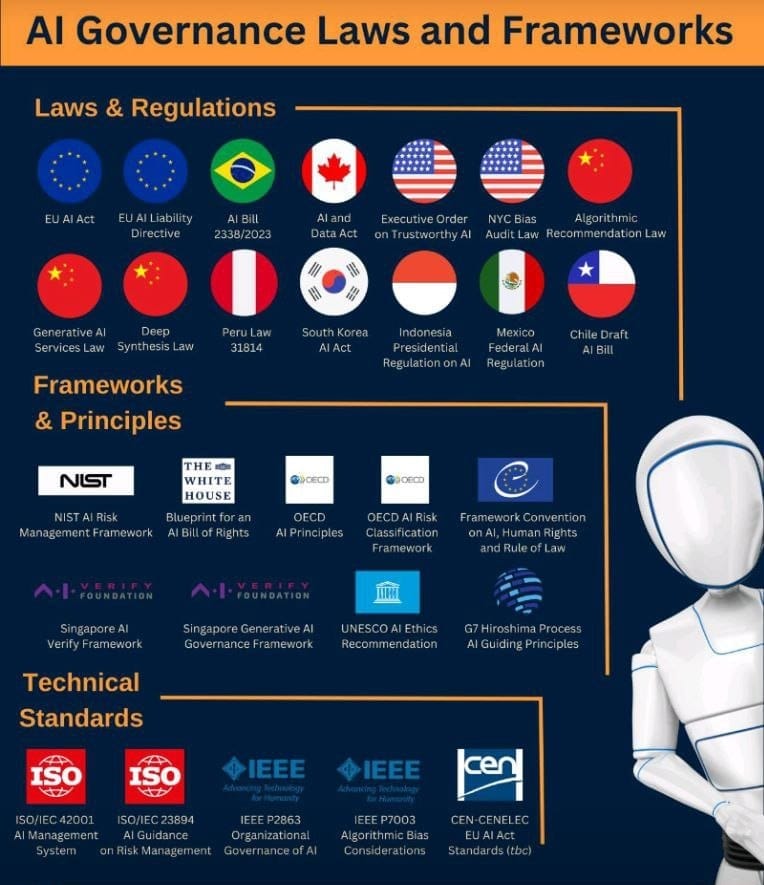
The Global Context of AI Governance
Before we dive into Indian administrative law, it's helpful to recognize that the challenge of regulating state use of AI is a global one. Countries and international bodies are developing a complex web of laws, ethical frameworks, and technical standards to manage this new reality.
Core Principles of Administrative Law
Administrative law is the branch of public law that ensures government actions are not arbitrary, illegal, or unfair. It provides the legal basis for citizens to challenge decisions made by administrative bodies, from a local municipal office to a central government ministry. Its core purpose is to uphold the rule of law and hold power to account.
Several key principles form the bedrock of administrative law. When the state uses technology to make decisions, these principles become the primary legal tools for ensuring fairness.
-
Principles of Natural Justice: These are fundamental procedural rules that every administrative authority must follow.
- Audi Alteram Partem ("hear the other side"): No person should be condemned unheard. This means an individual affected by a decision has a right to receive notice and be given a fair opportunity to present their case.
- Nemo Judex in Causa Sua ("no one should be a judge in their own cause"): The decision-maker must be impartial and free from bias. This applies not only to personal bias but also to systemic or institutional bias.
- Duty to Give Reasons: An administrative decision that affects rights or interests must be supported by reasons. These reasons must be clear, explicit, and demonstrate that the authority has applied its mind to the facts of the case. This is not just about transparency; it allows the affected person to know why a decision was made and provides the basis for a meaningful appeal or judicial review.
-
Limits on Discretionary Power: While administrative officials often have the discretion to make choices, this power is not absolute. A critical doctrine here is the rule against the non-fettering of discretion.
- Non-Fettering of Discretion: A public authority entrusted with a discretionary power cannot "fetter" or bind itself by adopting a rigid, inflexible policy. It must be willing to consider the individual merits of each case. It cannot blindly delegate its decision-making duty to another person—or, crucially for our purposes, to an algorithm.
The Collision: Algorithmic Governance vs. Administrative Law
The rise of "algorithmic governance"—the use of automated systems to make administrative decisions—places immense pressure on these foundational principles. Your experience with CRM and workflow automation in the private sector likely focused on efficiency and consistency. In the public sector, however, these same goals can lead to significant legal problems when they override fairness and accountability.
To see this conflict in action, let's explore some examples. The following article provides a superb overview of the challenges and legal landscape.
Algorithmic Governance and the Future of Administrative Discretion in India
The article 'Algorithmic Governance and the Future of Administrative Discretion in India' by S. Shruthika provides a comprehensive look at the friction between automation and administrative law. It's rich with both Indian and international examples that bring the theoretical problems to life.
Please read two sections from this paper to understand the scope of the problem: 'Understanding Algorithmic Decision-Making and Administrative Discretion' (starts on page 5): Pay close attention to the real-world examples, such as the Australian 'robo-debt' scandal, Aadhaar-based exclusions from the Public Distribution System (PDS) in India, and predictive policing in Hyderabad. These illustrate how automation can directly harm citizens. 'Algorithmic Bias, Opacity, and the Erosion of Natural Justice Principles' (starts on page 9): This section connects the technical problems of bias and opacity directly to the legal principles of natural justice. Note the examples of the Jharkhand PDS deaths and the COMPAS tool in the US.
The article you just reviewed highlights the central tensions:
- The "Black Box" Problem vs. The Duty to Give Reasons: How can a government agency provide "clear and explicit reasons" for a decision when the decision is made by a complex neural network whose internal logic is opaque even to its designers? A response of "the computer said so" is the antithesis of a reasoned decision.
- Automated Application vs. Non-Fettering of Discretion: When a public official simply accepts the output of an AI system without independent consideration, they have unlawfully fettered their discretion. The decision has been delegated to the machine, violating a core tenet of administrative law.
- Algorithmic Bias vs. Natural Justice: A system trained on biased historical data (like the COMPAS example) is inherently not impartial. Its use violates the rule against bias, a pillar of natural justice.
A Legal Framework for Reasoned Automated Decisions
Given these profound challenges, how can administrative law adapt? The solution is not to ban technology, but to build a framework that subjects it to the rule of law. A recent article from the NLSIR Online blog provides a sophisticated and practical roadmap for achieving this.
A Framework for Reasoned Automated Decision-Making ...
This article, 'A Framework for Reasoned Automated Decision-Making under Indian Administrative Law' by Chytanya Agarwal, moves from identifying the problem to proposing concrete legal and technical solutions. It's a fantastic example of the kind of techno-legal analysis central to your goal of working in AI governance.
Please read the following key sections carefully: 'The Required Standard Of Reasoning' (starts under the 'The ‘Black Box’ Problem In AI' section): This part outlines the legal standard for a reasoned decision under Indian law (citing Siemens Engg. and S.N. Mukherjee) and, most importantly, introduces the proportionality test from the recent Supreme Court case of Madhyamam Broadcasting Ltd. v. Union of India. Focus on how the third prong of this test (necessity/least restrictive alternative) becomes a powerful tool to demand more interpretable AI. 'Policy Safeguards To Navigate The Black Box Problem' (the main body of the article): This section proposes three specific solutions. Study each one: Non-Determinative Use of ADM: How the doctrine of non-fettering requires meaningful human oversight. Explainable AI (xAI): Understand the difference between system-level explanations and decision-specific explanations, and why a subject-centric counterfactual explanation is the most legally sound approach. Chain-of-Thought Prompting: A technical solution that directly addresses the need for interpretability.
This article provides a powerful toolkit for ensuring automated decisions comply with administrative law. Let's summarize the three proposed safeguards:
-
Meaningful Human Oversight (The Non-Fettering Doctrine): The simplest safeguard is to ensure the AI is only an assistant, not the ultimate decider. An administrative official must retain the final authority, apply their mind independently, and be able to override the AI's recommendation. This is what cases like Loomis in the US and Article 22 of the GDPR point towards. The human must be more than a rubber stamp.
-
Explainable AI (xAI) as a Legal Requirement: When human oversight is not practical for every decision, the system itself must be able to provide legally sufficient reasons. The article argues compellingly that a "subject-centric, counterfactual" explanation is the best fit. Instead of a technical data dump (revealing source code), the system should provide a human-understandable reason like:
"Your loan application was denied because your debt-to-income ratio is 45%. If your ratio had been 40% or lower, your application would have been approved."
This explanation is specific, actionable, and gives the person a clear basis for an appeal, satisfying the duty to give reasons. -
Chain-of-Thought (CoT) Prompting: This is a more advanced technical approach that aligns with your interest in the "how" of AI. By designing the AI model to break down its reasoning into a sequence of logical steps, the "black box" becomes a "glass box." The AI's reasoning process is made visible and can be recorded as the official reason for the decision, directly fulfilling the duty to provide reasons.
The Madhyamam Broadcasting proportionality test is the modern legal lever to enforce these safeguards. A court can now ask: "Is using this opaque, unexplainable AI system the least rights-restrictive means to achieve the goal of efficiency, when more interpretable alternatives like xAI or CoT models exist?" The answer will often be no.
Test your understanding!
A state's transport department implements a new AI system to automatically suspend driving licenses based on traffic camera footage. A taxi driver receives a notification that their license is suspended for 90 days. The notification simply states: "Your license has been suspended due to multiple rule violations detected by our automated traffic management system." The driver, whose livelihood is at stake, cannot get any more details.
Based on the principles of administrative law discussed, what are the two strongest legal arguments the driver can make to challenge this suspension?
Show answer
The driver has two very strong arguments rooted in administrative law:
-
Violation of the Duty to Give Reasons: The notification fails to provide "clear and explicit reasons" as required. It doesn't specify which violations occurred, when they occurred, or what evidence the system used. This violates a core principle of natural justice and makes it impossible for the driver to formulate a meaningful appeal.
-
Unlawful Fettering of Discretion: The system appears to be making the decision to suspend the license automatically, without any human official applying their mind to the case. This is a classic example of an authority unlawfully fettering its discretion by binding itself to the output of an algorithm. The law vests the power to suspend a license in a human authority, not a machine, and that authority has effectively abdicated its duty.
Conclusion
In this lesson, we've moved from the high-altitude principles of constitutional law to the ground-level rules of administrative law. We've seen that while AI offers governments powerful tools for efficiency, its deployment must conform to the time-tested principles of fairness, transparency, and accountability.
Key Takeaways:
- Administrative Law provides the primary legal framework for regulating the day-to-day use of AI by government agencies.
- The core principles of Natural Justice (fair hearing, no bias) and the Duty to Give Reasons are directly challenged by opaque "black box" AI systems.
- The doctrine of Non-Fettering of Discretion prohibits public officials from blindly delegating their decision-making authority to an algorithm.
- Solutions to this conflict involve a combination of legal and technical safeguards: ensuring meaningful human oversight, mandating legally sufficient explanations through Explainable AI (xAI), and designing interpretable systems using techniques like Chain-of-Thought (CoT) prompting.
- Recent jurisprudence, like the proportionality test in Madhyamam Broadcasting, provides a powerful legal tool to compel the state to adopt these less rights-restrictive, more transparent technologies.
Preview of the Next Lesson:
Having examined the general principles of public law (constitutional and administrative), we will now turn to a fascinating and complex question that sits at the frontier of law and technology: legal personality. In our next lesson, we will analyze the arguments for and against applying the concept of legal personality to autonomous AI systems and what that could mean for liability and rights.