Introduction
Welcome to our new module on Data Protection Law. In the previous module, we concluded by examining the theoretical legal challenges posed by highly autonomous AI, specifically the question of legal personality. We established that for the foreseeable future, the global consensus is to ground responsibility firmly with the human and corporate actors who create and deploy AI systems.
This brings us to a crucial, practical question: what are the concrete rules governing these actors? Since modern AI is overwhelmingly powered by data, the most fundamental legal framework is data protection law. This lesson begins our deep dive into India's landmark Digital Personal Data Protection (DPDP) Act, 2023.
Today's lesson addresses the learning outcome: Describe the purpose, scope, and key definitions (e.g., personal data, processing) of the DPDP Act 2023. We will break this down into three parts:
- The 'Why': The purpose and historical context of the Act.
- The 'Where': The Act's territorial and extraterritorial scope.
- The 'What' and 'Who': The core definitions that form the building blocks of this legislation.
Understanding these foundations is non-negotiable for anyone involved in AI governance, as they dictate the rules of the road for collecting and using the data that fuels AI models.
1. The Purpose and History of the DPDP Act
A law is not just a set of rules; it's a response to a societal need and the culmination of a historical process. The DPDP Act is the direct legislative outcome of the Indian Supreme Court's recognition of privacy as a fundamental right.
To understand this journey and the Act's core purpose, let's begin with two videos that set the stage.
Digital Personal Data Protection Act 2023 (DPDP Act) | India's Data Protection Law | 18 June, 2025
First, this brief segment from Sansad TV introduces the DPDP Act and connects it directly to the foundational Puttaswamy judgment, which is the constitutional anchor for the entire law.
Watch the first two minutes of this video to understand the Act's high-level purpose and its origin in the right to privacy.
Digital Personal Data Protection Act,2023 A Tectonic Shift in the Data Protection Landscape in India
Next, this clip from a webinar by the law firm Khaitan & Co traces the six-year legislative journey from the Puttaswamy judgment through various draft bills to the final enactment of the DPDP Act 2023. This provides valuable context on the evolution of the law.
Watch the segment from 03:36 to 06:31. Focus on the timeline of events and how it reflects a long and deliberative process to create a data protection framework for India.
As the videos explain, the DPDP Act's primary purpose is to provide a legal framework that operationalizes the fundamental right to privacy established in Justice K.S. Puttaswamy (Retd.) vs. Union of India (2017).
The Act’s long title—the formal statement of its purpose—is revealing. It aims to provide for the processing of digital personal data in a manner that recognizes both:
- The right of individuals to protect their personal data.
- The need to process such personal data for lawful purposes.
This dual objective is the central balancing act of the entire legislation. It is not designed to stop data processing but to ensure it happens fairly, transparently, and with respect for individual rights.
A great way to understand the Act's intent is to deconstruct its name: Digital Personal Data Protection Act, 2023.
- Digital: The Act's scope is primarily limited to data in digital form.
- Personal Data: The subject matter is data that can identify an individual, not anonymous or corporate data.
- Protection: The legislative intent is to protect individuals' rights, making it a rights-based framework.
2. The Scope of the Act: Applicability
Now that we know why the Act exists, we need to understand where and to what it applies. This is governed by Section 3 of the Act. Its scope can be broken down into three key areas: territorial application, extraterritorial application, and exclusions.
To get a clear overview, please watch this detailed explanation.
Digital Personal Data Protection Act,2023 A Tectonic Shift in the Data Protection Landscape in India
This segment from the Khaitan & Co webinar clearly explains the applicability of the law, including its domestic reach, its powerful extraterritorial effect, and the specific activities that are excluded.
Watch the video from 10:44 to 14:40. Pay close attention to the examples used to illustrate when the law applies to entities outside India and the distinction between digital and digitized data.
Let's formalize what you just watched, referencing the statutory text from Section 3 of the DPDP Act.
Territorial Application (Within India)
The Act applies to the processing of digital personal data within the territory of India. This covers two scenarios for data collection:
- The data is collected directly in digital form (e.g., filling out a web form, using an app).
- The data is collected in non-digital form and subsequently digitized (e.g., a handwritten patient form at a clinic that is later scanned and entered into a computer system).
Once data is in a digital format within India, the Act applies.
Extraterritorial Application (Outside India)
This is a critical provision for the global digital economy. The Act also applies to the processing of digital personal data outside the territory of India if that processing is connected to offering goods or services to Data Principals within India.
What this means in practice:
- A US-based e-commerce company that ships products to customers in India must comply with the DPDP Act.
- An EU-based streaming service that markets its content to Indian users and accepts payment in Rupees is subject to the Act.
- An AI company in Singapore offering a service to users in India falls under the Act's jurisdiction.
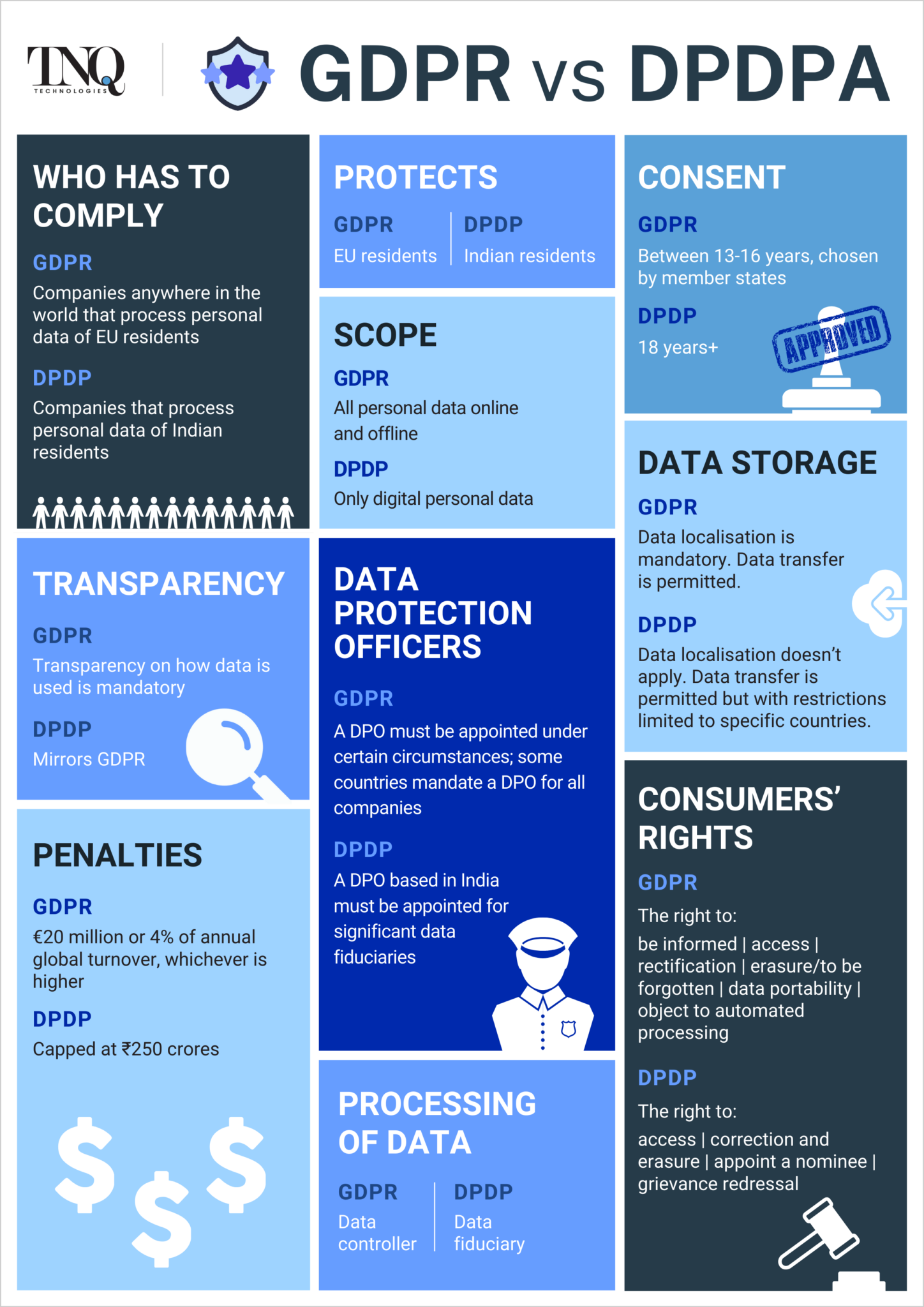
This "long-arm" provision is similar to the one in the EU's GDPR and reflects India's intent to protect its citizens' data regardless of where it is processed. However, unlike GDPR, the DPDP Act does not explicitly mention "profiling" or "monitoring of behavior" as a trigger for extraterritoriality, unless it is done in connection with offering goods or services.
Exclusions
The Act does not apply in two main situations:
- Personal or Domestic Purpose: If an individual processes personal data for their own personal use (e.g., keeping a digital address book of friends for a party).
- Publicly Available Data: If the personal data is made publicly available by the individual themselves (e.g., on their public blog or social media profile) or by another person who is under a legal obligation to make that data public.
3. Key Definitions: The Building Blocks of the Act
To interpret any law, you must first understand its language. Section 2 of the DPDP Act provides the official definitions for its key terms. These are the nouns, verbs, and actors in the data protection ecosystem. For this part, it's best to go directly to the source.
THE DIGITAL PERSONAL DATA PROTECTION ACT, 2023 ...
We will now examine the official definitions from the Act itself. This is the primary source text and provides the precise legal meaning of the core concepts we will be using throughout the course.
Please read Section 2, 'Definitions,' from the official gazette notification of the Act. Focus on the definitions for the following key terms: (h) data (t) personal data (n) digital personal data (j) Data Principal (i) Data Fiduciary (k) Data Processor (x) processing Take a moment to absorb the breadth and simplicity of these definitions.
Let's consolidate and clarify the most critical definitions you just read.
The "What": Data and its Forms
- Personal Data: This is the cornerstone. It means "any data about an individual who is identifiable by or in relation to such data." This is a broad, principles-based definition. It can include anything from a name or phone number to an IP address, location data, or online behavioral data, as long as it can be linked to a person.
- Key Distinction from GDPR: Unlike the EU's GDPR, the DPDP Act does not create special categories for "sensitive personal data" (like health, biometrics, or political opinions) that require stricter protections. It treats all personal data under a single, uniform framework.
- Digital Personal Data: This simply means personal data in a digital form.
The "Who": The Main Actors
- Data Principal: The individual to whom the personal data relates. In simple terms, this is you and me. The Act grants rights to Data Principals.
- Data Fiduciary: Any person (an individual, company, government entity, etc.) who, alone or with others, determines the purpose and means of processing personal data. This is the entity in control, often called the "data controller" in other jurisdictions like the GDPR. They are the primary party responsible for compliance.
- Data Processor: Any person who processes personal data on behalf of a Data Fiduciary. A processor acts on the instructions of the fiduciary. A classic example is a cloud provider (like AWS) that stores data for a client, or a payroll company that processes employee data for another firm. Your experience with CRM vendors and chatbot implementers often involves them acting as Data Processors for the healthcare clinics (the Data Fiduciaries).
The "How": The Action of Processing
- Processing: The definition is extremely broad and technology-neutral. It is a "wholly or partly automated operation or set of operations performed on digital personal data." It includes a long list of activities such as collection, recording, organisation, structuring, storage, adaptation, retrieval, use, sharing, disclosure, erasure, or destruction. Essentially, almost anything you can do with data counts as processing.
Test your understanding!
An AI-powered ed-tech platform, "LearnFast," is based in the United States. It offers personalized learning courses to students globally. It has a significant user base in India, where students sign up using their names, email addresses, and phone numbers. The platform tracks their learning progress and quiz scores to recommend new courses. "LearnFast" uses a third-party cloud provider headquartered in Ireland to store all this user data.
- Does the DPDP Act, 2023 apply to "LearnFast"? Why or why not?
- In this scenario, who is the Data Principal, who is the Data Fiduciary, and who is the Data Processor?
- List three examples of "personal data" being processed in this scenario.
Show answer
- Yes, the DPDP Act applies to "LearnFast." Even though the company is in the US, it falls under the Act's extraterritorial scope (Section 3(b)) because it is processing the personal data of Indian students in connection with "offering goods or services to Data Principals within the territory of India."
-
- Data Principal: The Indian students whose data is being collected and used.
- Data Fiduciary: "LearnFast," the US-based ed-tech platform, because it determines the purpose (personalized learning) and means (using its AI platform) of processing the students' data.
- Data Processor: The third-party cloud provider in Ireland, as it is processing the data (by storing it) on behalf of the Data Fiduciary ("LearnFast").
- Examples of personal data include:
- The students' names, email addresses, and phone numbers.
- The students' learning progress and quiz scores, as this is data about an identifiable individual.
- Technical data like the students' IP addresses or device identifiers, which can also be used to identify them.
Conclusion
In this lesson, we have laid the essential groundwork for understanding India's data protection landscape. We have established that the DPDP Act is a rights-based law born from a constitutional mandate, designed to balance individual privacy with the need for lawful data processing.
Key Takeaways:
- Purpose: The DPDP Act aims to operationalize the fundamental right to privacy by regulating the processing of digital personal data, balancing individual rights and lawful business needs.
- Scope: The Act has a broad reach. It applies to data processed within India (if digital or digitized) and, crucially, to foreign entities that offer goods or services to individuals in India.
- Core Definitions: The Act is built on a few key concepts:
- Personal Data: Broadly defined as any data related to an identifiable individual.
- Actors: The Data Principal (the individual), the Data Fiduciary (the one in charge), and the Data Processor (the one acting on behalf).
- Processing: A catch-all term for nearly any operation performed on data.
These concepts are the vocabulary we will use for the rest of this module and beyond. Without a firm grasp of them, analyzing the legal implications of any data-driven AI system is impossible.
Preview of the Next Lesson:
Now that we have defined the key terms and actors, our next lesson will address the logical follow-up question: What are the fundamental rules that Data Fiduciaries must follow when they process personal data? We will explore the core data protection principles that form the heart of the Act's obligations, such as purpose limitation, data minimization, and accuracy.