Introduction
Welcome back. In our last lesson, we explored the seven foundational principles of the DPDP Act—such as purpose limitation, data minimization, and accuracy—which act as the guiding rules for all data processing activities. These principles establish the duties that organizations, or 'Data Fiduciaries', must uphold.
Today, we will examine the other side of this coin. For every obligation imposed on a Data Fiduciary, a corresponding right is vested in the individual, or 'Data Principal'. This lesson is dedicated to fulfilling the learning outcome: Detail the rights of Data Principals and the corresponding obligations of Data Fiduciaries. We will dissect this symbiotic relationship, which forms the operational core of the DPDP Act and is crucial for anyone involved in building, deploying, or governing AI systems.
The Central Relationship: Data Principal and Data Fiduciary
The entire DPDP Act revolves around the relationship between two key actors:
- Data Principal: The individual to whom the personal data relates. In simple terms, this is you and me.
- Data Fiduciary: The entity (e.g., a company, government agency, or non-profit) that, alone or with others, determines the purpose and means of processing personal data. This is the entity in control and, therefore, the one held accountable.
To refresh these key definitions, let's watch a brief segment from a legal analysis of the Act.
Digital Personal Data Protection Act,2023 A Tectonic Shift in the Data Protection Landscape in India
The following clip from a Khaitan & Co webinar provides precise legal definitions of the key actors under the DPDP Act, including the Data Principal, Data Fiduciary, and Data Processor.
Please watch from 07:35 to 10:44. Pay close attention to how the 'Data Fiduciary' is defined as the one determining the 'purpose and means' of processing, which establishes their central responsibility.
This structure is common in global data protection law. The EU's GDPR, for example, uses the terms 'Data Subject' (equivalent to Data Principal) and 'Data Controller' (equivalent to Data Fiduciary). Understanding this parallel will be helpful as we explore comparative regulations later in the course.
The Rights of the Data Principal
The DPDP Act empowers individuals by granting them a set of specific, enforceable rights over their personal data. Let's explore the most significant ones. The KPMG report, "Decoding the Digital Personal Data Protection Act, 2023," provides an excellent summary of these rights.
Decoding the Digital Personal Data Protection Act, 2023
This document from KPMG clearly lays out the rights granted to Data Principals. We will use it as a framework for our discussion.
Review the infographic on page 1, which provides a visual summary of the rights of Data Principals. We will refer back to these throughout this section.
Now, let's break down each key right:
1. Right to Access Information
Data Principals have the right to obtain a summary of their personal data being processed, understand the processing activities, and know the identities of all other Fiduciaries or Processors with whom their data has been shared.
- Implication for AI: If an AI model has been trained on your data or is making predictions about you, you have the right to request information about what data is being used and for what purpose. This underpins the principle of transparency we discussed previously.
2. Right to Correction and Erasure
This is a two-fold right:
-
Correction: You can request the Fiduciary to correct inaccurate or misleading data, complete incomplete data, and update outdated data. This is the enforcement mechanism for the 'Accuracy' principle.
-
Erasure (or "Right to be Forgotten"): You can request the deletion of your personal data once the original purpose of collection is fulfilled or after you withdraw consent. This enforces the 'Storage Limitation' principle.
-
Implication for AI: This poses a significant technical challenge for AI. How does a company 'erase' a user's data once it has been integrated into a complex, trained neural network? The law demands a solution, forcing developers to design models and data pipelines that can verifiably honor erasure requests.
3. Right to Withdraw Consent
A Data Principal can withdraw their consent at any time. The process for withdrawal must be as easy as the process for giving consent. Once consent is withdrawn, the Fiduciary must cease processing the data.
- Implication for AI: If a user initially consented to their data being used to personalize an AI service but later withdraws that consent, the Fiduciary must stop using their data for that purpose. This prevents indefinite data use and reinforces user autonomy.
4. Right to Grievance Redressal
Before approaching the Data Protection Board, a Data Principal must first seek redressal from the Data Fiduciary. This means every Fiduciary must establish an effective and accessible mechanism for handling complaints and queries from users.
5. Right to Nominate
Unique to the DPDP Act, this right allows an individual to nominate another person to exercise their rights on their behalf in the event of their death or incapacity.
- Implication for AI: This right acknowledges that a person's digital footprint and the data associated with it have value and relevance even after they are gone. It creates a legal mechanism for managing a person's digital legacy.
The Obligations of the Data Fiduciary
The rights of the Data Principal are mirrored by the obligations of the Data Fiduciary. To fulfill your rights, the company must perform specific duties. The following image provides a clear visual overview of these obligations.
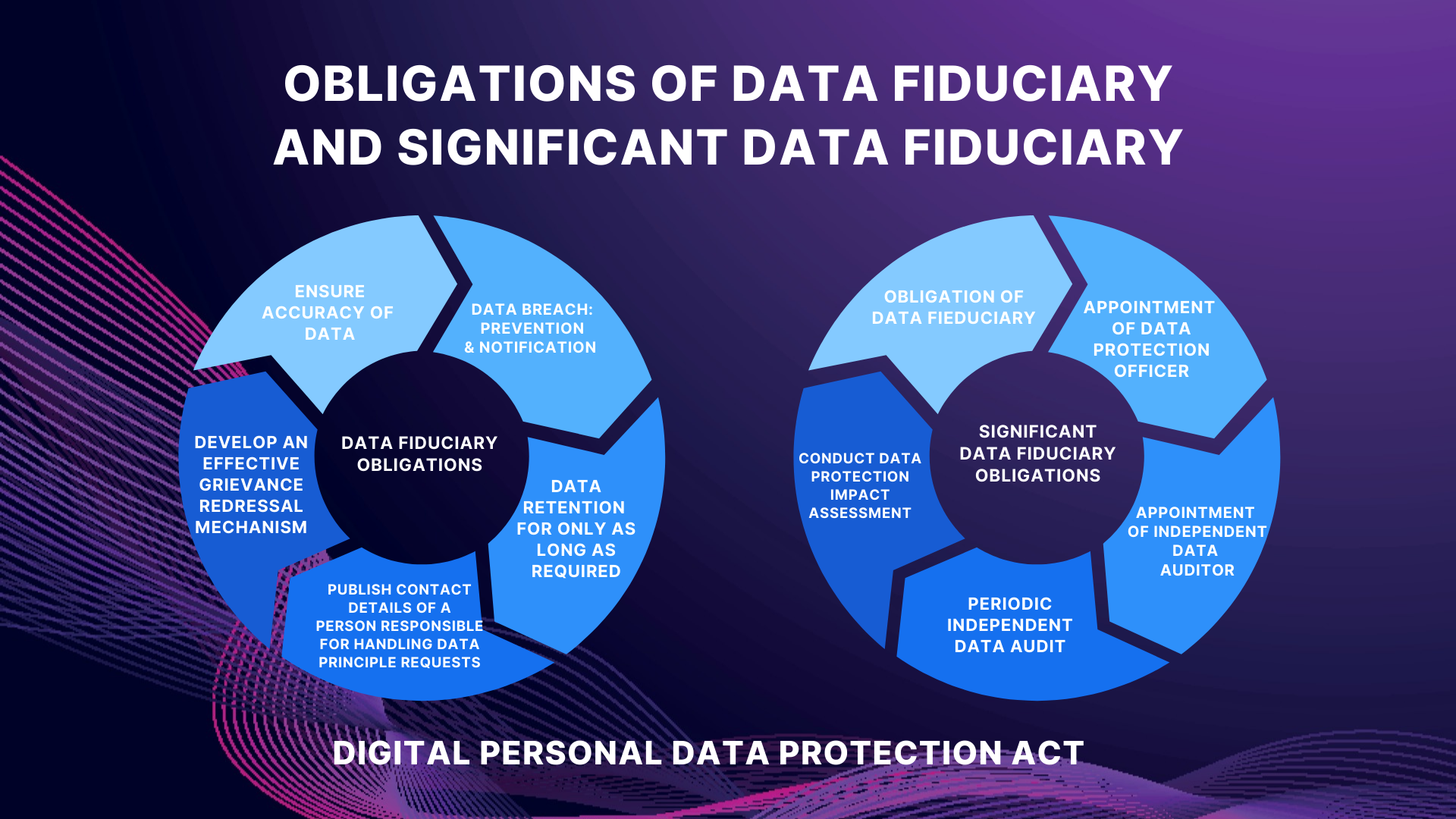
To understand these obligations in detail, we'll return to the Khaitan & Co analysis.
Digital Personal Data Protection Act,2023 A Tectonic Shift in the Data Protection Landscape in India
This segment provides a comprehensive walkthrough of the general obligations imposed on all Data Fiduciaries. It covers everything from overall accountability to specific duties like data erasure and breach notification.
Watch the segment from 27:35 to 34:55. As you watch, note how each obligation directly corresponds to either a core principle (from the last lesson) or a Data Principal's right (from this lesson).
Let's summarize the key obligations discussed in the video:
- Accountability: The Fiduciary is ultimately responsible for compliance, even if it uses a Data Processor (e.g., a cloud provider or a third-party AI service). This is managed through robust contracts. Your experience coordinating with CRM vendors for healthcare clinics directly reflects this; the clinic (Fiduciary) is accountable for what the vendor (Processor) does with its patient data.
- Ensure Data Accuracy: The Fiduciary must take steps to ensure data is accurate and complete, especially when making decisions that impact the individual. This is the operational side of the Principal's Right to Correction.
- Implement Security Safeguards: The Fiduciary must protect data from breaches. Failure to do so carries heavy penalties.
- Provide Notice: As we saw in the previous lesson, a clear notice must be provided before or at the time of collecting data, explaining the 'what' and 'why' of the data collection.
- Erase Data: The Fiduciary must delete data when the purpose is complete or consent is withdrawn. This obligation extends to ensuring their Data Processors also delete the data.
- Notify Breaches: In case of a data breach, the Fiduciary must notify both the Data Protection Board and the affected individuals. The Act is strict, with no threshold for reporting, meaning even minor breaches may require notification.
- Establish Grievance Redressal: The Fiduciary must create an effective system for users to lodge complaints and exercise their rights.
Test your understanding!
A user signs up for an AI-powered financial planning service. A year later, they find a new job with a higher salary. They access their profile on the service and notice their income details are outdated.
- What right can the user exercise?
- What is the corresponding obligation of the financial planning company (the Data Fiduciary)?
- The user then decides to close their account. What additional right can they exercise regarding their personal data, and what must the company do?
Show answer
- The user can exercise their Right to Correction to update their outdated income details.
- The company has an obligation to facilitate this request and ensure the accuracy of the personal data it holds, especially since this data is likely used to make decisions (i.e., provide financial advice) that affect the user.
- Upon closing their account, the user can exercise their Right to Erasure. The company is then obligated to erase the user's personal data from its systems and ensure any Data Processors it used also delete the data, as the original purpose for processing (providing the service) is no longer valid.
Heightened Obligations: Children and SDFs
The DPDP Act recognizes that not all data processing carries the same level of risk. Therefore, it imposes stricter rules in two key situations:
1. Processing Children's Data:
For Data Principals under 18, the Act requires the Fiduciary to obtain verifiable parental consent. Furthermore, it prohibits processing that is "detrimental to the well-being of a child" and bans tracking, behavioral monitoring, or targeted advertising directed at children.
2. Significant Data Fiduciaries (SDFs):
The government can designate certain Fiduciaries as "Significant" based on factors like the volume and sensitivity of data they process and the potential risks to individuals or national security. SDFs have additional obligations, as shown in the image above. These include:
- Appointing a Data Protection Officer (DPO) based in India.
- Appointing an independent data auditor to conduct regular audits.
- Conducting periodic Data Protection Impact Assessments (DPIAs) to proactively identify and mitigate risks.
This tiered approach ensures that entities with the greatest potential to cause harm, like large tech platforms or organizations handling sensitive health data, are subject to the highest level of scrutiny.
Conclusion
In this lesson, we mapped the core relationship in India's data protection landscape: the rights granted to Data Principals and the corresponding obligations placed upon Data Fiduciaries. This is not just a legal abstraction; it is the practical framework for ensuring individual autonomy in an age of data-driven technology.
Key Takeaways:
- A Symbiotic Relationship: The DPDP Act is built on a balance. The rights of individuals (to access, correct, erase, withdraw consent, etc.) are realized through the duties of organizations.
- Empowerment through Rights: The Act empowers Data Principals with actionable rights, shifting them from passive data sources to active participants in the digital ecosystem.
- Accountability through Obligations: Data Fiduciaries are held accountable for upholding these rights. Their obligations include ensuring data accuracy, providing security, notifying breaches, and facilitating erasure, with ultimate responsibility resting on them even when using third-party processors.
- Risk-Based Regulation: The Act applies stricter rules for higher-risk scenarios, imposing additional obligations for processing children's data and for entities designated as Significant Data Fiduciaries.
Preview of the Next Lesson:
Now that we have a firm grasp of the principles, rights, and obligations, our next step is to put it all together. In the next lesson, we will move from theory to practice and apply the DPDP Act's requirements to specific AI data collection, training, and deployment scenarios. We will analyze how these rules impact real-world AI use cases in areas like healthcare, finance, and e-commerce.