Introduction
Welcome to your third lesson. In our previous discussion, we distinguished between the three major approaches to AI: rule-based systems, machine learning, and deep learning. We highlighted the critical trade-off between the performance of modern systems and their interpretability, a central challenge for AI governance.
This lesson builds directly on that foundation by diving deep into the most prevalent form of machine learning. We will address the learning outcome: Describe the process of supervised learning, including the role of labeled data, model training, and evaluation.
For anyone aspiring to work in AI law and governance, understanding this process is non-negotiable. The choices made at each step—from how the initial data is collected and labeled to how the final model's performance is measured—have profound legal and ethical implications. Questions of data privacy, algorithmic bias, and accountability for AI-driven decisions all originate in the mechanics of the supervised learning workflow. Your background in data analytics and Python will be a significant asset in grasping the technical details we'll cover.
1. The Core Idea: Learning with an Answer Key
Supervised learning is a machine learning paradigm where the algorithm learns from data that has been manually labeled with the correct output. Think of it as a student studying for an exam using practice questions that come with a complete answer key. By comparing its answers to the correct ones, the student learns the underlying patterns and can eventually answer new questions without the key.
All Machine Learning Concepts Explained in 22 Minutes
To start, let's get a formal definition. This video, 'All Machine Learning Concepts Explained,' offers a concise introduction to the concept of supervised learning and the pivotal role of labeled data.
Please watch the following two clips: 00:34 - 01:31: This provides a general introduction to machine learning as a process of pattern recognition from data. 04:54 - 05:25: This clip specifically defines supervised learning and the concept of learning from labeled examples.
The Role of Labeled Data
As the video highlighted, the "supervision" in supervised learning comes from the labeled dataset. This dataset consists of input data paired with the correct output label.
- Input Data (Features): The set of variables or attributes used to make a prediction. For a loan application, this might include income, credit score, and age.
- Output Data (Label/Target): The "correct answer" that the model is trying to learn to predict. For the loan application, this would be a label like
DefaultorNo Default.
Your work with CRM systems and KPI tracking is a practical example of this. A CRM record contains features (customer interaction history, purchase frequency, company size), and you might create a label (e.g., High-Value Client, At-Risk of Churn) that an AI could learn to predict.
Two Primary Tasks: Classification and Regression
Supervised learning problems are typically broken down into two categories:
- Classification: The goal is to predict a discrete category or class. The output is a label.
- Legal Example: Classifying a legal document as a
Contract,Pleading, orMotion. - Business Example: Determining if an email is
SpamorNot Spam.
- Legal Example: Classifying a legal document as a
- Regression: The goal is to predict a continuous numerical value. The output is a number.
- Legal Example: Predicting the likely monetary award in a personal injury case based on precedent.
- Business Example: Forecasting a company's quarterly revenue based on sales data.
Supervised Learning A Clear, Practical Guide (2025)
The article 'Supervised Learning: A Clear, Practical Guide' provides excellent, simple definitions for classification and regression with clear examples.
Read the first section, 'What is supervised learning?', to solidify your understanding of these two fundamental task types.
2. The End-to-End Supervised Learning Workflow
Building a supervised learning model is a structured, multi-step process. Understanding this workflow is essential for auditing an AI system or assessing its legal risks.

Let's break down these stages.
Stage 1: Data Preparation and Splitting
Before training can begin, the dataset must be prepared. This involves cleaning the data (e.g., handling missing values) and, most importantly, splitting it into distinct sets.
The most common split is into a training set and a test set.
- Training Set: The majority of the data (e.g., 80%), used by the model to learn the patterns between the input features and the output labels.
- Test Set: A smaller portion of the data (e.g., 20%) that is held back and kept completely separate. The model never sees this data during training. It is used only at the very end to evaluate the model's performance on new, unseen data.
This separation is fundamental to honest evaluation. Training and testing on the same data is like giving a student an exam with the exact same questions they used to study—it only proves they can memorize, not that they have truly learned.
How to train AI ML models? Full pipeline in 15 mins.
The video 'How to train AI ML models?' provides an excellent, practical overview of the data splitting process, including common pitfalls that can have serious consequences for model reliability.
Watch the segment from 06:19 to 08:53. Pay close attention to the concepts of: Train/test split ratios (e.g., 80/20). The problem of imbalanced splits and the solution of 'stratified splitting'. The idea that a single random split might be misleading, highlighting the need for robust evaluation.
Often, a third set called a validation set is also created from the training data. This is used to fine-tune the model's settings (called hyperparameters) during the development process before the final evaluation on the test set.
Stage 2: Model Training (Fitting)
This is the "learning" phase. The model, which is essentially a complex mathematical function, iteratively adjusts its internal parameters to find the mapping between the input features and the output labels in the training set. The goal is to minimize the difference between the model's predictions and the actual labels. This process is also known as "fitting" the model to the data.
All Machine Learning Concepts Explained in 22 Minutes
Let's return to 'All Machine Learning Concepts Explained' for a simple definition of model fitting.
Watch the short clip from 03:24 to 03:43. It uses the analogy of finding the best-fit line in linear regression, which is a perfect mental model for the training process.
A Deeper Look: The Mathematics of Training
Given your interest in the technical details, we can frame "training" more formally. The process of minimizing the difference between predictions and actual labels is known as Empirical Risk Minimization.
- A Loss Function measures the "cost" or "error" of a single incorrect prediction.
- The Risk is the average loss over the entire dataset.
- Training is the optimization process of finding the model parameters that minimize this risk on the training data.
This process is what allows the model to "learn" the patterns from the data.
The Wikipedia article on Supervised Learning offers a more formal, mathematical explanation of this process. This will give you the academic rigor you're looking for.
Read the section 'How supervised learning algorithms work' and the subsection 'Empirical risk minimization'. You don't need to memorize the formulas, but focus on understanding the concepts of a hypothesis space, a loss function, and the goal of finding the function g that minimizes risk (error) on the training data.
Stage 3: Model Evaluation
Once the model is trained, we must rigorously evaluate its performance on the unseen test set. This tells us how well the model is likely to perform in the real world.
A key part of evaluation is checking for overfitting and underfitting.
- Underfitting: The model is too simple and fails to capture the underlying patterns in the data. It performs poorly on both the training and test sets.
- Overfitting: The model is too complex and has essentially "memorized" the training data, including its noise. It performs exceptionally well on the training data but poorly on the test data because it cannot generalize to new examples.
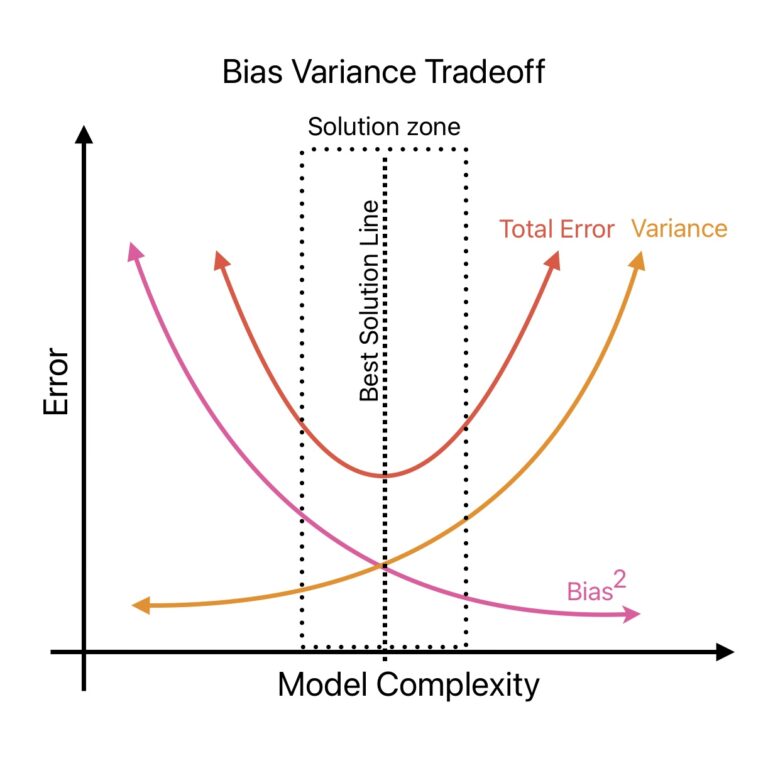
This relates to a core concept in machine learning: the Bias-Variance Tradeoff.
- Bias: The error from erroneous assumptions in the learning algorithm. High bias can cause a model to miss relevant relations between features and target outputs (underfitting).
- Variance: The error from sensitivity to small fluctuations in the training set. High variance can cause a model to model the random noise in the training data (overfitting).
The goal is to find a balance—a model that is complex enough to capture the true patterns but not so complex that it models the noise.
Choosing the Right Metrics
Evaluation isn't just one number; we use different metrics depending on the task.
- For Classification:
- Accuracy: The percentage of correct predictions. Can be misleading for imbalanced datasets (e.g., if 99% of transactions are not fraud, a model that always predicts "not fraud" has 99% accuracy but is useless).
- Precision: Of all the positive predictions, how many were actually correct? (Minimizes false positives).
- Recall (Sensitivity): Of all the actual positive cases, how many did the model identify? (Minimizes false negatives).
- F1-Score: A harmonic mean of Precision and Recall, providing a single score that balances both.
- For Regression:
- Mean Absolute Error (MAE): The average absolute difference between predicted and actual values.
- Root Mean Squared Error (RMSE): Similar to MAE but penalizes larger errors more heavily.
Supervised Learning A Clear, Practical Guide (2025)
The 'Supervised Learning: A Clear, Practical Guide' article provides an excellent summary of these crucial evaluation metrics.
Read the section titled 'Evaluation metrics'. Focus on understanding when you would use each metric. For example, why is accuracy sometimes a poor choice?
3. Practical Application: A Code Walkthrough
To synthesize these concepts, let's walk through a practical example. The following project from the guide you've been reading builds an email spam classifier. Since you have experience with Python, seeing the code will connect the theoretical steps to their practical implementation.
Supervised Learning A Clear, Practical Guide (2025)
This mini-project demonstrates the entire supervised learning workflow for a classification problem using Python.
Read through the 'Mini-Project 1: Email spam classifier' section. As you review the code, connect each block to the workflow stages we've discussed: Load the Dataset: This is the initial labeled data (each message is labeled 'spam' or 'ham'). Clean and Prepare: Note the train_test_split function. This is the crucial data splitting step. Build and Train: The model.fit(X_train, y_train) line is where the model training or fitting happens. Evaluate the Results: The classification_report and confusion_matrix functions perform the evaluation on the test set (y_test, y_pred).
This walkthrough makes the abstract process tangible. You can see how a few lines of code can execute the entire workflow of splitting data, training a model, and evaluating its ability to generalize.
Test your understanding!
Imagine you are advising a fintech company that has developed an AI model to predict which loan applications are fraudulent. The development team proudly reports that after training their model on their entire historical dataset of 100,000 applications, it achieved 99.5% accuracy in identifying fraud.
From an AI governance and risk perspective, what are two major red flags in their reported process, and what legal or business risks do they create?
Show answer
-
Red Flag 1: Training and Testing on the Entire Dataset. The team did not use a separate, unseen test set. By evaluating the model on the same data it was trained on, they are only measuring its ability to memorize, not its ability to generalize to new, future loan applications.
- Risk: This creates a significant business and legal risk. The model is likely overfit. Its real-world performance will almost certainly be much lower than 99.5%. This could lead to massive financial losses if the model fails to detect actual fraud in production. From a legal standpoint, if the company sold this model or made regulatory claims based on the 99.5% figure, it could be accused of misrepresentation or failing to conduct proper due diligence.
-
Red Flag 2: Relying Solely on Accuracy. Fraud detection is a classic imbalanced dataset problem; the vast majority of applications are not fraudulent. If only 0.5% of applications are fraudulent, a model that simply predicts "not fraudulent" for every application would still be 99.5% accurate but would be completely useless.
- Risk: The 99.5% accuracy figure is dangerously misleading. The company has no real idea how well the model actually catches fraud. They should be using metrics like Precision (to ensure the applications it flags are truly fraudulent, avoiding insulting good customers) and Recall (to ensure it is catching a high percentage of all actual fraud cases). Relying on this vanity metric could lead to regulatory scrutiny and demonstrates a lack of technical competence.
Conclusion
In this lesson, we have unpacked the complete process of supervised learning. You now have a framework for analyzing how a vast number of today's AI systems are built and validated.
Key Takeaways:
- Supervised learning uses labeled data to train a model to map inputs to outputs.
- The process follows a clear workflow: Data Preparation (including the crucial train-test split), Model Training (minimizing error on the training set), and Model Evaluation (assessing performance on the unseen test set).
- Evaluation is critical to ensure a model can generalize and to avoid overfitting.
- The choice of evaluation metrics (e.g., accuracy vs. F1-score) must be appropriate for the specific problem to avoid a misleading assessment of performance.
Preview of the Next Lesson:
We have now covered the different types of AI (rule-based, ML, DL) and the process for the most common paradigm (supervised learning). We are now ready to move into Module 2: The Mechanics of Modern AI. In the next lesson, we will open the "black box" and look at the fundamental building block of most modern AI systems: the artificial neural network. You will learn about its architecture, including neurons, layers, weights, and activation functions, setting the stage for understanding deep learning.