Introduction
Welcome to a new module focusing on a foundational piece of India's digital legislation: the Information Technology Act, 2000. In our previous module, we concluded by examining the enforcement machinery of the very modern Digital Personal Data Protection (DPDP) Act, 2023. We now shift our focus to an earlier, yet equally critical, law that provides the legal bedrock for all digital activities in India.
In this lesson, we will analyze the legal status of AI-generated outputs as 'electronic records' under the IT Act, 2000. This might seem like a simple definitional exercise, but its consequences are profound. For any output from an AI system—be it a contract draft from an LLM, a diagnostic image analysis, or a log from an autonomous vehicle—to have any legal weight, it must first be recognized by the law. This lesson explores that initial, crucial step of recognition and the evidentiary pathway that follows, a topic of immense importance for your future legal practice in AI governance.
1. The IT Act and the Concept of an "Electronic Record"
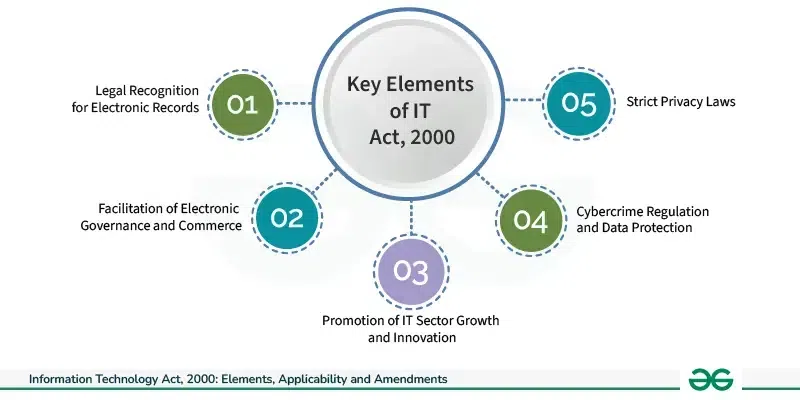
The Information Technology Act, 2000 was enacted to provide legal recognition for transactions carried out by means of electronic data interchange and other means of electronic communication. It was designed to be a technology-neutral framework.
One of its most fundamental objectives is to grant legal validity to electronic documents, placing them on par with their paper counterparts.
The key to this recognition lies in the Act's definition of an "electronic record." To understand how this definition applies to AI, let's look at a detailed analysis from a recent academic paper.
Deepfakes, AI, and Cloud Forensics
The following resource, "Deepfakes, AI, and Cloud Forensics," directly addresses how the IT Act's definitions apply to modern technologies. It provides a precise reference for the term 'electronic record'.
Please read the second paragraph of the section titled 'II. LEGAL FRAMEWORK FOR ADMISSIBILITY OF SECONDARY ELECTRONIC EVIDENCE IN INDIA'. Focus on the explanation of Section 2(1)(t) of the IT Act and its broad scope.
As the paper highlights, Section 2(1)(t) of the IT Act, 2000 defines an "electronic record" as:
"data, record or data generated, image or sound stored, received or sent in an electronic form or micro film or computer-generated micro fiche."
This definition is deliberately broad and technology-agnostic. It focuses on the form of the information (electronic) rather than its origin or content. This is why it seamlessly covers outputs from modern AI systems, which were not contemplated when the law was written.
Consider these examples:
- A piece of text generated by an LLM like ChatGPT.
- An image created by a diffusion model like Midjourney.
- A credit risk score calculated by a machine learning algorithm.
- The log files from a chatbot's conversation with a customer.
- A medical diagnosis suggested by a computer vision model analyzing an X-ray.
All of these are "data generated... in an electronic form" and therefore qualify as electronic records under the IT Act.
2. From Legal Recognition to Evidentiary Admissibility
Establishing that an AI output is an "electronic record" is the first step. The critical next question for a lawyer is: How can I prove this record in court?
Legal recognition under the IT Act opens the door for an electronic record to be used as evidence, but it doesn't automatically make it admissible. The rules for admissibility are found in India's law of evidence.
Historically, this was the Indian Evidence Act, 1872. In 2023, this was replaced by the Bharatiya Sakshya Adhiniyam, 2023 (BSA). For your legal studies, it is crucial to know that the core principles governing electronic evidence from the old act have been retained in the new one.
The following resource explains how the legal framework creates a bridge between the IT Act's definition and the evidentiary rules for AI-generated artifacts.
Legal Personality of Artificial Intelligence: Rights, Liabilities ...
The paper "Legal Personality of Artificial Intelligence" explains how Indian evidentiary law has adapted to digitality, treating AI outputs as potential evidence.
Read the second paragraph of the introduction, starting with 'The definitional catalogue...'. Focus on how the Bharatiya Sakshya Adhiniyam (BSA) recognizes electronic records as admissible evidence and cross-references the IT Act, 2000, creating a 'stable approach to treat AI-generated logs, prompts, and outputs as evidentiary artifacts'.
As the paper clarifies, the law of evidence essentially states that an electronic record can be treated as a document for evidentiary purposes, but only if it meets a specific set of procedural requirements designed to ensure its authenticity and integrity. This is where we encounter the famous—and often litigated—Section 65B of the Indian Evidence Act, 1872, whose principles are now enshrined in Section 63 of the BSA, 2023.
3. The Procedural Gauntlet: Admissibility of Electronic Records
To be admitted as evidence, an electronic record must pass a stringent test. This procedure ensures that the record is a reliable and unaltered copy of the original. Given your legal aspirations, a deep understanding of this procedure is non-negotiable.
The following video provides a detailed lecture on the historical bedrock of this rule, Section 65B of the Indian Evidence Act. The principles discussed are directly applicable to the new Section 63 of the BSA.
Admissibility of Electronic Records Under Section 65 B of the Indian Evidence Act 1872
This lecture by Lex Discourse provides a lawyer's perspective on the admissibility of electronic records. We will focus on the foundational definitions and the core conditions for admissibility.
Please watch two key segments from the video: 20:05 to 27:11: This part explains how the IT Act expanded the traditional definition of a 'document' to include 'electronic record' and 'computer output'. This is the legal foundation. 29:35 to 37:31: This crucial section explains the conditions under Section 65B that make an electronic record admissible as primary evidence, distinguishing it from traditional documents. Focus on understanding the concept of a 'computer output' and the special procedure required for it.
Let's summarize the core requirements for an electronic record (a "computer output") to be admissible, based on the principles discussed in the video:
- It must be treated as a document: The law deems the computer output (e.g., a printout) to be a document.
- It must satisfy specific conditions: The output is admissible as evidence of the original information without further proof or production of the original, if four conditions are met. These conditions, originally in Section 65B(2), are designed to ensure the reliability of the computer system that produced the record. They relate to:
- The regular use of the computer.
- The regular feeding of information into the computer.
- The proper operation of the computer.
- The output being a reproduction of the original information stored in the computer.
- It must be accompanied by a certificate: A certificate must be provided that identifies the electronic record, describes how it was produced, and confirms that the above conditions are satisfied. This certificate must be signed by a person occupying a responsible official position in relation to the operation of the device.
This certificate is the key that unlocks the door to admissibility for most electronic evidence.
4. AI and the Challenge to Evidentiary Law
The framework we've just discussed was designed for records produced by conventional computers. But what happens when the "computer" is a vast, distributed, and constantly learning neural network? AI-generated outputs, while falling under the definition of "electronic record," pose unique challenges to these evidentiary rules.
Deepfakes, AI, and Cloud Forensics
The paper on Deepfakes and AI Forensics delves into these modern challenges, highlighting the gaps in the current legal framework.
Read the subsections '2.3 Key Issues' and '3.3 AI-Generated Evidence'. Pay attention to the problems identified: The 'statutory silence' on deepfakes and AI outputs. The practical challenges of certification for cloud-based or decentralized systems. The 'liar's dividend' phenomenon.
The challenges raised in the paper are at the cutting edge of AI law:
- Authenticity and the "Liar's Dividend": With generative AI, it's possible to create highly realistic fake content (deepfakes). Conversely, a party could try to discredit genuine evidence by claiming it's an AI-generated fake. Proving the provenance of a digital artifact becomes incredibly complex.
- The Certification Problem: Who is the "responsible official" who can issue a certificate for an output from a model like GPT-4? Is it the end-user who wrote the prompt? A data-center manager at Microsoft Azure? An engineer at OpenAI? The law's requirement for a knowledgeable person to certify the proper functioning of the "computer" is difficult to apply to large, opaque, third-party AI models.
- Opacity of the "Computer": The conditions for admissibility require assurance that the computer was operating properly. With complex neural networks, especially those exhibiting "emergent" behaviors, demonstrating proper operation is not straightforward.
These are not settled issues; they are active areas of legal debate and will likely be the subject of significant litigation in the coming years.
Test your understanding!
A construction company uses an AI-powered project management tool hosted on a foreign cloud server to generate daily progress reports, including timelines and budget forecasts. A dispute arises with a client who claims the project is delayed. The company wants to submit an AI-generated report from six months ago as evidence to prove they were on schedule at that time.
What are the two main legal and practical hurdles the company's lawyer must overcome to get this report admitted as evidence in an Indian court?
Show answer
The two main hurdles are:
-
Satisfying the Conditions of Admissibility: The lawyer must prove that the report is an "electronic record" under the IT Act, 2000. More importantly, they must satisfy the stringent admissibility requirements of Section 63 of the BSA (mirroring the old Section 65B of the Evidence Act).
-
Obtaining the Certificate: This is the major practical hurdle. The "computer" that generated the report is the AI model running on a foreign cloud server. The company's lawyer would need to obtain a certificate from a "responsible official" at the foreign cloud/AI provider. This person would have to certify the identity of the record and the proper functioning of the complex AI system at the time the report was generated six months ago. Getting a foreign entity to cooperate and provide such a legally compliant certificate for a specific past output is often extremely difficult, if not impossible. This is a classic example of the certification challenge for cloud-based evidence.
Conclusion
In this lesson, we established the foundational legal status of AI-generated content within the Indian legal system. You have seen how a law from the year 2000 provides the initial hook for recognizing these modern creations and how the law of evidence provides a strict, procedural pathway for their use in legal proceedings.
Key Takeaways:
- Legal Status: AI-generated outputs are classified as "electronic records" under the broad, technology-neutral definition in Section 2(1)(t) of the IT Act, 2000.
- Evidentiary Bridge: This classification allows them to be treated as documentary evidence, but their admissibility in court is governed by the Indian law of evidence (now the BSA, 2023).
- Admissibility Requirements: For an electronic record to be admissible, it generally must be accompanied by a certificate confirming the integrity and proper functioning of the computer system that produced it (the framework of the old Section 65B, now Section 63 of the BSA).
- Modern Challenges: Generative AI and cloud-based systems pose significant challenges to this framework, particularly regarding authentication (proving it's not a fake) and the practical difficulty of obtaining the required certificate from third-party or foreign entities.
Preview of the Next Lesson:
Now that we have established that an AI's output is an electronic record, the next question is: who is legally responsible for it? In the next lesson, we will apply the attribution and acknowledgment provisions of the IT Act to AI-driven communications, exploring how the law determines the originator of an electronic message when that "originator" might be an autonomous system.