Introduction
Welcome back. In our last session, we explored how AI can act as a "fourth party" in Alternative and Online Dispute Resolution (ADR/ODR), a largely voluntary setting where technology facilitates negotiated settlements. We concluded that AI's role is primarily to augment, not replace, human decision-makers.
Today, we shift our focus from the voluntary and private sphere of ADR to the compulsory and public domain of the state justice system. This lesson addresses the learning outcome: Define 'predictive justice' and explain how AI models are used in judicial and policing contexts. Here, the stakes are significantly higher, as AI is not merely suggesting settlements but is used to inform decisions about liberty, surveillance, and resource allocation by police and courts. Your background in implementing workflow automation and data analytics will provide a strong foundation for understanding how these complex data-driven systems are designed and deployed within the rigid structures of the legal system.
1. Defining Predictive Justice: A Spectrum of Applications
At its core, "predictive justice" refers to the use of artificial intelligence and statistical algorithms to forecast legal outcomes or events relevant to the legal process. This goes far beyond simply predicting a case's winner. The concept encompasses a wide range of applications that are reshaping how the justice system operates.
To build a rigorous and nuanced understanding, let's consult a foundational academic text on the subject.
ai approaches to predictive justice: a critical assessment
The paper 'AI Approaches to Predictive Justice: A Critical Assessment' by Federico Galli and Giovanni Sartor provides a comprehensive overview of the field. It helps us move beyond the hype and understand the different forms prediction can take.
Please read the following two sections: Section 1. 'PREDICTIVE JUSTICE: BRIDGING THE GAP BETWEEN HYPE AND REALITY' (page 167): Focus on the definition of predictive justice and the dual narrative of optimism (efficiency, certainty) versus skepticism (fears of 'robot justice'). Section 3.1. 'Different types of legal predictions' (pages 179-182, up to 'Anticipation vs. explanation'): Pay close attention to the different 'objects of prediction.' This section provides an excellent typology for what these systems actually do.
As the reading highlights, the term "prediction" can be misleading. In machine learning, it refers to any inference that expands on available information, whether about the past, present, or future. Based on the paper, we can categorize predictive justice systems along two key dimensions:
- The Object of Prediction: What is the system trying to forecast?
- Future Human Conduct: This is the most common and controversial use. It includes predicting the likelihood that a defendant will re-offend (recidivism) or fail to appear in court.
- Legal Outcomes: Predicting the final decision of a case or the amount of damages to be awarded.
- Collateral Aspects: Forecasting adjacent factors like the duration of a proceeding or the amount of litigation fees.
- The Temporal Focus:
- Forecasting Future Events: Using data about a new case to predict its future outcome (e.g., will this defendant re-offend?). This is a true forecast.
- Categorizing Past Events: Using data from already decided cases to "predict" their known outcomes. The goal here is not to forecast, but to identify the factors (or "predictors") that are most strongly correlated with certain results. This is an analytical task that helps build the models used for true forecasting.
With this framework in mind, let's examine the two most prominent applications of predictive justice: in the courtroom and on the street.
2. Predictive Justice in the Courts: Algorithmic Risk Assessment
One of the earliest and most widespread uses of predictive justice is in judicial decision-making, particularly for bail and sentencing. Here, algorithms are used to generate "risk assessment scores" for defendants.
This powerful TEDx talk explains how these systems work and what happens when they are put under scrutiny.
The danger of predictive algorithms in criminal justice | Hany Farid | TEDxAmoskeagMillyard
In 'The danger of predictive algorithms in criminal justice,' Professor Hany Farid explains the concept of predictive risk assessment using the real-world example of the COMPAS algorithm and describes how he and his team reverse-engineered it.
Please watch the following segments: 1:16 - 2:42: This introduces the core concept of using an algorithm for bail decisions and mentions the influential ProPublica investigation into the COMPAS tool. 7:35 - 13:29: This is the technical deep dive. Professor Farid explains how his team reverse-engineered the proprietary algorithm and discovered its surprising simplicity and the source of its bias. Focus on how a complex 'AI' system was reduced to just two key variables.
As Professor Farid explains, the process seems straightforward on the surface:
- Information about a defendant is fed into the algorithm.
- The algorithm outputs a risk score (e.g., low, medium, high risk of reoffending).
- A judge uses this score to help decide whether to grant bail, and under what conditions.
The most well-known of these tools is COMPAS (Correctional Offender Management Profiling for Alternative Sanctions). What Professor Farid's work revealed is crucial for AI governance: despite being marketed as sophisticated AI, the proprietary COMPAS algorithm's predictive power was replicated with a simple classifier based on just two factors: age and number of prior crimes.
This finding demystifies the "black box" and pinpoints the source of the problem. Race was not an explicit input, but bias crept in through a proxy variable. Because of systemic inequities, communities of color are policed more heavily, leading to more arrests and convictions. Therefore, using "prior crimes" as a key input indirectly incorporates racial bias into the model. The algorithm isn't learning to predict crime; it's learning the patterns of a biased justice system.
3. Predictive Justice in Policing: Patrolling by Algorithm
The second major application is in law enforcement, commonly known as predictive policing. These systems aim to help police departments allocate resources more effectively by predicting where—and sometimes who—is most likely to be involved in future criminal activity.
This short video provides an excellent overview of the main approaches.
How predictive policing software works
The Verge's 'How predictive policing software works' clearly explains the different models used by police departments, from simple hotspot mapping to more complex machine learning systems.
Please watch the entire video (it is under 2 minutes). As you watch, identify the different types of predictive policing systems it describes.
The video introduces a spectrum of systems, which we can categorize into two main types:
- Place-Based Predictive Policing: This is the most common form. It forecasts crime risk for geographic areas.
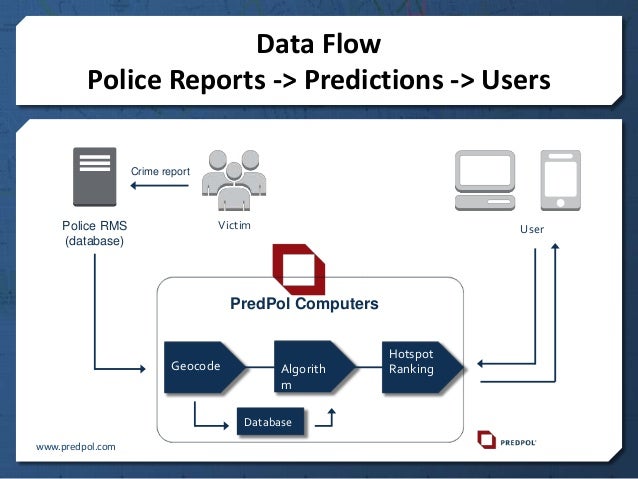
- Hotspot Analysis (e.g., PredPol): This is the simplest model. It analyzes historical crime data (type, location, time) and identifies "hotspots" where police should patrol. The underlying theory is that crime is not randomly distributed.
- Risk Terrain Modeling: This approach adds environmental and social data to the model, such as the proximity of bars, transit hubs, or even weather patterns, to create a more nuanced risk map.
- Learning Algorithms (e.g., HunchLab): These systems use machine learning (like the tree-based techniques mentioned in the video) to weigh hundreds of variables and learn complex patterns connecting them to crime risk.
- Person-Based Predictive Policing: This is a more controversial approach that assigns risk scores to individuals rather than places. The Chicago Police Department's "Strategic Subject List" (SSL) is a prominent example. The algorithm analyzed individuals' criminal records, known associations, and other factors to identify those supposedly at highest risk of being involved in gun violence, either as a victim or a perpetrator. Individuals on this list could then be subject to increased police attention.
4. The Engine of Bias: Feedback Loops
You've seen that both judicial and policing models rely heavily on historical crime data. But what happens when that data is biased? And more importantly, how can the algorithm itself amplify that bias over time? The answer lies in the concept of a "runaway feedback loop."
CHALLENGING RACIST PREDICTIVE POLICING ...
The law review note 'Challenging Racist Predictive Policing Algorithms...' provides a clear and powerful explanation of how these feedback loops work, turning predictive systems into self-fulfilling prophecies.
Please read these two short sections: 'Historical Crime Data Is Racially Biased' (pages 553-556): This section explains why the foundational data used to train these models is not a neutral reflection of all crime, but rather a reflection of historical policing practices. 'Racist Algorithms Will Exacerbate Racist Policing' (page 563): This section explains the feedback loop mechanism and why it is the 'ultimate danger' of predictive policing.
The feedback loop is the critical mechanism to understand:
- Biased Input: The algorithm is trained on historical arrest data, which over-represents crime in minority communities due to disproportionate policing.
- Biased Output: The algorithm predicts these same communities are "high-risk" and directs more police patrols to them.
- Biased Enforcement: Increased police presence naturally leads to more arrests and documented offenses in those targeted communities (for minor and major crimes alike).
- Reinforcement: This new arrest data is fed back into the algorithm as "ground truth." From the algorithm's perspective, its prediction was correct—more crime was indeed found where it predicted.
- Amplification: The algorithm becomes more "confident" in its biased predictions and directs even more resources to the same communities, while continuing to ignore crime elsewhere. The loop repeats and intensifies.
This creates a self-fulfilling prophecy where the system doesn't predict crime, but rather predicts policing. The algorithm ends up justifying and amplifying existing biases under a veneer of objective, data-driven neutrality.
Test your understanding!
A police department implements a predictive policing system. The algorithm identifies a neighborhood, "District 7," as a hotspot for drug-related crime. The department increases patrols in District 7, leading to a 50% rise in arrests for drug possession in that area. Arrests in a neighboring area, "District 5," which receives fewer patrols, remain flat. The department's leadership declares the program a success, citing the high number of arrests in the predicted hotspot.
Based on the concept of a feedback loop, what is the fundamental flaw in the leadership's conclusion?
Show answer
The fundamental flaw is mistaking correlation for causation and ignoring the role of the enforcement action itself. The leadership assumes the high arrest numbers validate the algorithm's prediction of high crime. However, the feedback loop concept suggests an alternative explanation:
- The algorithm's prediction was likely based on past arrest patterns, not necessarily the true underlying rate of drug use.
- The increased patrols in District 7 created a higher likelihood of detection and arrest for drug activity that might have been occurring at similar rates in District 5.
- The rise in arrests is a direct result of the increased police presence (the "enforcement action"), not necessarily a confirmation that more crime was happening there to begin with.
- By feeding this new arrest data back into the system, they will only strengthen the algorithm's bias towards District 7, ensuring it remains a "hotspot" indefinitely, regardless of the actual crime rate compared to other districts. They are not measuring crime; they are measuring police activity.
Conclusion
In this lesson, we have moved from the advisory role of AI in ADR to its more directive function within the formal justice system. We have defined predictive justice and examined its two primary applications.
Key Takeaways:
- Predictive Justice is the use of AI to forecast legal outcomes and events. It is applied in both judicial contexts (e.g., COMPAS risk scores for bail/sentencing) and policing contexts (place-based and person-based crime prediction).
- These systems are not magical "black boxes." Many are surprisingly simple classifiers that rely on a few key variables, which can act as proxies for protected characteristics like race.
- The primary fuel for these models is historical crime data. This data is not a neutral record of all crime but a biased record of past enforcement priorities and actions.
- The most significant risk of these systems is the "runaway feedback loop," where biased predictions lead to biased enforcement, which in turn generates more biased data, creating a self-fulfilling and amplifying cycle of inequality.
Preview of the Next Lesson:
Now that we have defined predictive justice and explained its primary applications and the critical risk of feedback loops, our next lesson will explore the other side of the coin. We will analyze the potential benefits these systems are claimed to offer, such as improved court efficiency, better resource allocation, and even the potential to identify and counteract human bias. This will set us up to later evaluate whether these purported benefits can be realized and if they can outweigh the profound risks we've explored today.