Introduction
Welcome back. In our last lesson, we examined the EU AI Act's "red lines" by identifying the eight specific categories of AI practices that are outright prohibited. These are systems deemed to pose an unacceptable risk to fundamental rights.
Today, we move one level down the risk pyramid to the "high-risk" category. These are AI applications that are permitted but are subject to a comprehensive and stringent set of legal obligations before they can be placed on the EU market. Your goal for this lesson is to describe the key compliance requirements for high-risk AI systems, including the process of conformity assessments and the ongoing duty of post-market monitoring.
Given your consulting background in implementing digital transformation projects, you'll find this lesson particularly practical. It details the operational rulebook—the systems, processes, and documentation—that an organization must establish to demonstrate legal compliance. Think of it as the implementation guide for launching a regulated AI product in Europe.
The Gateway to the Market: Conformity Assessment
Before a high-risk AI system can be sold or put into service in the EU, its provider must prove that it meets all the mandatory requirements. This process of verification is called a Conformity Assessment (CA). A successful CA allows the provider to affix the well-known CE marking to their product, signaling its compliance to regulators and customers.
The entire process, from determining if a CA is needed to the ongoing monitoring after launch, is a multi-step journey. The following infographic provides an excellent high-level roadmap of what's involved.
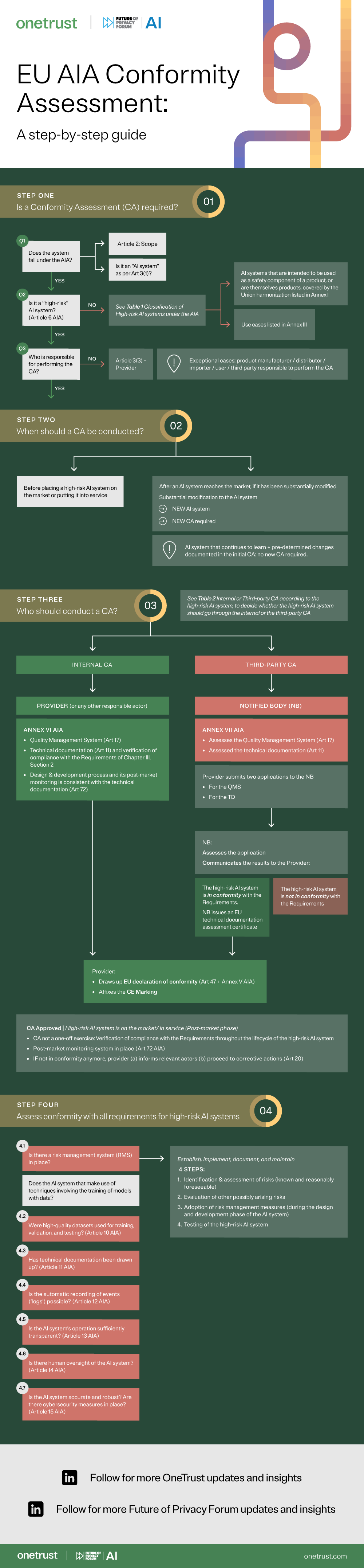
As the infographic suggests, once a system is confirmed as high-risk, the provider must choose the correct CA procedure. There are two main pathways.
To understand these pathways and the overarching framework, we will rely on a detailed guide from the Future of Privacy Forum.
Conformity Assessments under the EU AI Act
This white paper, 'Conformity Assessments under the EU AI Act,' provides a thorough breakdown of the assessment process and the specific requirements. It will be our primary resource for this lesson.
Please read the following sections: Start with Section III, 'The Conformity Assessment obligation...' (page 8). This will introduce the seven core requirements that are verified during a CA. Next, read 'Step 3: Who should conduct a CA?' (pages 17-21). Focus on understanding the difference between an 'internal conformity assessment' and a 'third-party conformity assessment.' Pay attention to the conditions that determine which path must be followed.
Let's summarize the key takeaways from your reading:
-
Internal Conformity Assessment (Self-Assessment): This is the default and most common procedure for most high-risk systems (e.g., those in education, employment, critical infrastructure). The provider performs the assessment themselves, following the procedure laid out in Annex VI of the Act. This involves verifying their own Quality Management System (QMS) and technical documentation against the law's requirements.
-
Third-Party Conformity Assessment: This more stringent procedure is required for a smaller subset of systems, most notably biometric identification systems. It involves an assessment by an independent, government-approved entity called a Notified Body. This body audits the provider's QMS and technical documentation to certify compliance.
The concept of a QMS, which must be documented through written policies and procedures, should be familiar from your work in implementing workflow automation and analytics systems. It's about ensuring quality and regulatory compliance in a systematic, auditable way.
A Path to Compliance: The Role of Standards
Proving compliance with the Act's often abstract requirements can be challenging. To simplify this, the EU framework uses a concept called "presumption of conformity." In essence, if a provider adheres to officially recognized technical standards, their AI system is presumed to comply with the corresponding legal requirements.
Standardization for Compliance in the European Union's AI ...
This article from the law firm WilmerHale clearly explains the crucial role of standards in the AI Act's compliance ecosystem.
Please read the section titled 'Standards and Specifications.' Focus on the difference between 'Harmonized Standards' and 'Common Specifications' and their role in creating a presumption of conformity.
As you've read, there are two key instruments here:
- Harmonized Standards: Developed by European standardization organizations upon request from the Commission. Adhering to these provides the strongest presumption of conformity.
- Common Specifications: Adopted by the Commission itself as a fallback if harmonized standards are not available or sufficient.
For a provider, aligning their system's design and documentation with these standards is the most direct path to a successful conformity assessment.
The Seven Pillars of High-Risk AI Compliance
The Conformity Assessment process is designed to verify that a high-risk AI system complies with seven fundamental requirements set out in Articles 9 through 15 of the AI Act. These are the pillars that support the entire regulatory structure for high-risk systems.
We will now go through each one, using the FPF white paper as our guide.
Conformity Assessments under the EU AI Act
Let's dive into the core substance of the compliance obligations. This is what the conformity assessment actually checks for.
Please read 'Step 4: Assess conformity with all requirements for high-risk AI systems' (pages 24-38). This is the most important section of the lesson. For each of the seven requirements (4.1 through 4.7), focus on understanding its purpose and the key actions a provider must take.
Now, let's synthesize and contextualize these seven pillars based on your reading.
1. Risk Management System (Article 9)
This is not a one-time check but an iterative process that must be maintained throughout the AI system's lifecycle. It requires the provider to identify, evaluate, mitigate, and monitor risks to health, safety, and fundamental rights. This involves testing the system against defined metrics before launch and continuously updating the risk assessment based on post-market data.
2. Data and Data Governance (Article 10)
Building on what we discussed in Module 3 about bias, this article operationalizes the solution. It mandates that training, validation, and testing datasets must be relevant, representative, and checked for errors and biases. For you, with a background in data analytics, this translates to legally mandated best practices in data management, including documentation of data provenance, scope, and any bias mitigation efforts.
3. Technical Documentation (Article 11)
This is the central evidence file for compliance. Before placing the system on the market, the provider must create comprehensive documentation (as detailed in Annex IV of the Act) that explains the system’s architecture, capabilities, limitations, and the processes used for its development and validation. This documentation must be kept for 10 years and be available to national authorities upon request.
4. Record-Keeping (Article 12)
High-risk systems must have the technical capability to automatically create logs of their operation. This ensures traceability, allowing for monitoring and post-incident investigation. Think of it as an airplane's "black box." The logs must record events like the start/end time of use and the data being processed, providing an audit trail of the system's functioning.
5. Transparency and Provision of Information (Article 13)
This requirement ensures that the person deploying the AI system (the "deployer") can understand and use it appropriately. Providers must supply clear instructions for use that detail the system's identity, intended purpose, capabilities, limitations, and the necessary human oversight measures. It's about enabling the user to make informed decisions and interpret the system's output correctly.
6. Human Oversight (Article 14)
High-risk systems must be designed to be effectively overseen by humans. This has two aspects:
- System Design: The system must have built-in interface tools that allow a human to monitor its operation and, crucially, to intervene, override a decision, or use a "stop" button to halt its operation.
- Human Competence: The provider must specify the skills and training needed for the human overseer, and the deployer is responsible for ensuring the assigned person is competent.
7. Accuracy, Robustness, and Cybersecurity (Article 15)
A system must perform at a level of accuracy appropriate for its intended purpose and be resilient to errors or inconsistencies. This also includes cybersecurity robustness—the system must be protected against vulnerabilities that could be exploited by malicious actors, such as through data poisoning or adversarial attacks, which we touched upon in Module 3.
Test your understanding!
A company is developing a high-risk AI tool for healthcare clinics to help triage incoming patient queries based on text descriptions of their symptoms. The tool categorizes queries as "urgent," "non-urgent," or "routine."
Drawing on the seven pillars of compliance, identify three distinct obligations the provider must fulfill before affixing the CE marking. Be specific.
Show answer
Here are a few possible answers, any three would be correct:
- Data & Data Governance (Art. 10): The provider must ensure the dataset used to train the triage model is representative of the patient population it will serve, actively checking for and mitigating biases related to demographics, language, or descriptions of rare conditions. They must document the sources of their data and the steps taken to ensure its quality.
- Transparency & Information (Art. 13): The provider must give the clinic (the deployer) a detailed user manual. This manual must specify the model's accuracy level for each category (e.g., "95% accuracy in identifying 'urgent' cases"), its known limitations (e.g., "less reliable for pediatric symptoms"), and instructions for how a clinician should interpret the AI's output.
- Human Oversight (Art. 14): The AI system's interface must be designed so a trained nurse or doctor can easily review the AI's categorization and override it if their clinical judgment differs. There must also be a clear mechanism to stop the system if it starts producing erratic or nonsensical results.
- Technical Documentation (Art. 11): The provider must compile a file that includes, among other things, a description of the risk management system, detailed information on the training data, the results of accuracy tests, and a copy of the post-market monitoring plan.
Life After Launch: Post-Market Monitoring
Compliance doesn't end when the product is sold. The AI Act mandates a continuous, proactive process to monitor the system's performance throughout its lifecycle.
Conformity Assessments under the EU AI Act
Finally, let's look at the obligations that continue after the conformity assessment is complete.
Please read the short section titled 'Ongoing requirements: post-market monitoring system' (pages 22-23). Focus on the purpose of this system and the activities involved.
As the reading highlights, the Post-Market Monitoring (PMM) system is a formal process for collecting and analyzing real-world performance data. This includes:
- Gathering feedback from deployers and end-users.
- Documenting serious incidents and malfunctions.
- Feeding this information back into the Risk Management System to identify new risks.
- Informing deployers and authorities of any necessary corrective actions or updates.
This creates a feedback loop, ensuring the AI system remains safe and compliant long after its initial assessment.
Conclusion
In this lesson, we have moved from the abstract to the operational, detailing the rigorous compliance framework for high-risk AI systems in the EU. You now understand that bringing such a system to market is not just a technical challenge but a profound legal and procedural one.
Key Takeaways:
- High-risk AI systems must undergo a Conformity Assessment (CA) before entering the EU market, culminating in a CE marking.
- This assessment can be an internal self-assessment by the provider or, for certain systems, must be conducted by a third-party Notified Body.
- Compliance is verified against seven core requirements: a Risk Management System, robust Data Governance, comprehensive Technical Documentation, Record-Keeping (logging), Transparency for users, effective Human Oversight, and high levels of Accuracy, Robustness, and Cybersecurity.
- Compliance is an ongoing duty, enforced through a mandatory Post-Market Monitoring system that collects real-world performance data to ensure safety and facilitate continuous improvement.
Preview of the Next Lesson:
We've discussed transparency as one of the seven pillars for high-risk systems. In our next lesson, we will dive deeper into this crucial principle, but in the context of the most powerful and discussed AI models today: General-Purpose AI (GPAI) and the Large Language Models (LLMs) that power them. We will analyze the specific transparency obligations for these models and their downstream applications, such as chatbots and deepfake generators.