Welcome to your third lesson! In our first two sessions, we meticulously covered all the sounds of the German language, from the standard alphabet to the unique umlauts and the eszett. You now have the complete toolkit to pronounce any German word you see.
Today, we'll put those skills into immediate, practical use. This lesson is all about your first conversations: learning to produce common German greetings and farewells. We'll cover what to say at different times of the day, how to distinguish between formal and informal situations, and how to say goodbye. By the end of our session, you'll be able to confidently greet people and end a conversation politely in German.
The All-Purpose Greeting: Hallo
The most common and versatile greeting in German is Hallo, which simply means "Hello." It's generally informal but is so widely used that you'll hear it everywhere. It's the perfect starting point.
Let's watch a short clip to see how Hallo and its most common informal farewell counterpart, Tschüss, are used in a simple conversation.
Learn Basic German Greetings & Farewells in Slow German | Super Easy German 274
This video from the "Easy German" channel uses slow, clear German, which is ideal for beginners. In this first segment, the hosts demonstrate the two most essential words for starting and ending a casual chat.
Watch the section from "Hallo und Tschüss". Pay attention to the pronunciation and the context—a simple, friendly phone call. Notice how "Tschüss" uses the ü sound we practiced in the last lesson.
As you can see, Hallo is straightforward. You can use it with friends, peers, and in many everyday situations like shopping.
Greetings for Different Times of Day
Just like in English, German has specific greetings for the morning, daytime, and evening. These are generally a bit more formal than Hallo.
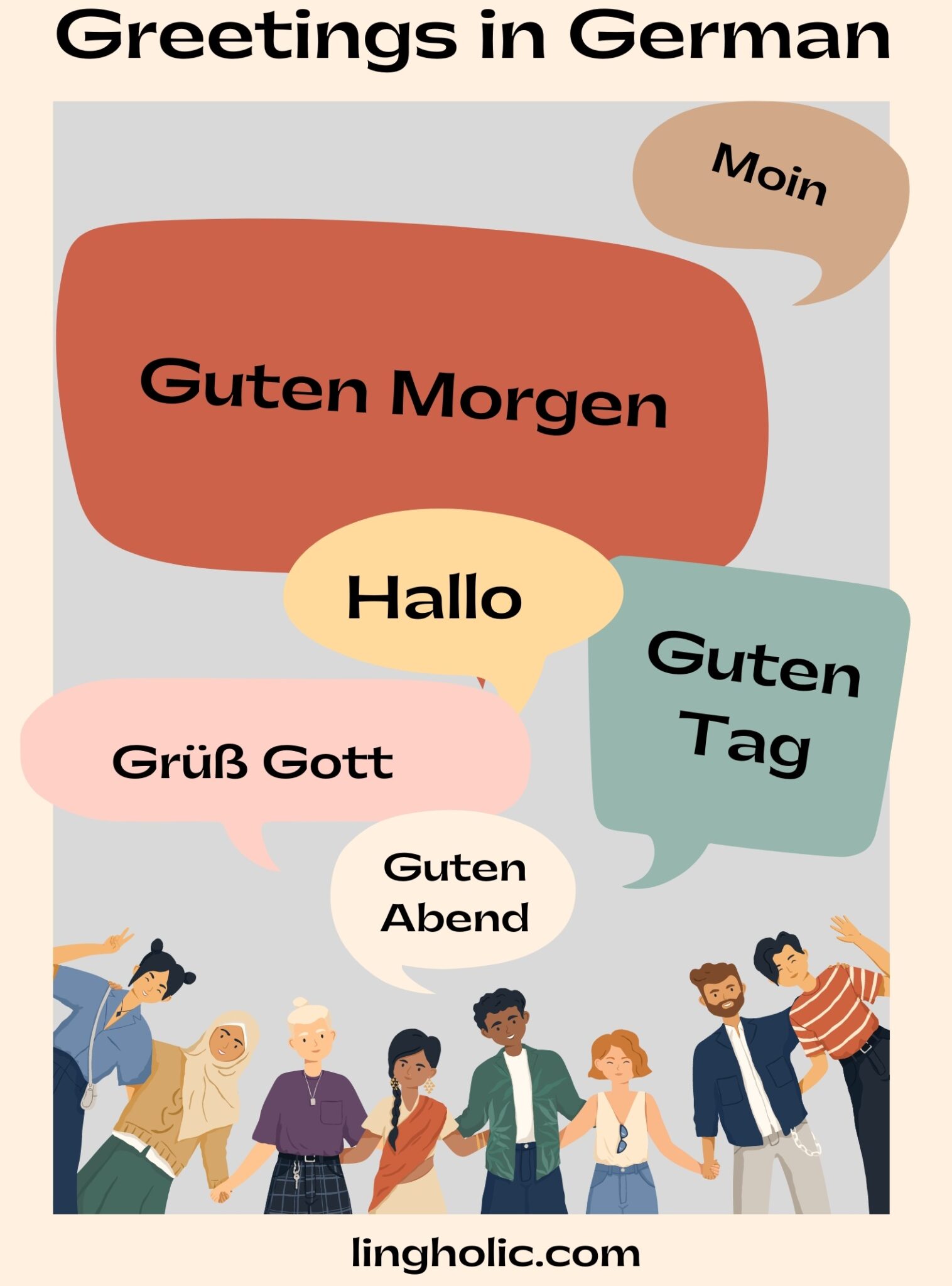
Let's break them down. For a clear explanation and pronunciation guide, we'll turn to a video from "Learn German with Anja".
GERMAN LESSON 1: Learn German for Beginners - German Greetings 🤗
Anja provides a very clear, beginner-friendly overview of the time-based greetings. She speaks clearly and gives you the pronunciation for each one.
Please watch the first part of the video, from the beginning until the explanation of 'Gute Nacht'. Listen carefully and try repeating each phrase after her.
To summarize and add some detail:
-
Guten Morgen! - "Good morning!"
- Used from when you wake up until about 10 or 11 AM.
- Pronunciation focus: Remember that in
Morgen, the 'r' is often a soft, guttural sound in the back of the throat.
-
Guten Tag! - "Good day!"
- This is the standard, all-purpose polite greeting for the majority of the day, typically from around 11 AM until 6 PM. It functions as both "good day" and "good afternoon."
- Pronunciation focus: The final 'g' in
Tagis pronounced like a 'k' sound: "Tahk."
-
Guten Abend! - "Good evening!"
- Used from about 6 PM onwards.
- Pronunciation focus:
Abendstarts with a long 'A' sound.
A quick note on grammar you might have noticed: Guten ends with '-en' for Morgen, Tag, and Abend. This is because these nouns are masculine. We will explore this concept of grammatical gender more in a later module, but it's good to start noticing these patterns.
Formal vs. Informal: A Key Distinction
Choosing the right greeting depends heavily on the social context. Guten Tag is more formal and is the safest choice when addressing strangers, officials, or in business settings. Hallo is informal, used for friends, family, and younger people.

The distinction between formal and informal language is a cornerstone of German culture. For now, just remember this simple rule: when in doubt, use Guten Tag. It's better to be slightly too formal than too familiar.
Let's read a short text that outlines these differences clearly.
How To Say Good Morning/Afternoon/Evening/Night
This article from Olesen Tuition provides excellent cultural and grammatical context. We'll focus on the section that explicitly contrasts formal and informal greetings.
Please read the section titled "Formal vs. Informal German Greetings". It gives clear examples and a helpful general rule for choosing the right one.
Saying Goodbye
Just as with greetings, there are formal and informal ways to say goodbye.
-
Auf Wiedersehen! (Formal)
This is the classic, polite way to say goodbye. It literally means "until we see again" (wieder= again,sehen= to see). You would use this in the same situations where you usedGuten Tag. -
Tschüss! (Informal)
This is the all-purpose, friendly "bye." It's what you'll hear most often among friends and in casual situations. Don't forget theüsound! -
Gute Nacht! (A special farewell)
This means "Good night." It is only used as a farewell when you or someone else is going to bed or leaving for the night. You would greet someone in the evening withGuten Abendbut say goodbye withGute Nacht.- Grammar note: Did you notice it's
Gute Nachtand notGuten Nacht? That's becauseNacht(night) is a feminine noun. This is your first practical encounter with German grammatical gender influencing the words around it!
- Grammar note: Did you notice it's
The "Easy German" video also demonstrates the difference between the formal Auf Wiedersehen and the informal Tschüss.
Learn Basic German Greetings & Farewells in Slow German | Super Easy German 274
Let's return to the "Easy German" video to see a formal farewell in action. The hosts simulate a more formal phone call.
Watch the segment from the formal greeting example. Notice the use of Guten Tag and Auf Wiedersehen. They also mention Auf Wiederhören ("until we hear again"), which is specifically for phone calls, but Auf Wiedersehen is more common to learn first.
Practice Your Pronunciation
Now it's time to bring everything together and practice speaking. The following resource has a list of the key phrases we've learned, each with an audio clip.
Greetings and essentials + audio | Learn German
This page from "The German Project" is excellent for pronunciation practice. It lists essential greetings and farewells with clear audio.
Go to the section "German greetings". For each phrase from Hallo! down to Ciao!, click the "Play" button, listen carefully to the native speaker, and then say the word or phrase out loud yourself. Try to match the pronunciation and intonation as closely as possible.
Spend some time with this list. Repetition is the key to making these sounds feel natural.
Conclusion
Excellent work today! You've taken your knowledge of German sounds and applied it to your first functional words and phrases. This is a massive step towards having real conversations.
Here are the key takeaways from this lesson:
- The most common greetings are Hallo (informal) and Guten Tag (formal).
- Greetings can change with the time of day: Guten Morgen, Guten Tag, and Guten Abend.
- The main farewells are Auf Wiedersehen (formal) and Tschüss (informal).
- Gute Nacht is a special farewell used only when someone is going to bed.
- The distinction between formal and informal language is crucial in German. When unsure, opt for the formal phrase.
In our next lesson, we will build directly on this foundation. After you've greeted someone, the next logical step is to introduce yourself. You will learn how to state your name, where you come from, and where you live, moving you even closer to your first full conversation.