Introduction
In our previous lesson, we mapped out the extensive organisational landscape of the Department of Atomic Energy (DAE), understanding the roles of its various R&D centres, industrial units, and regulatory bodies. You now have a "satellite view" of the entire Indian nuclear ecosystem. Today, we zoom in to the very heart of that ecosystem: the Bhabha Atomic Research Centre (BARC) at Trombay.
This lesson focuses on the physical hardware that makes BARC the crucible of India's nuclear R&D. We will identify BARC's major research reactor facilities. These are not power plants designed to light up cities, but precision instruments for science and technology. They are the workbenches for nuclear physicists, the testbeds for new materials, and the factories for life-saving radioisotopes. Understanding these facilities is a core part of grasping the "BARC lingo" you wanted to learn. By the end of this lesson, you'll be able to identify key reactors like Apsara-U and Dhruva and appreciate their distinct roles in the nation's nuclear programme.
The Pioneering Era: Apsara and CIRUS
To understand the present, we must first look to the past. The story of BARC's reactors begins in the 1950s, a period of immense scientific ambition and a drive for self-reliance. To get a feel for this pioneering era, let's watch a few clips from a classic Films Division documentary.
This vintage film captures the spirit and challenges of building India's first reactors. Pay close attention to the narrative of self-reliance. First, watch the segment on Asia's first reactor, Apsara, and listen to Jawaharlal Nehru's words at its inauguration. Next, watch the section on the Canada-India reactor, CIRUS. Notice the emphasis on the challenge of fabricating nuclear fuel elements indigenously—a significant metallurgical undertaking. Finally, there is a brief mention of a third reactor, Zerlina, which highlights the growing self-sufficiency in reactor technology.
The video gives you a sense of the historical importance of these first facilities.
-
Apsara (1956): As you saw, this was a moment of great national pride. It was a 1 MW "swimming pool" type reactor, designed and built entirely by Indian scientists and engineers. Light water was used as both the moderator (to slow down neutrons) and coolant. Though permanently shut down in 2009, its legacy is immense.
-
CIRUS (1960): The Canada-India Reactor, U.S. (CIRUS) was a major step up in scale and complexity (40 MW). As the video highlighted, while the initial collaboration was key, the real achievement was India's ability to fabricate its own natural uranium fuel rods for it. This reactor was the training ground that gave India the expertise and confidence to launch its Pressurised Heavy Water Reactor (PHWR) programme.

These early reactors were not just scientific tools; they were the foundation upon which the entire self-reliant nuclear power programme was built.
The Modern Workhorses: Apsara-U and Dhruva
While Apsara and CIRUS have been decommissioned, their modern successors are the operational heart of BARC today. These are the two most important research reactors you should know: Apsara-U and Dhruva.
Apsara-Upgraded (Apsara-U)
As its name suggests, Apsara-U is the modern incarnation of India's first reactor. Commissioned in 2018, it is a higher-power (2 MW) swimming pool type reactor designed for a new generation of research.
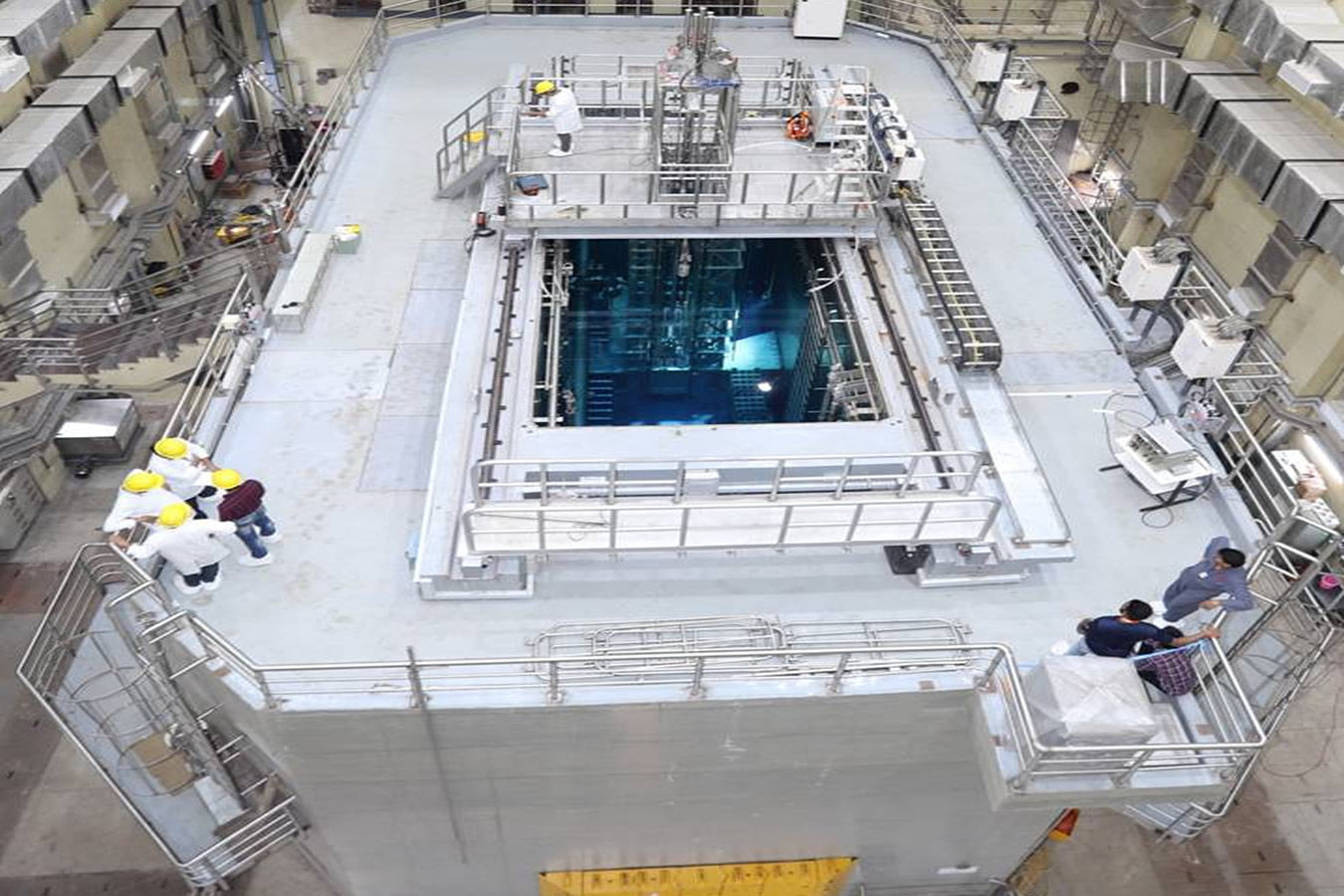
Let's look at its specifications directly from the source: the BARC website.
This page provides the technical specifications for BARC's reactors. We will focus on the Apsara-U reactor.
On the "Research Reactors in BARC" page, locate the section for Apsara-U. Read the accompanying paragraph and review the specifications table provided for it. Pay attention to: Reactor Type: Swimming pool. Fuel Material: Low Enriched Uranium (LEU) in the form of Uranium Silicide. This is a modern, high-density fuel. Moderator/Coolant: Light water. Uses: Note the focus on isotope production, neutron activation analysis, and research in nuclear physics and material science.
Apsara-U's primary role is to produce radioisotopes for medical use, conduct experiments for physics and materials science, and serve as a training facility. Its relatively low power and open-pool design make it an accessible and versatile tool.
Dhruva
If Apsara-U is a versatile workhorse, Dhruva is the heavy-duty engine of BARC's research capabilities. Commissioned in 1985, it is a high-power (100 MW), high-flux research reactor that is among the most powerful in the world.
The term "high flux" is key BARC lingo. It refers to a very high density of neutrons (). This intense neutron environment is crucial for two main purposes:
- Efficient Isotope Production: Creating a wide variety of high-quality radioisotopes.
- Advanced Materials Research: Using beams of neutrons to probe the atomic structure of materials, a technique highly relevant to your background in metallurgy.
Let's examine its details.
Now, let's look at the specifications for the Dhruva reactor on the same page.
Find the section dedicated to Dhruva. Read the introductory text and study its technical specifications table. Note the key differences from Apsara-U: Reactor Type: Vertical Tank Type. Power: 100 MW (50 times more powerful than Apsara-U). Fuel Material: Natural Uranium Metal. Moderator/Coolant: Heavy water. Significance: It is designated as a "National Facility for Neutron Beam Research."
The contrast between Apsara-U and Dhruva is a miniature reflection of the broader Indian nuclear programme:
- Apsara-U: Uses enriched uranium and light water, similar to Boiling Water Reactors (BWRs) or Pressurized Water Reactors (PWRs).
- Dhruva: Uses natural uranium and heavy water, the same combination as India's fleet of Pressurised Heavy Water Reactors (PHWRs).
Dhruva's design and operational experience are therefore directly tied to the country's main power generation programme.
To see these reactors in a more modern context, the following video provides a concise overview.
INS Lecture Series 2022: History of the Nuclear Reactor Development by Argala Srivastava
This lecture by a BARC scientist offers a quick summary of the research reactors.
Watch the segment from research reactors operating in India. It provides clear visuals and descriptions of both Dhruva and Apsara-U.
Other Specialized Facilities
Beyond the two major reactors, BARC has hosted a series of smaller, specialized reactors and facilities for specific research goals. You don't need to memorize their details, but knowing they exist provides a fuller picture of BARC's capabilities.
-
PURNIMA Series (I, II, III): These were very low-power experimental reactors, each designed to test the physics of advanced fuels. PURNIMA-I used plutonium fuel (for Stage 2 of the nuclear programme), while PURNIMA-II and III used Uranium-233 fuel (for Stage 3). They were crucial for validating the physics calculations for future reactor designs.
-
Critical Facility for AHWR: This is another low-power reactor used to test the core design of the Advanced Heavy Water Reactor (AHWR), a key component of India's Thorium utilisation plan (Stage 3). It allows scientists to validate their computer models with real-world experiments before building the full-scale power reactor.
These facilities demonstrate a key principle of reactor development: "test before you build." They ensure that the physics of new and complex reactor cores are perfectly understood in a safe, low-power environment.
Conclusion
Today, we have taken a tour of the heart of BARC—its research reactors. These facilities are the foundation of India's nuclear science and technology development, each with a specific purpose and a rich history.
Here are the key takeaways:
- BARC's reactor programme began with the pioneering Apsara (Asia's first reactor, indigenous design) and CIRUS (a larger, collaborative project that was crucial for mastering PHWR technology).
- The current major operational reactors are Apsara-U, a 2 MW swimming pool reactor used for general research and isotope production, and Dhruva, a 100 MW high-flux reactor that is a national facility for materials research and large-scale isotope production.
- The reactors showcase different technologies: Apsara-U uses enriched uranium and light water, while Dhruva uses natural uranium and heavy water, mirroring different streams of power reactor technology.
- BARC also operates smaller critical facilities (like the one for AHWR) and has used experimental reactors (like the PURNIMA series) to validate the physics of future reactor designs, particularly those for Stages 2 and 3 of the nuclear programme.
You are now familiar with the names and purposes of the key R&D infrastructure at Trombay. When you hear these names at BARC, you will understand the context and their significance.
In our next lesson, we will continue our goal of learning the "BARC lingo" by focusing on the human element. We will define the common acronyms for organisational units and, importantly, the personnel designations you will encounter every day, such as Scientific Officer (SO/C), OCES, and DGFS.