Introduction
In our last lesson, we constructed a media plan by working backward from a revenue goal, allocating a budget, and forecasting performance using estimated KPIs. This gave us a strategic roadmap. Now, we will bring that roadmap to life by learning how to set formal, measurable targets for those KPIs.
This lesson focuses on how to set measurable KPI targets for a campaign based on business goals and historical benchmarks. Moving from estimated forecasts to concrete targets is what transforms a media plan from a simple document into an active performance management tool. You'll learn how to derive your primary "North Star" metric, like Cost Per Acquisition (CPA), directly from your business's financial health and how to use benchmarks to set realistic targets for the secondary metrics that drive it.
From Business Goal to KPI Target
The foundation of effective performance marketing is ensuring every action is tied to a core business objective. Setting KPI targets is the most direct way to create this link. However, not all metrics are created equal. It's crucial to distinguish between metrics that simply look good on a report (vanity metrics) and true Key Performance Indicators (KPIs) that reflect business health.
15 essential digital marketing KPIs to track in 2026
This article from AI Digital clearly distinguishes between general metrics and true KPIs.
First, read the introduction and the section Vanity Metrics vs. Real KPIs. Pay close attention to the examples given, such as the difference between "Page Views" (a metric) and "Conversion Rate on Key Landing Pages" (a KPI). This distinction is fundamental to focusing your efforts on what truly drives results.
As the article highlights, a true KPI is explicitly tied to a core business goal. The first step in setting targets is to select the right KPIs for your campaign's objective. The following table from the same article provides an excellent framework for this.
15 essential digital marketing KPIs to track in 2026
This table shows how to align your KPIs with your specific campaign objectives.
Focus on the table in the section "How to choose the right KPIs". Notice how the essential KPIs change based on the objective—"Awareness" campaigns prioritize metrics like Impressions and CTR, while "Conversion" campaigns focus on CVR, CPA, and ROAS.
For most performance marketing campaigns, your primary or "North Star" KPI will be either Cost Per Acquisition (CPA) for lead generation or service businesses, or Return On Ad Spend (ROAS) for e-commerce businesses. These are the top-level indicators of profitability.
Calculating Your Primary Target: The LTV-to-CAC Method
Once you've identified your primary KPI, how do you set a specific target for it? Instead of guessing, the most robust method is to calculate what your business can afford to pay to acquire a customer while remaining profitable. This involves understanding your Customer Lifetime Value (LTV).
LTV represents the total profit you can expect to make from a single customer over the entire duration of their relationship with your business. Your LTV directly determines your maximum allowable Customer Acquisition Cost (CAC or CPA).
The video below by Eric Andrews provides a clear, practical walkthrough of how to calculate your maximum CAC based on your business model. This is a critical skill for any serious performance marketer.
Performance Marketing | Setting Targets, Tracking Conversions & Scaling
This video, "Performance Marketing | Setting Targets, Tracking Conversions & Scaling," explains how to calculate your target CAC by first understanding your customer LTV.
Please watch the section from calculating your targets. The presenter does an excellent job of breaking down the calculation for two different business types: One-time purchase businesses (common in e-commerce). Recurring purchase businesses (common for subscriptions or services). Follow his calculations closely. The key insight is that a business with higher repeat purchases has a higher LTV, and can therefore afford a much higher CAC to acquire a new customer.
As you saw, understanding your unit economics and customer purchase frequency allows you to set a data-driven, defensible target for your CPA. If you want to be profitable on the first purchase, your target CPA must be below your first-order profit margin. If you have a business with strong repeat purchases, you can afford a higher CPA, even if it means losing money on the first transaction, because you know you will become profitable over the customer's lifetime.
Setting Secondary Targets: Using Benchmarks and Diagnostics
After setting your primary target (e.g., Target CPA = $50), the next step is to determine targets for the secondary metrics that drive it: Conversion Rate (CVR), Cost Per Click (CPC), and Click-Through Rate (CTR). These are your diagnostic metrics. If you fail to hit your CPA target, you'll analyze these secondary metrics to understand why.
The relationship is:
To set targets for these, you have two primary sources of data:
- Historical Performance (Internal Data): This is always the best place to start. If your website has historically converted at 2% for similar traffic, then 2% is a realistic initial target for your CVR.
- Industry Benchmarks (External Data): When you have no historical data (e.g., you're a new company or launching in a new market), industry benchmarks are your next best source. They provide a reasonable starting point.
The image below from WordStream shows search advertising benchmarks for 2024 across various industries.
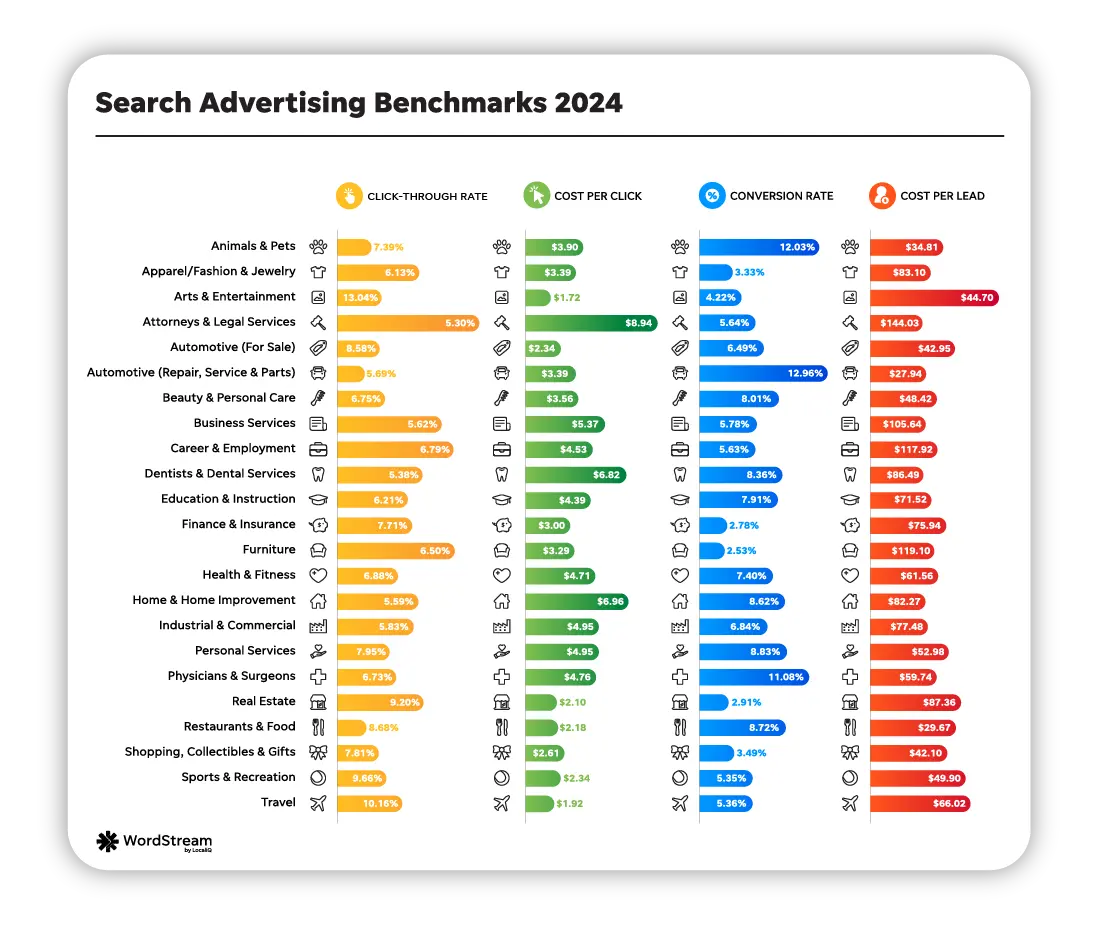
For example, if you were launching a campaign in the "Real Estate" industry, you could use these benchmarks as a starting point: a target CTR of 9.20%, a target CVR of 2.91%, and a target CPC of $2.10.
While these benchmarks are useful starting points, remember that your primary goal is to hit your main business KPI (CPA or ROAS). Secondary metrics are the levers you pull to get there. The following video explains this hierarchy perfectly.
How To Analyse Facebook Ads The RIGHT Way
In his video "How To Analyse Facebook Ads The RIGHT Way," Ben Heath explains the crucial difference between optimizing for primary vs. secondary metrics.
Watch these two key segments: Primary Optimization Metrics: The key takeaway here is that your initial and most important decisions should be based on your primary metrics—either cost per conversion or ROAS. Diagnosing with Secondary Metrics: This part explains that the purpose of secondary metrics (like CTR, hook rate) is to understand why your primary metric is what it is. This helps you diagnose problems and inform future creative or strategic decisions.
Making Targets Actionable: The SMART Framework
To ensure your KPI targets are effective, they should be framed using the SMART methodology. This ensures they are clear, actionable, and tied to a timeline.
- Specific: Clearly define what you will measure.
- Measurable: The target must be quantifiable.
- Achievable: The target should be realistic, based on historical data or solid benchmarks.
- Relevant: The KPI must align with a core business objective.
- Time-bound: The target must have a deadline.
This framework is a powerful tool for turning general goals into specific, actionable targets.
How to Set Marketing KPIs in 4 Simple Steps
This resource from Ryan Tronier provides a great explanation of the SMART framework and compares it with other goal-setting models.
Read the section on SMART goals. The example provided, "Generate 100 qualified demo sign-ups... in 60 days," is a perfect illustration of a well-defined, SMART goal that can be directly translated into KPI targets.
Example:
- Vague Goal: We need to improve our Google Search performance.
- SMART KPI Target: For the Q3 campaign, achieve a target CPA of $50 for non-branded search keywords, while maintaining a CVR of at least 4% and keeping CPC below $2.00.
Putting It All Together: Revisiting the Campaign Scenario
Let's return to the DTC running shoe brand from our last lesson. We had a business goal of $25,000 in revenue and an Average Order Value (AOV) of $125. Last time, we used rough estimates for our KPIs. Now, let's set formal targets.
1. Set the Primary Business Target (ROAS)
Assume the product has a 50% profit margin.
- Profit per order = $125 (AOV) * 50% = $62.50
- The business wants to be profitable on the first sale. Let's say they want to make at least $31.25 in profit per order.
- Maximum allowable ad spend per order (CPA) = $62.50 (Profit) - $31.25 (Desired Profit) = $31.25
- Target ROAS = AOV / Target CPA = $125 / $31.25 = 4.0 or 400%
Our primary, blended target is a 4:1 ROAS.
2. Set Channel-Specific Targets
We know from experience and from the video LINK that prospecting campaigns have higher CPAs (lower ROAS) than bottom-of-funnel campaigns.
- Meta Ads (Prospecting): We can set a lower ROAS target, perhaps aiming to break even on the first purchase. Target ROAS = 2:1 (CPA = $62.50).
- Google Shopping & Search (BOFU): Here we expect higher performance. Target ROAS = 5:1 (CPA = $25).
3. Set Secondary Diagnostic Targets (for Google Shopping)
Our target CPA for Google Shopping is $25. Let's set targets for CVR and CPC.
- Benchmark Research: We consult the "Search Advertising Benchmarks 2024" image. For the "Shopping, Collectibles & Gifts" category, the average CVR is 3.49% and the average CPC is $2.61.
- Calculation & Analysis:
- To achieve a $25 CPA with a 3.49% CVR, our required CPC would be:
- Insight: Our required CPC ($0.87) is significantly lower than the industry average CPC ($2.61). This signals a potential challenge. To hit our aggressive 5:1 ROAS target, we must either achieve a much higher CVR than the industry average or find a way to acquire clicks far more cheaply.
- To achieve a $25 CPA with a 3.49% CVR, our required CPC would be:
This data-driven approach immediately highlights the main challenge for the campaign manager: improve the conversion rate of the landing page or refine keyword/product targeting to find cheaper, high-converting clicks. This is the power of setting targets properly.
Conclusion
In this lesson, you've learned the critical process of moving from general business goals to specific, measurable KPI targets. This is the strategic core of performance marketing, enabling you to manage campaigns with precision and purpose.
Key Takeaways:
- Start with the Business Goal: Your primary KPI target (CPA or ROAS) should be derived from your business's financials, specifically your profit margins and Customer Lifetime Value.
- Use Benchmarks Wisely: When you lack historical data, use industry benchmarks as a realistic starting point for your secondary, diagnostic KPIs (CVR, CPC, CTR).
- Prioritize Your Metrics: Optimize your campaigns to hit your primary KPI (CPA/ROAS). Use secondary KPIs to diagnose performance issues and understand why you are or are not hitting your main goal.
- Be SMART: Frame your targets using the SMART framework to ensure they are Specific, Measurable, Achievable, Relevant, and Time-bound.
You have now completed the foundational module on strategy and planning. You understand the marketing funnel, the core KPIs, how to build a media plan, and how to set targets. However, none of this is possible without accurate measurement. In our next module, we will shift from strategy to the essential technical skills needed to track your results, starting with how to set up a Google Tag Manager container and deploy your first conversion tag.