In our last lesson, we learned to build suspense by manipulating time and information, creating that agonizing feeling of a bomb about to go off. That was about external tension and the reader's anticipation of an event. Today, we turn inward. We move from the ticking bomb to the emotional explosion it causes inside your character.
Your goal for this lesson is to write an emotionally intense scene by focusing on physical reactions and internal thought. Whether it's the raw grief of loss, the fury of betrayal, or a heated argument, mastering this skill is what transforms characters from puppets in a plot to living, breathing people your readers will care about deeply. The high-stakes adventures you enjoy, like Harry Potter, are memorable not just for their magic and action, but for the powerful emotional journeys of their characters. This lesson gives you the tools to create that same impact.
The Anatomy of an Emotion
In writing, an emotion is never just a single word like "sad" or "angry." It's a full-body, full-mind experience. Telling the reader "He was furious" is like showing them a photograph of a meal. Showing them the emotion through its component parts is like letting them taste it.
A great way to deconstruct an emotion is to think of it as a combination of five threads woven together.
How to Write Point-of-View Characters' Emotions
This article from Cellar Door Editorial provides a clear framework for understanding how to express a character's feelings.
Focus on the section that begins "In a story, five main threads". This list breaks down emotion into thoughts, sensations, dialogue, actions, and setting. We will concentrate on the first two.
As the article explains, the key components are:
- Thoughts: The character's internal monologue.
- Inner Physical Sensations: The body's involuntary response.
- Dialogue: What the character says (and how they say it).
- Actions: What the character does.
- Setting: How the environment is perceived through the character's emotional filter.
For this lesson, we are zeroing in on physical sensations and thoughts, as they are the most direct windows into a character's internal state.
Emotion as a Physical Event
A common mistake for new writers is treating emotions as abstract ideas. They are not. Emotions are physical events. Fury is a surge of heat; fear is a knot of ice in the stomach; grief is a crushing weight on the chest. To write these feelings authentically, you must first connect with how they manifest in the body.
The image below gives a simple but effective two-step process for this: identify the abstract emotion word, then replace it with the physical reactions it produces.
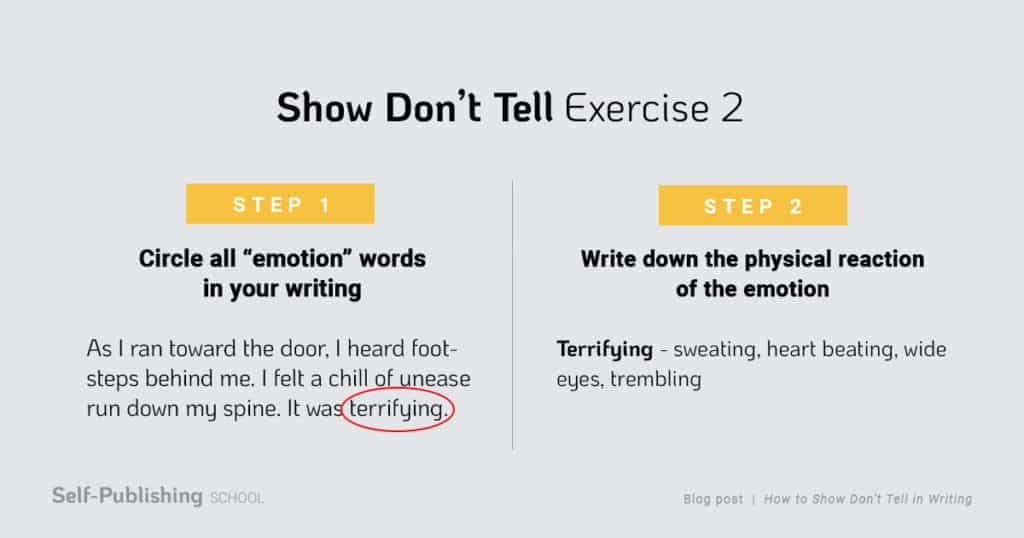
To generate these physical details, you can use a technique called "body scanning." Before you write an emotional scene, take a moment to access that feeling yourself.
6 Tips to Write Deeply Emotional Fiction
The article from "Helping Writers Become Authors" offers excellent advice on how writers can connect with emotions to portray them authentically.
First, read the section under Tip #1, "one of the biggest revelations," which explains that emotions are physical sensations and describes the body scanning technique. Then, jump to Tip #5, "Imagine Your Physical Reactions," which encourages you to put yourself in your character's situation and observe your own bodily responses.
This process of imagining your own physical reactions is your research. When your character learns of a betrayal, don't just write "she was shocked." Close your eyes. Imagine receiving that news. What happens first?
- Does the air rush out of your lungs?
- Does your hearing go fuzzy, replaced by a high-pitched ringing?
- Does the blood drain from your face, making your skin feel cold and tight?
- Does your stomach clench into a painful knot?
These specific, visceral details are far more powerful than any generic label. They place the reader directly inside the character's body at the moment of impact.
Introspection: The Key to Unique Emotion
Describing physical reactions is a huge step, but it's only half the story. A pounding heart can mean fear, excitement, or anger. What truly defines the emotion and makes it unique to your character is their introspection—their internal thoughts, questions, and interpretations of what is happening.
This is what elevates your writing from cliché to something profound and character-driven.
How to Describe Emotion Without Being Melodramatic or Cliche
The video "How to Describe Emotion Without Being Melodramatic or Cliche" by editor Ellen Brock makes a powerful argument for the importance of introspection.
First, watch the section from the key, where she explains that most writers need to get better at introspection, not just describing emotions. Then, watch her analysis of a scene from Stephen King's Misery, from the example. Notice how the character's fear is conveyed through his internal questions and observations, not by stating "he was scared."
As the video demonstrates, the power lies not in telling us Paul is frightened, but in showing us his mind racing, trying to assess the threat. His thoughts—Help was the operative word. Already that seemed like the operant word—reveal his dawning horror far more effectively than describing his heart rate.
This is the difference between a generic character and a specific one. When faced with a monster, one character might think, How do I kill it? Another might think, What does it want? A third might think, It's beautiful. Their internal thoughts, their unique interpretation of the event, are what make the emotion their own.
Case Study: Writing an Argument
Let's apply these principles to a common emotionally intense scene: an argument. Arguments are rarely about what they seem to be about on the surface. The real conflict happens in the subtext, driven by the characters' internal thoughts and unsaid feelings.
7 Tips For Writing a Great Argument
In "7 Tips For Writing a Great Argument," Hannah Lee Kidder provides practical advice for making arguments feel realistic and impactful.
Watch Tip #3 on understatement and escalation. Real arguments don't usually start with screaming; they build. Also, watch Tip #5 on subtext. This is where introspection becomes crucial. The argument might be about dirty dishes, but the character's internal thoughts are about a much deeper betrayal.
When writing an argument, use the dialogue for the surface-level conflict. Use physical reactions and internal thoughts to reveal the true stakes.
- Dialogue: "You forgot to take out the trash again."
- Physical Reaction: His knuckles whitened as he gripped his coffee mug.
- Internal Thought: Again. It's always 'forgot.' As if he didn't remember every promise he ever broke.
The tension here comes from the gap between the trivial spoken words and the profound inner turmoil.
Writing Exercise: The Moment of Discovery
Now it's your turn to combine physical reaction and internal thought to create an emotionally charged scene.
The Prompt:
Your protagonist, a young spy in training, has been assigned a mentor they deeply admire and trust. While searching the mentor's office for a misplaced training manual, your protagonist stumbles upon a hidden ledger. It contains coded payments from the very enemy organization they are being trained to fight, with dates corresponding to missions that have recently failed, costing the lives of fellow recruits.
Write a short scene (300-500 words) that covers the moment your protagonist finds and deciphers the ledger. The scene should end as they close the ledger, their world shattered, faced with the decision of what to do next.
A Checklist for Your Scene:
- Focus on Physicality: Don't just say the character is shocked or betrayed. What happens to their body? Do their hands start shaking so much they can barely hold the page? Does their breath catch? Does a wave of nausea or cold wash over them? Use the "body scanning" technique we discussed.
- Prioritize Introspection: What are the specific thoughts that race through their mind? Show the process of denial turning into horrifying realization. Do they try to find an alternative explanation? Do specific names or faces of fallen comrades flash in their memory? Let their thoughts, not emotional labels, carry the scene.
- Avoid Melodrama: Resist the urge to have them scream or collapse. As we learned, real emotional impact often comes from understatement and a character trying to process, or even suppress, an overwhelming feeling.
- End on a Decision Point: The scene should conclude not with a grand action, but with the quiet, terrifying weight of a new reality and the question: What now?
Conclusion
Writing emotionally intense scenes is about navigating the inner world of your character. It’s a craft of subtlety and authenticity. By moving beyond simple emotional labels and focusing on the concrete details of physical sensations and the unique landscape of a character's thoughts, you invite the reader to feel with them, not just observe them from a distance.
Key Takeaways:
- Emotions are physical events. Use "body scanning" to translate abstract feelings into concrete, visceral sensations.
- Introspection is more powerful than description. A character's unique thoughts and interpretations are what make an emotion feel real and avoid cliché.
- In scenes like arguments, the real tension lies in the subtext—the gap between what is said and what is thought and felt internally.
- Authentic emotional intensity often comes from understatement and a character's internal struggle to process an overwhelming feeling.
In our next lesson, we will take these skills and apply them to one of the most nuanced and powerful emotional scenes: writing a romantic scene. You'll see how the principles of subtext, physical awareness, and internal monologue are essential for building believable chemistry and emotional connection between characters.