Welcome to the next lesson in our module on world-building. In the previous session, we drilled down into the mechanics of what makes speculative fiction believable: creating a consistent system, whether it's magic or technology, with defined rules, costs, and limitations. You learned that what a system can't do is often more interesting than what it can.
Now, we're zooming out. A system like magic doesn't exist in a vacuum. It shapes—and is shaped by—the people who use it. This lesson expands our focus from the system itself to the entire society that grows around it. We will be exploring how to outline the key elements of a fictional society: its culture, government, and history. For the kinds of intricate, plot-heavy stories you enjoy, a well-defined society is not just background detail; it's a powerful engine for generating conflict, creating believable characters, and making your world feel truly inhabited.
By the end of this lesson, you will have a framework for constructing a coherent and compelling fictional society, one with the depth to support the complex narratives you aim to write.
The Pillars of Society: History, Culture, and Government
When building a fictional society, it's helpful to think of it as resting on three interconnected pillars: its history, its government, and its culture. These three elements don't exist in isolation; they continuously influence and reinforce one another.
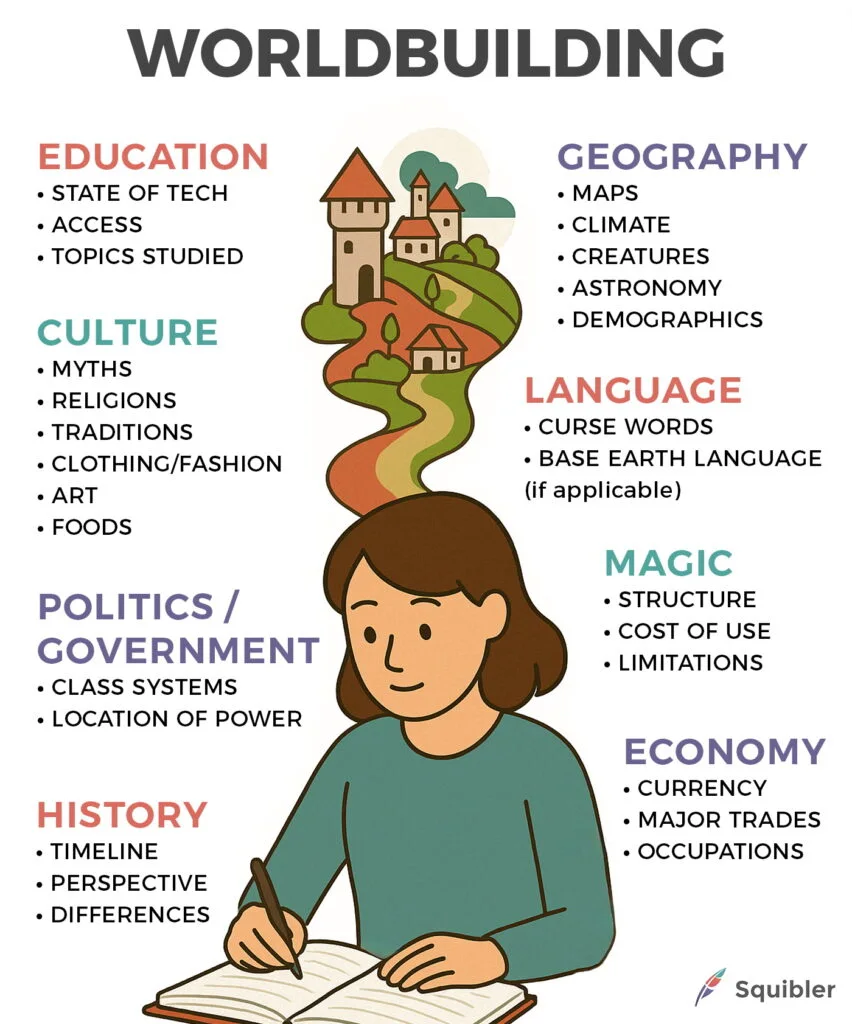
Here's how they form a feedback loop:
- History shapes Culture and Government. A past filled with brutal wars might forge a militaristic culture and an authoritarian government. A history of magical discovery might lead to a culture that reveres knowledge and a government run by mages.
- Government shapes Culture and History. A ruling body enacts laws that reflect and enforce cultural norms. It also controls the "official" narrative of history, deciding which events are celebrated and which are buried. Think of the Ministry of Magic in Harry Potter trying to suppress the truth of Voldemort's return.
- Culture shapes Government and History. A society's shared values, beliefs, and traditions determine what forms of leadership are considered legitimate and which historical figures become heroes or villains. A culture that values strength might accept a ruler who takes power by force.
A society feels authentic when these three pillars are logically connected. The first step is to establish the foundation: its past.
Pillar 1: History – The "Why" of Your Society
History provides the "reason for being" for your society. It explains why things are the way they are. You don't need to write a detailed textbook, but having a general sense of the major events that shaped your world will give it depth and consistency.
This guide from RollForFantasy.com offers a straightforward approach to creating societies. We'll start with its first major point, which grounds society in its past.
Please read the section titled "Reason for being." Pay attention to how the author provides a short historical justification for the orc, human, and elven societies. This "reason" is the core of your world's backstory.
As the guide points out, making a society dystopian "just because you need it to be" feels hollow. Grounding it in a history of corporate corruption, as in their example, makes it far more plausible.
History doesn't just exist in books; it's written on the landscape itself. The following video discusses city-building, but its points on historical layers are universally applicable.
The Ultimate Guide to Worldbuilding Fantasy Cities
This video from The Tale Tinkerer, "The Ultimate Guide to Worldbuilding Fantasy Cities," explains how to make a setting feel ancient and lived-in.
Watch the segment from the beginning of the main content. The creator discusses how a city's past becomes its present through visible layers of history, cultural exchange, and founding myths. This is a powerful visualization technique for imagining your world's backstory.
Pillar 2: Government – The Structure of Power
Once you have a history, you can consider how your society organizes itself. Government is the framework of power, law, and social order. Who rules, and why? How are laws made and enforced? Your background in commerce will likely make these concepts of structure, hierarchy, and resource control quite intuitive.
This infographic gives a quick overview of the sheer variety of governmental systems you can draw from.

To see how these concepts apply to storytelling, the next video offers an entertaining and insightful breakdown of common government types in fiction, highlighting their storytelling potential and common pitfalls.
WORLDBUILDING GOVERNMENTS AND POLITICS - Terrible Writing Advice
This video from the channel Terrible Writing Advice humorously deconstructs how governments are used (and misused) in fiction.
First, watch the breakdown of the most common fantasy government, the Monarchy. Notice the distinction between absolutist and constitutional monarchies. Next, watch the segment on Republics and Democracies. The video explains different models (Roman, Athenian, parliamentary, presidential) and their inherent strengths and weaknesses, which are great sources of conflict.
To build out your government, you need to consider not just the rulers, but the entire system of control.
Let's return to the "Society creation guide" to flesh out the concept of governance.
Read the sections on Rulers and Law and order. These sections prompt you to think about how leaders come to power and the nature of law enforcement, which says a lot about a society. A corrupt city guard creates a very different world from a respected and efficient one.
The system you designed in the last lesson has huge implications here. If magic is hereditary, it might lead to a magical aristocracy or monarchy. If advanced tech requires rare resources, a plutocracy (rule by the wealthy who control those resources) or a corporatocracy could emerge.
Pillar 3: Culture – The Texture of Daily Life
If history is the foundation and government is the framework, culture is the living, breathing soul of your society. It’s the collection of shared behaviors, beliefs, and values that define a people. It’s what people do every day: what they eat, what they wear, what they celebrate, what they fear, and what they hold sacred.
An Easy Guide to Crafting Fictional Cultures - Well-Storied.
This article from Well-Storied provides an excellent, systematic breakdown of the elements that make up a culture.
First, read the introduction from the beginning. Then, browse through the twelve numbered sections, starting with "Developing Common Cultural Elements." You don't need to read each one in depth; the goal is to see the wide range of components—from religion and holidays to clothing and family dynamics—that you can use to build a unique culture.
Many of these cultural elements are born from your society's history and government. A society with a history of famine might have cultural traditions centered around food preservation and harvest festivals. A theocratic government will produce a culture where religious rituals are part of daily life. In Harry Potter, the wizarding world's history of persecution led to a culture of secrecy, enforced by the Ministry's "Statute of Secrecy."
Exercise: Outlining Your Society
Let's tie these three pillars together. In the last lesson's exercise, you began designing a system called "Chrono-Weaving," which allows users to manipulate the flow of time for small objects. Now, let's build the society that exists around it.
Your Task:
Based on the system of Chrono-Weaving, write a short outline (a few sentences for each point) for the society that has developed. Answer the following:
- History: What is a key event in this society's past related to Chrono-Weaving? (e.g., The "Shattered Century" was a dark age caused by temporal wars, leading to a deep cultural distrust of unchecked Chrono-Weaving.)
- Government: What kind of government rules this society, and how does it control or relate to Chrono-Weaving? (e.g., The society is a Technocracy ruled by the "Horologist's Guild." Only licensed members are permitted to practice Chrono-Weaving, and misuse is punished by having one's own timeline accelerated, causing rapid aging.)
- Culture: Describe one specific cultural tradition, norm, or piece of art that has emerged because of Chrono-Weaving. (e.g., A common wedding tradition involves the couple using their combined abilities to restore a broken object, symbolizing their commitment to repairing their relationship through difficult times. Conversely, intentionally breaking a restored object is the gravest insult.)
This exercise will help you see how history, government, and culture can be woven together to create a society that feels logical and rich with story potential.
Conclusion
Today, we've moved from the micro-level of a single system to the macro-level of an entire society. You've learned how a society's history, government, and culture are intertwined, each shaping and being shaped by the others. A compelling fictional world is one where these connections feel authentic, creating a believable stage for your characters and a deep well of potential conflicts to drive your plot.
Key Takeaways:
- A fictional society is built on the interconnected pillars of History (the past), Government (the power structure), and Culture (the daily life).
- History provides the "why" for your society's current state.
- Government determines who holds power and how rules are enforced, providing a source of stability and conflict.
- Culture encompasses the shared traditions, beliefs, arts, and norms that give a society its unique texture and identity.
- The specific rules of your world (like a magic or tech system) will profoundly influence all three pillars.
In our next and final lesson of this module, we will place your society onto the map. You'll learn how to create a plausible geography for your fictional world and explore how the physical environment—its mountains, oceans, climates, and resources—can have a dramatic impact on a society's history, government, and culture.