Welcome to the first lesson of our new module, "Prose and Stylistic Technique." In the previous module, we honed your ability to write compelling dialogue, culminating in a lesson on avoiding common pitfalls like info-dumping. By learning to cut unnecessary words and add subtext, you've already been practicing a key aspect of powerful prose: making every word count.
Now, we zoom out from dialogue to look at the very fabric of your writing—the sentences and words that build your world, describe your characters, and narrate your plot. You've mentioned wanting to elevate your writing beyond "basic average English," and this is where that journey begins. Our first step is to master the art of word selection.
This lesson focuses on choosing the most precise and impactful words. You will learn to distinguish between a word's literal meaning (denotation) and its associated feelings (connotation), and see how wielding this understanding allows you to control the tone, mood, and subtext of your writing with surgical precision.
Denotation and Connotation: The Two Sides of a Word
Every word carries two layers of meaning. The first is its literal, dictionary definition—this is its denotation. The second is the entire web of ideas, emotions, and cultural associations that it evokes—this is its connotation.
A skilled writer understands that readers react to both. Choosing a word with the right denotation but the wrong connotation can completely undermine the intended feeling of a scene.

To build a solid foundation, let's start with a formal definition of these terms.
The Importance of Word Choice in Writing
This article from Writers.com provides a clear and concise breakdown of the core elements of word choice. We'll start with the most fundamental one: meaning.
In the article, please read the section titled "Meaning". Pay close attention to the distinction between the "literal dictionary definition" (denotation) and the "web of uses and associations it carries" (connotation).
The difference between denotation and connotation is what makes the English language so rich and, at times, tricky. For example, group, crowd, and mob all denote a gathering of people. But their connotations are vastly different. A group feels neutral, a crowd feels large and impersonal, and a mob feels threatening and chaotic.
Let's watch a short video that uses memorable examples to illustrate how powerfully connotation works in storytelling.
Denotation and Connotation: What's the Difference?
This video from the channel Death Cafe with Cheri provides excellent, easy-to-grasp examples of denotation and connotation in action.
Watch the following three segments: The definitions, which clearly defines both terms. The first example, which explores the different feelings evoked by the words 'group,' 'crowd,' and 'mob.' The Star Wars example. This is a brilliant illustration of how the entire emotional weight of one of cinema's most iconic scenes hinges on the choice of a single word: 'father' versus 'dad' or 'papa'.
The Star Wars example is perfect because it shows that even with a word as common as "father," the connotative weight is immense. "Father" carries an authority and formality that "dad" or "papa" lacks, making Darth Vader's reveal both shocking and mythic. As a writer, every such choice is an opportunity to fine-tune your reader's emotional experience.
Shades of Meaning: The Myth of the Perfect Synonym
The concept of connotation leads us to a crucial principle: there are no true synonyms. Words that appear to mean the same thing almost always have subtle differences in their associations or intensity. We call these differences shades of meaning.
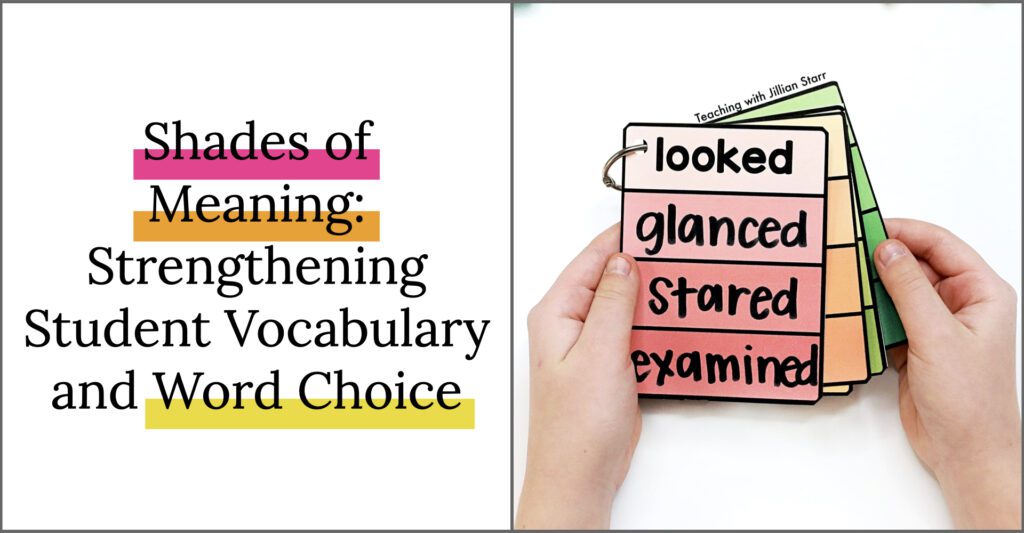
To look is general. To glance is quick and casual. To stare is intense and prolonged. To examine is careful and analytical. Choosing the right word from this spectrum gives the reader a much clearer picture of a character's actions and intentions. This is the essence of specificity.
Vague words force you to prop them up with other words, often adverbs. Specific words do the work on their own.
-
Weak: He walked very slowly through the mud.
-
Strong: He
trudgedthrough the mud. -
Weak: She looked at him angrily.
-
Strong: She
glaredat him.
Let's return to the article on word choice to explore how specificity strengthens your prose.
The Importance of Word Choice in Writing
This section focuses on the power of choosing specific, descriptive words over vague ones.
Please read the section titled "Specificity". Note the examples given, such as replacing "awful" with "despicable." Also, pay attention to the point about precise language making adverbs (like "very" or "overly") unnecessary.
Shaping the Reader's Experience: Tone, Mood, and Character
Now that we have our core tools—understanding connotation and valuing specificity—we can use them to achieve a specific impact. Your word choice is the primary dial you use to control the story's tone (the narrator's attitude) and mood (the feeling you create for the reader).
In a horror novel, a tree branch doesn't just break; it snaps. In a romance, a character's eyes don't just look nice; they sparkle.
12 Ways to Write Better Sentences for Creative Writers
In her video "12 Ways to Write Better Sentences," editor Ellen Brock demonstrates how word choice directly creates a specific vibe for the reader.
Watch the segment from "Set the tone with word choices". The example of the boat—how it can slice, bob, or float through the water—is a perfect demonstration of how a single verb choice can completely change the feeling of a sentence from aggressive to lazy to hopeful.
Beyond setting the mood, word choice is a powerful tool for characterization. A character's vocabulary and phrasing can reveal their:
- Education and background: Does a character use simple, direct words, or complex, academic language?
- Personality: Is their language optimistic or pessimistic? Formal or casual?
- Emotional state: Do they speak in clipped, sharp words when angry, or long, meandering sentences when thoughtful?
Furthermore, the overall vocabulary level of your narration has a direct impact on pacing. More complex language slows the reader down, encouraging them to savor the prose, while simpler language can create a faster, more breathless pace. Neither is inherently better; the choice depends on the story you want to tell.
12 Ways to Write Better Sentences for Creative Writers
This next segment from the same video explores the strategic use of vocabulary level.
Now watch from "Use vocabulary level strategically". The comparison between the dense prose of We Need to Talk About Kevin and the stark, direct style of Survivor is fantastic. It shows that a "lower" reading level doesn't mean less sophisticated writing; it's a stylistic choice that serves the story's pace and voice.
Conclusion
Mastering word choice is a lifelong practice, but its principles are straightforward. Moving beyond "basic English" isn't about memorizing obscure words; it's about learning to see the nuances in the words you already know and choosing them with intention. By paying attention to connotation, specificity, and tone, you transform your prose from a blunt instrument into a finely tuned one.
Key Takeaways:
- Denotation vs. Connotation: Denotation is a word's dictionary definition. Connotation is its emotional and cultural baggage. Effective writing leverages both.
- Specificity is Power: Precise nouns and verbs create vivid images and eliminate the need for weak adverbs. There are no perfect synonyms; every word has its own unique shade of meaning.
- Word Choice Creates Impact: The words you select determine the mood of a scene, the tone of the narration, and the pacing of the story.
- Words Reveal Character: A character's vocabulary is a fundamental part of their voice, revealing their background, personality, and emotional state.
In our next lesson, we will build directly on this foundation. Now that you understand why precise word selection is so critical, we will explore practical strategies for actively expanding your vocabulary, so you always have the right word at your fingertips.
Practice Exercise
Below is a short, neutral description of a character entering a forest. Your task is to rewrite it twice (about 100-150 words for each version).
- Version 1: Rewrite the scene to create a mood of wonder and enchantment.
- Version 2: Rewrite the scene to create a mood of dread and suspense.
Focus on changing the nouns, verbs, and adjectives to manipulate the connotations and specificity.
Original Scene:
The woman walked toward the forest. The trees were big, and the sun went down behind them. She went into the trees. It got darker. Sounds were audible in the woods around her. A path went through the bushes in front of her. She continued on her way.