Welcome to the final lesson in our module on Advanced Functions, Closures, and Decorators. In our previous session, you learned to stack decorators, gaining insight into how their application and execution order are critical design considerations. You saw that @A @B def func... is equivalent to func = A(B(func)), and this composition dictates the flow of logic in your programs.
However, the decorators we've built so far have a significant limitation: they are often tailored to functions with a specific signature. This brittleness prevents them from being truly reusable components. This lesson addresses that final piece of the puzzle. We will master the technique of argument forwarding, which allows a decorator to wrap any function, regardless of its parameters. This is the key to writing generic, framework-level code.
By the end of this lesson, you will be able to build universal decorators that correctly handle arbitrary arguments and return values, completing your deep dive into this powerful Python feature.
The Problem: Brittle Decorators
Let's start by seeing the problem firsthand. Imagine a simple decorator that runs a function twice. If we apply it to a function with no arguments, it works perfectly. But what happens when the decorated function requires arguments?
The following reading from "Primer on Python Decorators" demonstrates this exact issue. A decorator designed for a zero-argument function fails with a TypeError when applied to a function that takes an argument.
This section clearly illustrates the core problem we are about to solve. It shows a decorator breaking when the wrapped function's signature changes.
Please read the section Decorating Functions With Arguments. The key takeaway is the TypeError and its explanation: the inner wrapper function wrapper_do_twice() doesn't accept any arguments, but the call to the decorated function greet("World") tried to pass one to it.
You could try to fix this by adding a parameter to the wrapper, like def wrapper_do_twice(name):. However, this "fix" would then break the decorator for functions that take no arguments, or functions that take a different number of arguments. This approach isn't scalable. We need a general solution.
The Solution: *args and **kwargs
The solution lies in a fundamental Python feature for handling a variable number of arguments: *args and **kwargs. You've likely encountered these in your development work, particularly in frameworks like Django. Let's do a quick, focused review to ensure your understanding is solid before we apply them to decorators.
*argscollects any number of positional arguments into a tuple.**kwargscollects any number of keyword arguments into a dictionary.
The article "Python args and kwargs: Demystified" provides an excellent foundation.
Python args and kwargs: Demystified
This reading explains the syntax and behavior of *args and **kwargs in function definitions. It will solidify your understanding of how they work.
Please read the following three sections: Using *args: Focus on how *args gathers positional arguments into a tuple. Note that args is just a convention; the asterisk * is the crucial part. Using **kwargs: Understand how **kwargs gathers keyword arguments into a dictionary. Ordering Arguments: This is critical. Pay close attention to the required order of parameters in a function signature: standard arguments, *args, and then **kwargs.
Universal Argument Forwarding in Decorators
Now, we can apply this knowledge to make our decorators universal. By defining our inner wrapper function with the signature def wrapper(*args, **kwargs):, we create a "catch-all" that can accept any arguments passed to the decorated function.
Inside the wrapper, we then use the unpacking operators (* and **) to "forward" these arguments to the original function call: func(*args, **kwargs).
This video provides a superb visual explanation of this packing and unpacking process.
Python Decorators - Visually Explained
This video animates the entire process of argument forwarding, making the concepts of packing and unpacking very clear.
Watch the segment from reuse the decorator. Pay close attention to these three stages: The Problem: The video first shows how a decorator breaks when the decorated function takes arguments (functions that don't have parameters). Positional Arguments: It then introduces *args to solve the problem for positional arguments, visually showing arguments being packed into a tuple and then unpacked in the call to the base function (The answer is yes). Keyword Arguments: Finally, it adds **kwargs to handle keyword arguments, showing them being packed into a dictionary and then unpacked (our decorator isn't as flexible).
With this pattern, the decorator becomes transparent to the arguments of the function it wraps.
Handling Return Values and Metadata
A truly robust decorator must do two more things:
- Return the value from the original function. If the wrapper doesn't explicitly return the result of
func(*args, **kwargs), the return value will be lost (and the decorated function will implicitly returnNone). - Preserve the original function's metadata (its name, docstring, etc.). Decorators work by replacing the original function with a wrapper. Without intervention, introspection tools see the wrapper function's details, not the original's.
The Primer on Python Decorators article continues right where we left off, addressing these exact points.
This reading shows you how to complete the decorator pattern by handling return values and preserving metadata.
Continue your reading in the same article: Argument Forwarding Solution: First, read this short section which shows the code solution using *args, **kwargs for the problem we identified earlier. Returning Values: This section explains why you must capture and return the value from the decorated function call. Preserving Metadata: This section introduces @functools.wraps, the standard tool for solving the metadata problem. This is a critical best practice.
The Universal Decorator Blueprint
By combining argument forwarding, return value handling, and metadata preservation, we arrive at a standard, production-ready blueprint for any decorator.
This image provides a fantastic visual summary of all the components of a robust decorator.
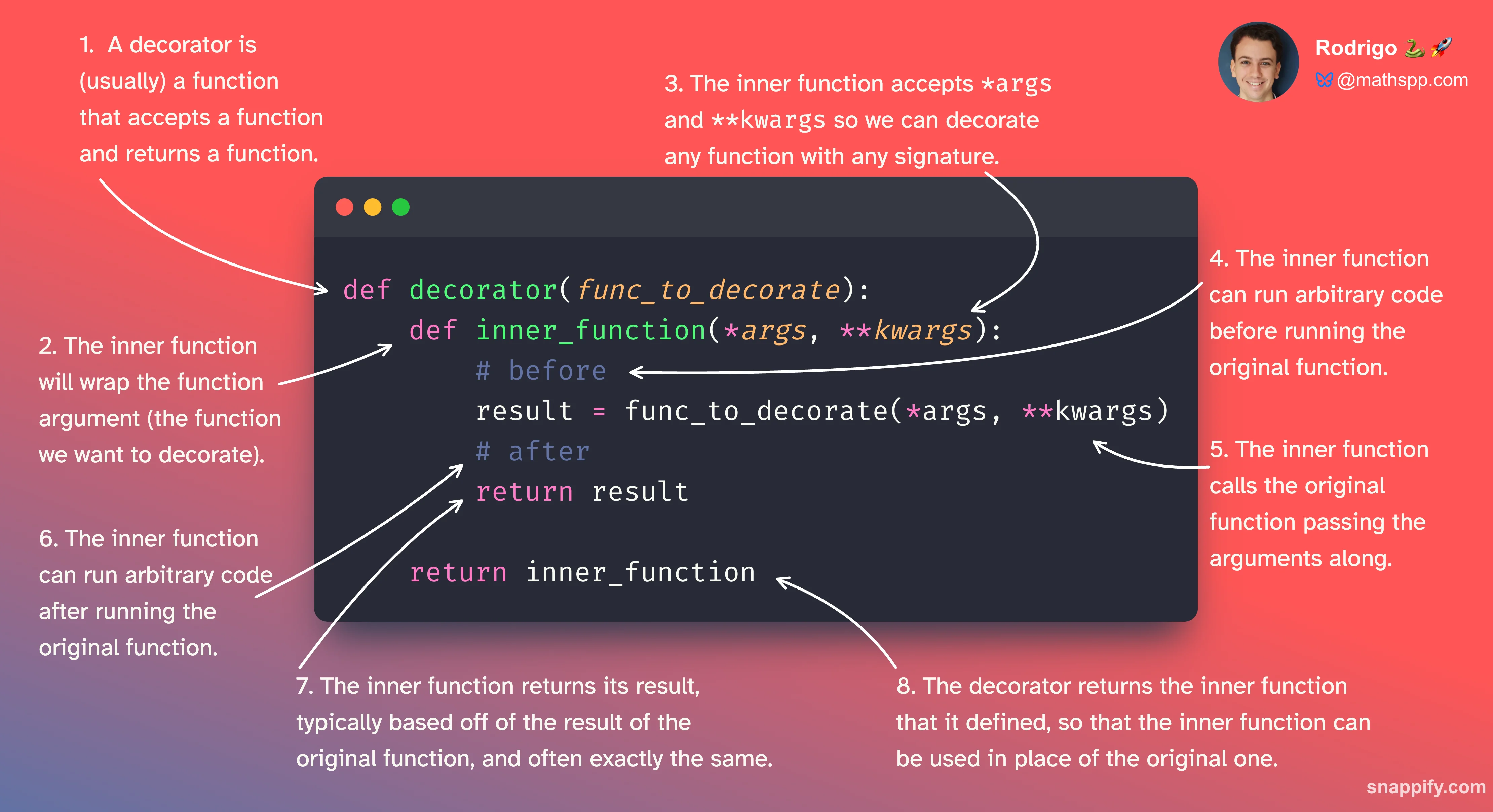
And here is what that blueprint looks like in clean, idiomatic Python code. This is the pattern you should internalize.

As a full-stack developer using Django, you're already using decorators that rely on this exact pattern. For example, Django's @login_required or @permission_required decorators must wrap view functions that can have varied signatures (e.g., def my_view(request): vs. def my_detail_view(request, pk):). These decorators work universally precisely because their internal wrapper is defined with def wrapper(request, *args, **kwargs): and forwards the arguments to the original view. Understanding this pattern demystifies a core part of the framework's magic.
Conclusion
In this lesson, you've assembled the final components for creating truly powerful and reusable decorators. By mastering argument forwarding, you can now write higher-order functions that are flexible, robust, and agnostic to the implementation details of the functions they modify.
Here are the key takeaways:
- Brittle Signatures are a Problem: Hardcoding parameters in a decorator's wrapper limits its reusability.
- Universal Forwarding with
*argsand**kwargs: The combination ofdef wrapper(*args, **kwargs):to accept arguments andfunc(*args, **kwargs)to forward them is the standard solution. - A Robust Decorator Must:
- Accept arbitrary arguments using
*argsand**kwargs. - Forward those arguments to the original function call.
- Capture and return the result from the original function.
- Use
@functools.wrapsto preserve the original function's name, docstring, and other metadata.
- Accept arbitrary arguments using
This lesson concludes our deep dive into Python's advanced function concepts. You now have a senior-level understanding of functions as first-class objects, closures, lexical scoping, and the complete decorator pattern.
In the next module, we will shift our focus to Iterators, Generators, and Context Managers. We'll explore Python's mechanisms for lazy evaluation and memory-efficient data processing, skills that are indispensable for building scalable backend systems and handling large datasets.