In our last lesson, we explored the classical idea of escape velocity and saw how it leads to the theoretical concept of a black hole—an object so dense that its escape velocity surpasses the speed of light. This view, rooted in Newton's physics, treats gravity as a force pulling objects together. However, this is not the complete picture. To truly grasp the nature of black holes and their effects on the universe, we need to shift our perspective entirely.
This lesson delves into one of the most profound ideas in modern physics: Albert Einstein's theory of General Relativity. We will explore his revolutionary view of gravity not as a force, but as the curvature of a unified fabric called spacetime, which is bent and warped by the presence of mass and energy. Understanding this geometric view of gravity is fundamental to our entire journey toward understanding black holes and their place in the cosmos.
Einstein's Happiest Thought
In 1907, while working at the patent office in Bern, Albert Einstein had what he later called "the happiest thought of my life." He imagined a person falling from the roof of a house. He realized that during the fall, the person would feel weightless. If they were to drop objects from their pockets, those objects would float alongside them. In that moment, for that falling observer, the force of gravity would seem to have vanished.
This simple thought experiment contains the seed of a revolutionary idea: the Principle of Equivalence. It states that the effects of gravity are locally indistinguishable from the effects of acceleration.
- An observer in a windowless room in freefall near Earth experiences weightlessness, exactly like an observer floating in a spaceship in the vacuum of deep space, far from any source of gravity.
- An observer standing in that same room on the surface of the Earth feels a downward pull. This is indistinguishable from the "force" they would feel if the room were a rocket in deep space, accelerating "upwards" at 9.8 m/s².
This equivalence is not just a similarity; Einstein proposed it is a fundamental identity. The following video from the channel Veritasium provides a wonderfully clear and intuitive explanation of this principle and its profound consequences.
What Everyone Gets Wrong About Gravity
This video, "What Everyone Gets Wrong About Gravity," will help you build a strong intuition for the equivalence principle and why it forces us to reconsider the very nature of gravity.
Watch the segment that begins with Einstein's "happiest thought" and explains the equivalence between a falling person and an astronaut in deep space. Focus on the core argument: if the experience of the observer is identical, then the physical situation must be the same. This section runs from the happiest thought.
The video makes a crucial point: if a person in freefall feels no force and experiences no acceleration—if they are an "inertial observer"—then gravity cannot be a force in the traditional sense. So what is it? Einstein concluded that gravity must be a property of the environment itself, an intrinsic feature of the universe that all objects are subject to. That feature, he would discover, is the geometry of spacetime.
The Fabric of Reality: Spacetime
Before Einstein, space and time were considered separate, absolute concepts—a fixed, unchanging stage on which the events of the universe played out. Einstein's theory of Special Relativity (1905) had already challenged this, showing that space and time are relative and interwoven.
It was his former professor, Hermann Minkowski, who formalized this by proposing the concept of a single, four-dimensional entity: spacetime. In this view, reality is a continuum with three spatial dimensions (length, width, height) and one time dimension. Every event in the universe has a specific location in both space and time.
To learn more about this foundational concept, we'll turn to a brief reading from Stanford University's Gravity Probe B project.
GP-B — Einstein's Spacetime - Gravity Probe B
This section will introduce you to Minkowski's idea of a four-dimensional spacetime, which became an essential mathematical tool for Einstein's theory of gravity.
Please read the first section, The Fourth Dimension. Pay attention to Minkowski's famous quote and the idea of a "worldline" representing an object's path through spacetime.
Matter Bends Spacetime, and Spacetime Guides Matter
With the concepts of the equivalence principle and a unified spacetime, we can now assemble Einstein's full picture of gravity. He proposed that spacetime is not a rigid, passive backdrop. Instead, it is a dynamic, flexible fabric that is distorted by the presence of mass and energy.
This is the central idea of General Relativity, often summarized in a phrase coined by physicist John Archibald Wheeler: "Spacetime tells matter how to move; matter tells spacetime how to curve."
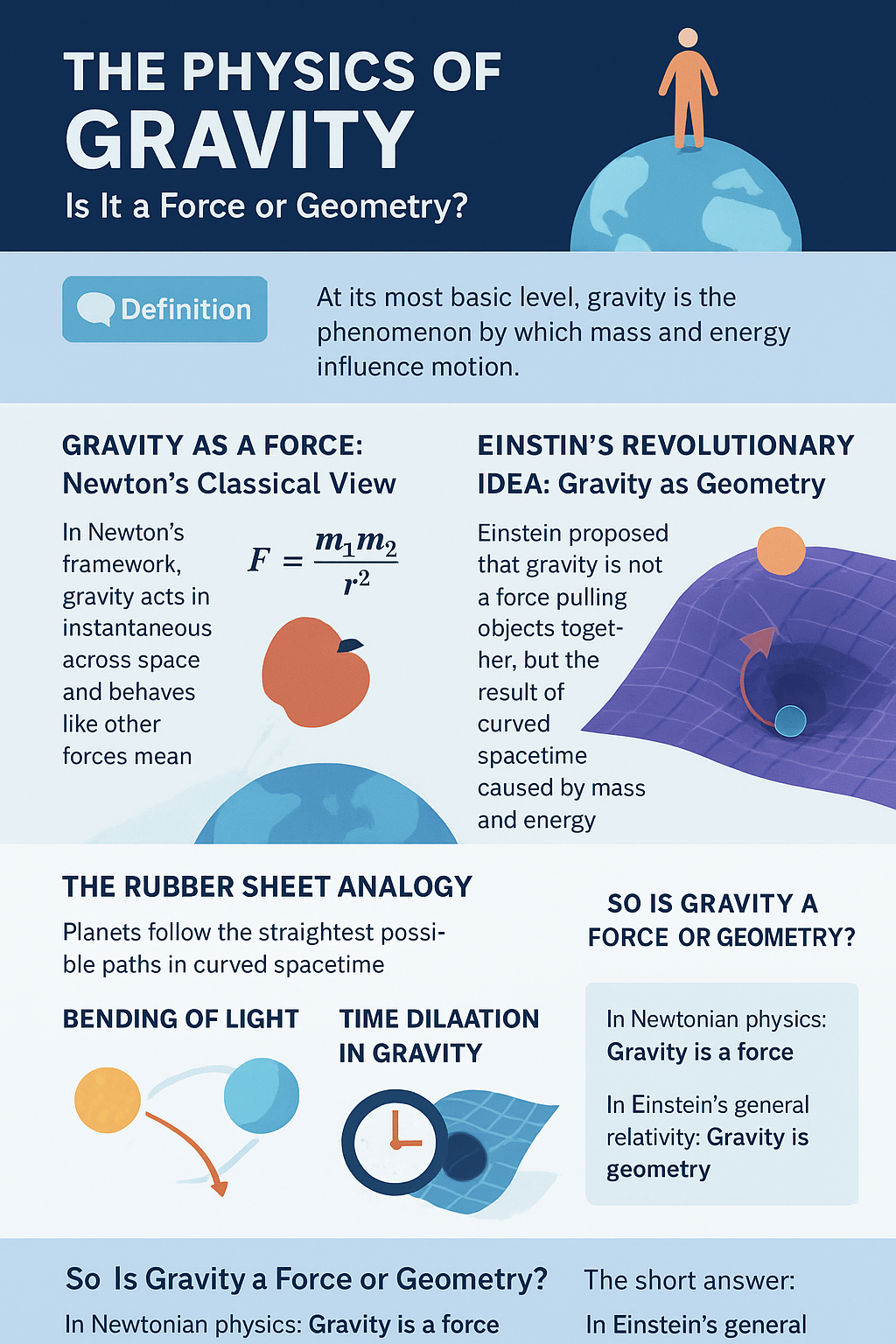
The most common analogy used to visualize this is a bowling ball placed on a stretched rubber sheet.
- The massive bowling ball (like the Sun) creates a deep depression in the sheet (spacetime).
- A marble (like the Earth) rolled nearby doesn't get "pulled" towards the bowling ball by a mysterious force. Instead, it follows the straightest possible path across the curved surface of the sheet, causing it to circle the central depression in an orbit.
An object in "freefall"—whether it's an apple falling to Earth or a planet orbiting the Sun—is simply following its natural path, a geodesic, through the curved geometry of spacetime. What we perceive as the force of gravity is merely the effect of moving along these curved paths.

The following reading elaborates on this core concept.
GP-B — Einstein's Spacetime - Gravity Probe B
These next two sections from the Stanford resource connect the equivalence principle directly to the idea of curved spacetime and explain the rubber sheet analogy in more detail.
First, read the section on The Equivalence Principle. This reinforces the leap from equivalence to the idea that gravity must be a property of spacetime. Then, continue to the next section, Gravity as Curved Spacetime, which explains the curvature concept and the rubber sheet analogy.
A New Way to Visualize Gravity
While the rubber sheet analogy is useful, it has serious limitations. It uses gravity (the ball sinking) to explain gravity, and it only shows the curvature of space, completely ignoring the crucial role of time. In fact, for everyday gravity on Earth, the "warping" of time is far more significant than the warping of space.
A better way to think about it is that massive objects alter the flow of time. Clocks closer to a massive object run slightly slower than clocks farther away. An object in freefall, like a dropped apple, isn't just moving through curved space; it's following a path through curved time. It's converting its motion forward through time into motion downward through space.
The following video from the channel ScienceClic English does a masterful job of deconstructing the flawed rubber sheet analogy and building a more accurate, dynamic visualization of General Relativity.
A new way to visualize General Relativity
This video, "A new way to visualize General Relativity," will give you a more sophisticated and physically accurate mental model of how gravity works.
First, watch the critique of the elastic sheet analogy to understand its shortcomings. Next, see how the curvature of the time dimension is the primary reason objects fall. This is the conceptual heart of the video. Finally, watch the unique animation showing gravity as a perpetual contraction of the grid. An object in freefall is motionless relative to this falling grid, which is why it appears to accelerate towards the massive body.
This final visualization is powerful. The ground beneath your feet is constantly pushing against this natural "in-falling" of spacetime, which is why you feel a force (your weight) and are in a state of constant upward acceleration, even while standing still. A person in freefall, by contrast, is simply moving along with the natural geometry of spacetime and thus feels no force at all.
Conclusion
In this lesson, we have fundamentally shifted our understanding of gravity, moving from Newton's idea of a force to Einstein's more profound vision of geometry in motion.
Let's recap the key points:
- The Equivalence Principle establishes that gravity is indistinguishable from acceleration, suggesting it is not a force but a property of spacetime.
- Mass and energy curve the four-dimensional fabric of spacetime.
- Objects move along the straightest possible paths (geodesics) through this curved spacetime. We perceive this motion as the effect of gravity.
- This curvature affects both space and, crucially, time. The "warping" of time is what primarily causes objects to fall.
We have now replaced the classical notion of gravity with a much more powerful and accurate framework. In our next lesson, we will apply this understanding of extreme spacetime curvature to its ultimate source: a collapsing star. We will see how this process can bend spacetime so severely that it leads to the formation of an object with gravity so strong, it traps everything—even light.