Welcome to the final lesson of our first module. In our previous lesson, we witnessed the dramatic end of a massive star's life, culminating in an unstoppable gravitational collapse. We saw that if the star's core is massive enough, no known force can halt this collapse, crushing matter into an object of extreme density. Today, we will give that object a name and a precise definition.
This lesson will connect the concepts of gravity, mass, and stellar collapse to formally define a black hole. We will explore the idea of escape velocity and see how, for these collapsed stellar cores, it reaches the ultimate cosmic speed limit—the speed of light. This will establish the fundamental property of a black hole and set the stage for exploring its strange anatomy in our next module.
Escaping Gravity's Pull
Every object with mass exerts a gravitational pull. To break free from that pull, you need to travel at a certain minimum speed. This speed is called the escape velocity. For instance, a rocket launching from Earth must reach a speed of about 11 kilometers per second (over 40,000 km/h) to escape Earth's gravity and travel into deep space. If it moves any slower, it will eventually fall back down.
The idea that gravity could be strong enough to trap even light is surprisingly old, predating Einstein by over a century. The physicist Brian Cox provides a wonderful introduction to this historical concept.
Brian Cox on how black holes could unlock the mysteries of our universe
In this clip from Big Think, Brian Cox explains the early origins of the black hole concept, starting with the work of John Michell and Pierre-Simon Laplace in the late 1700s.
Watch the first segment where he introduces the concept of escape velocity and the thought experiment of an object massive enough to trap light. Then, continue to his description of the event horizon as the boundary from which you cannot escape.
As Professor Cox explained, the escape velocity of an object depends on two factors: its mass and its size. A more massive object has a stronger gravitational pull, and thus a higher escape velocity. But equally important, if you compress an object to make it smaller while keeping its mass the same, the gravitational pull at its surface becomes much stronger, and its escape velocity increases.
Let's dive deeper into this crucial idea.
24.5 Black Holes - Astronomy 2e | OpenStax
This reading from the OpenStax Astronomy 2e textbook formalizes the thought experiment of compressing a star and its effect on escape velocity.
Please read the section titled Classical Collapse. Pay close attention to the logical progression: as the Sun is imagined to shrink, the distance to its center decreases, gravity at the surface increases, and therefore the escape velocity rises.
The Point of No Return
The thought experiment in the reading leads us to a remarkable conclusion. As an object is compressed smaller and smaller, its escape velocity continues to climb. Eventually, a critical point is reached where the escape velocity becomes equal to the speed of light (approximately 300,000 kilometers per second). If the object is compressed even further, the escape velocity exceeds the speed of light.
Since the theory of relativity tells us that nothing in the universe can travel faster than light, this creates a one-way trap. Once the escape velocity surpasses the speed of light, nothing—no particle, no rocket, and not even light itself—can get away.
This is the definition of a black hole: a region of spacetime where gravity is so strong that the escape velocity is greater than the speed of light.
The object has become truly "black" because the very light that would allow us to see it cannot escape its surface.
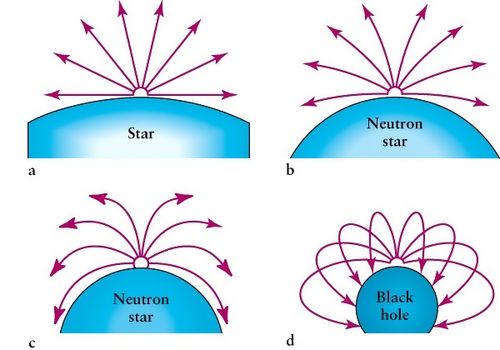
The following video provides a concise and dynamic summary, connecting the stellar collapse we learned about in the last lesson to the formation of this inescapable object.
Black Holes Explained – From Birth to Death
This video from Kurzgesagt, titled "Black Holes Explained," animates the process of a star's death and the formation of a black hole.
First, watch the recap of stellar collapse from the failure of fusion to the supernova. This reinforces what we covered in our previous lesson. Next, watch the explanation of what defines a black hole, focusing on the event horizon as the boundary where the escape velocity surpasses light speed.
Gravity as Curved Spacetime
In our second lesson, we learned that Einstein's theory of General Relativity describes gravity not as a force, but as a curvature of spacetime caused by mass and energy. A black hole represents the most extreme case of this curvature.
It's not that gravity is "pulling" on light. Rather, the mass has become so concentrated that it has warped the fabric of spacetime to an incredible degree. Close to a black hole, spacetime is so distorted that all possible paths for a particle or a ray of light that lead "outward" are curved back inward. The very geometry of space prevents escape.

The boundary that marks this "point of no return," where the escape velocity equals the speed of light, is called the event horizon. Anything that crosses the event horizon—a spaceship, a planet, a ray of light—is trapped forever and can no longer affect or communicate with the outside universe.
To solidify this relativistic view, let's return to our OpenStax reading.
24.5 Black Holes - Astronomy 2e | OpenStax
This reading connects the classical idea of escape velocity to the modern, relativistic understanding of black holes as regions of extreme spacetime curvature.
Read the section Collapse with Relativity, which explains how the curvature of spacetime itself is what traps light. Then, continue reading about the properties of the event horizon and how its size, the Schwarzschild radius, depends on the black hole's mass.
Conclusion
In this lesson, we have arrived at a formal definition of a black hole, bridging the gap between stellar collapse and the strange objects that result. Let's review the key points:
- Escape velocity is the speed required to break free from an object's gravitational influence. It depends on both the object's mass and its size.
- The catastrophic collapse of a massive star's core creates an object of immense density.
- A black hole is defined as an object so dense that its escape velocity exceeds the speed of light, the universe's ultimate speed limit.
- This creates a boundary called the event horizon, a one-way membrane through which nothing can escape, because the very fabric of spacetime inside it is curved inward.
We have now laid all the necessary groundwork, from escape velocity and spacetime curvature to stellar collapse. We are ready to begin exploring the black hole itself. In our next module, we will start by taking a much closer look at the properties of the event horizon, the enigmatic "surface" of the black hole.