Hello! Welcome back to our course on Operating Systems.
In our last lesson, we explored binary and counting semaphores, understanding their atomic wait and signal operations. We saw how they can be used for mutual exclusion and for managing pools of resources. While those examples were fundamental, the real power of semaphores lies in coordinating more complex interactions between processes.
Today, we will tackle the Producer-Consumer Problem, a classic synchronization challenge that appears frequently in the GATE exam. Our goal is to use the semaphores we learned about to build a correct and robust solution. By the end of this lesson, you will be able to implement the solution and, crucially, analyze why it works and how incorrect implementations can fail—a key skill for GATE.
1. Understanding the Producer-Consumer Problem
The scenario is straightforward:
- One or more Producer processes generate data (items) and place them into a shared buffer.
- One or more Consumer processes take these items out of the buffer and consume them.
- The shared buffer has a fixed size, let's say
nslots.
This simple setup introduces three core synchronization constraints:
- Preventing Overflow: The producer must not add an item to the buffer if it is full. If it is full, the producer must wait.
- Preventing Underflow: The consumer must not try to remove an item from the buffer if it is empty. If it is empty, the consumer must wait.
- Ensuring Mutual Exclusion: The producer and consumer must not access the buffer at the same time to avoid corrupting the data or the buffer's state.
To get a clear picture of this problem, let's start with a short introductory video.
4.13 Producer Consumer Problem | Semaphores | Process Synchronization | OS | Operating System |
This video from KnowledgeGATE by Sanchit Sir clearly introduces the Producer-Consumer problem, defining the roles of the producer, consumer, and the shared buffer, and outlining the coordination issues that need to be solved.
Watch from 00:23 to 03:19. Focus on understanding the three main issues: producer waiting when full, consumer waiting when empty, and the need for mutual exclusion.
2. The Semaphore-Based Solution
To address the three constraints we just identified, we will use a combination of counting and binary semaphores. This is the standard, elegant solution you must know for the GATE exam. We need three semaphores:
-
full: A counting semaphore to track the number of filled slots in the buffer.- A consumer will perform
wait(full)before consuming. Iffullis 0 (buffer is empty), the consumer blocks. - A producer will perform
signal(full)after producing. - Initial value: 0.
- A consumer will perform
-
empty: A counting semaphore to track the number of empty slots in the buffer.- A producer will perform
wait(empty)before producing. Ifemptyis 0 (buffer is full), the producer blocks. - A consumer will perform
signal(empty)after consuming. - Initial value:
n(the size of the buffer).
- A producer will perform
-
mutex: A binary semaphore to ensure mutual exclusion when accessing the buffer.- Both producer and consumer must perform
wait(mutex)before entering the critical section (accessing the buffer) andsignal(mutex)after leaving it. - Initial value: 1.
- Both producer and consumer must perform
The following pseudocode shows how these semaphores are used.
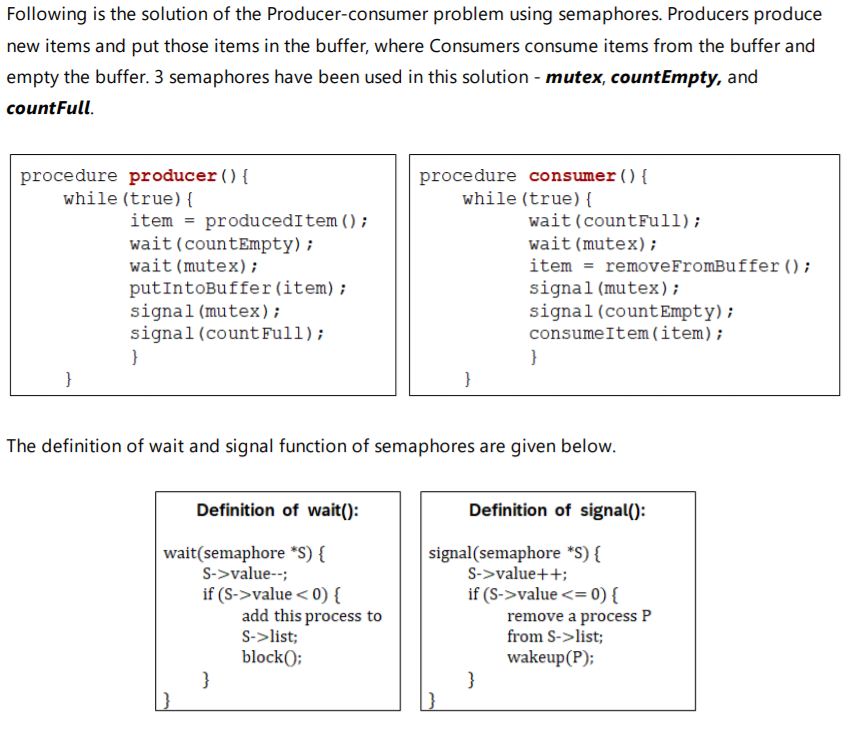
Let's break down the logic:
-
Producer:
wait(empty): Decrements the count of empty slots. If there are no empty slots, the producer blocks until a consumer frees one up. This solves the overflow problem.wait(mutex): Acquires the lock for the critical section.- ...Add item to buffer...: The critical section where the buffer is modified.
signal(mutex): Releases the lock.signal(full): Increments the count of full slots, potentially waking up a waiting consumer.
-
Consumer:
wait(full): Decrements the count of full slots. If there are no full slots, the consumer blocks until a producer adds an item. This solves the underflow problem.wait(mutex): Acquires the lock for the critical section.- ...Remove item from buffer...: The critical section.
signal(mutex): Releases the lock.signal(empty): Increments the count of empty slots, potentially waking up a waiting producer.
3. Visualizing the Solution in Action
Reading pseudocode is one thing, but seeing it handle concurrent execution is another. The following video provides an excellent step-by-step walkthrough of how these semaphores manage the processes, even when preemption occurs.
L-3.11: Solution of Producer Consumer Problem using Semaphore | Operating System
This video from Gate Smashers demonstrates the semaphore solution dynamically. It's crucial for understanding how the semaphore values change and how processes are blocked and unblocked to maintain correctness.
Watch from 01:40 to 17:25. The first part (until 08:43) shows a simple sequential execution. The second part (from 08:43 onwards) is more important, as it simulates preemption and shows how the semaphores prevent race conditions and ensure data consistency. Pay close attention to how a process gets blocked on a semaphore when its value is zero or negative.
4. A Critical Detail: The Order of Wait Operations and Deadlock
The solution we've just studied works perfectly. However, a slight change in the code can lead to a catastrophic failure: deadlock. This is a favorite topic for GATE questions.
Consider this incorrect version of the consumer code:
// Incorrect Consumer Code
wait(mutex); // Swapped with wait(full)
wait(full);
// ... critical section ...
signal(mutex);
signal(empty);
What could go wrong here? Let's trace a scenario:
- The buffer is empty. The semaphore values are
full = 0,empty = n,mutex = 1. - The Consumer process runs. It executes
wait(mutex). The value ofmutexbecomes 0. The consumer now has the lock. - The Consumer then executes
wait(full). Sincefullis 0, the consumer blocks. Crucially, it blocks while still holding the mutex lock. - Now, the Producer process runs. It needs to add an item to the buffer to wake up the consumer. It starts by executing
wait(empty), which succeeds. - Next, the Producer tries to execute
wait(mutex)to enter its critical section. - However,
mutexis 0 (held by the blocked consumer). So, the Producer also blocks.
Now, the Consumer is waiting for the Producer to signal full, but the Producer is waiting for the Consumer to signal mutex. Neither can proceed. This is a classic deadlock.
The rule is simple but vital: Always perform the resource availability check (wait(empty) or wait(full)) before acquiring the mutual exclusion lock (wait(mutex)).
Let's analyze a real GATE question that tests this exact type of flaw.
Operating System: GATE CSE 2014 Set 2 | Question: 31
This GATE Overflow page discusses a 2014 GATE question. The provided code has a subtle error in the semaphore logic that leads to deadlock under certain conditions. The discussion walks through the scenario that causes the deadlock.
Read the question and then look at the first comment and the accepted answer. The explanation details a step-by-step simulation where both the producer and consumer get blocked, leading to a deadlock. Understand the sequence of events that triggers this state.
Test your understanding!
Analyze the code in the image below. It presents a slightly different but also flawed implementation of the Producer-Consumer problem.
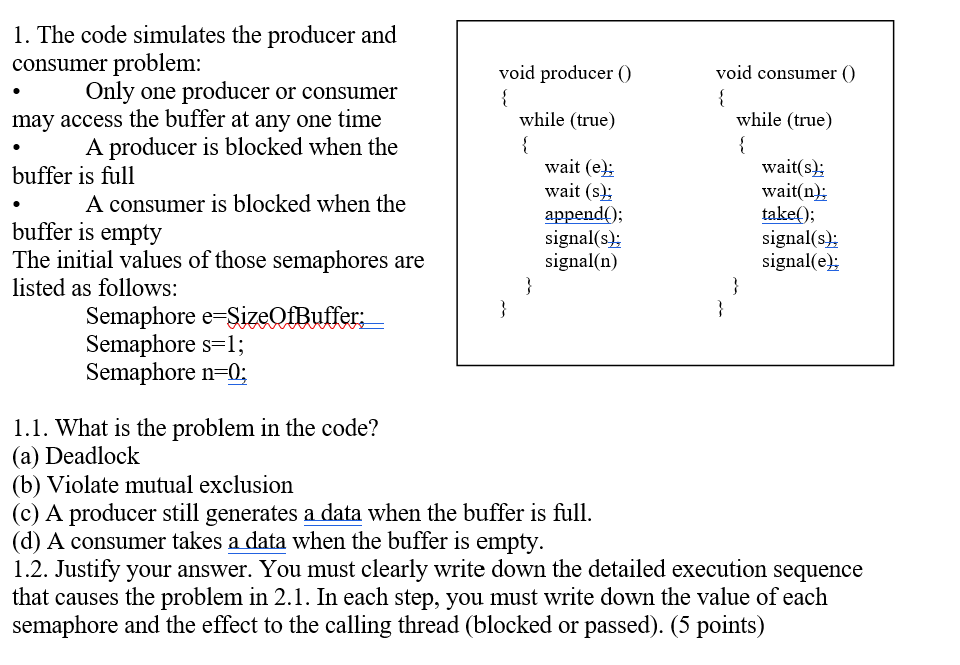
What is the error in this code? Describe a sequence of operations that demonstrates the error.
Show answer
The error is the same one we just discussed: the wait(mutex) call is performed before wait(full) in the consumer and before wait(empty) in the producer. This can lead to deadlock.
Execution Sequence for Deadlock:
- Initial State: Assume the buffer is empty.
full = 0,empty = 5,mutex = 1. - Consumer Runs:
wait(mutex): Succeeds.mutexbecomes 0.wait(full): Fails (sincefullis 0). The consumer process blocks, but it still holds the mutex.
- Producer Runs (Context Switch):
wait(mutex): Fails (sincemutexis 0, held by the consumer). The producer process blocks.
Result: Both processes are blocked forever. The consumer is waiting for the producer to signal full, but the producer can't run because it's waiting for the consumer to signal mutex.
Conclusion
In this lesson, we moved from the theory of semaphores to a significant practical application: solving the Producer-Consumer problem. This is a foundational concept in concurrency, and mastering its solution is essential for the GATE exam.
Key Takeaways:
- The Producer-Consumer problem requires managing three conditions: buffer overflow, buffer underflow, and mutual exclusion.
- The standard solution uses three semaphores: a counting semaphore
full(initially 0), a counting semaphoreempty(initiallyn), and a binary semaphoremutex(initially 1). - The
fullandemptysemaphores elegantly handle the waiting logic for buffer state, whilemutexprotects the critical section. - The order of semaphore operations is critical. Performing
wait(mutex)before checking resource availability (wait(full)orwait(empty)) can lead to deadlock.
In our next lesson, we will explore another classic synchronization challenge: the Readers-Writers Problem. This problem introduces more complex constraints, where we want to allow multiple "reader" processes to access data simultaneously, but a "writer" process must have exclusive access.