Hello! Welcome to your next lesson.
In our last session, we saw how atomic hardware instructions like Test-and-Set provide a robust solution for mutual exclusion, overcoming the race conditions of simple software locks. We also noted a key characteristic of the basic implementation: a waiting process enters a "busy-wait" loop, continuously consuming CPU cycles. This approach, while simple, can be inefficient and lead to problems like priority inversion.
Today, we'll build directly on that foundation. This lesson formally introduces two fundamental synchronization mechanisms: spinlocks (which use busy-waiting) and mutex locks (which avoid it). Our goal is to describe how each works and, most importantly, compare them to understand their trade-offs. This comparison is crucial for solving performance-related synchronization questions that frequently appear in the GATE exam.
1. From Busy-Waiting to Blocking: The Mutex Lock
The primary drawback of the Test-and-Set loop we studied is busy-waiting. A process stuck in that loop is "spinning"—using its entire CPU time slice to repeatedly check a lock. This is wasteful. If a process can't proceed, it would be far more efficient to take it off the CPU and let another process run.
This is the core idea behind the mutex lock. The name "mutex" is short for mutual exclusion. Like a spinlock, it ensures only one thread can be in a critical section at a time. However, its approach to waiting is different.
Instead of spinning, a thread that tries to acquire a locked mutex is put into a sleeping or blocked state by the operating system. It yields the CPU and is placed in a queue of threads waiting for that specific lock.
Let's watch a short video that introduces this concept.
The video 'OS30 - Mutex Lock' from the EZCSE channel provides a clear, high-level introduction to mutex locks and their basic mechanics.
Watch the first 1 minute and 15 seconds. This segment defines what a mutex is and describes the general idea of acquiring and releasing a lock.
The Atomicity Requirement
As we've learned, implementing locks is tricky. If we design a mutex with simple, separate instructions for checking the lock and acquiring it, we will face the exact same race condition that plagued our initial software lock attempts.
To illustrate this, let's see what happens when the acquire operation is not atomic.
The same video now demonstrates the critical flaw of a non-atomic acquire operation. This reinforces why we need hardware support.
Continue watching from 01:15 to 05:52. Observe how a context switch between checking the lock and setting it allows two processes to enter the critical section, violating mutual exclusion.
This failure shows that the core operations of a mutex—acquire() and release()—must themselves be atomic. Modern operating systems implement these operations using the very hardware instructions we discussed in the last lesson, like Test-and-Set or Compare-and-Swap.
A typical implementation of a mutex lock looks like this:
acquire(): The thread callsacquire(). The OS uses an atomic instruction to check if the lock is free.- If free: The OS grants the lock to the thread, and it proceeds into the critical section.
- If busy: The OS adds the thread to a waiting queue associated with the lock, changes the thread's state to Blocked, and calls the scheduler to run a different thread.
release(): The thread finishes its critical section and callsrelease().- The OS checks the waiting queue. If it's empty, it simply marks the lock as free.
- If the queue is not empty, the OS picks a thread from the queue (often in FIFO order), moves it to the Ready state, and marks the lock as held by this newly awakened thread.
The key takeaway is that a mutex avoids wasting CPU cycles by putting waiting threads to sleep. However, this comes at the cost of two context switches: one to put the thread to sleep and another to wake it up later.
2. The Spinlock: A Formal Look at Busy-Waiting
What we previously called "busy-waiting" is the defining feature of a spinlock. It's a lock where a waiting thread repeatedly checks the lock status in a tight loop until it becomes available.
As the previous video mentioned, this mechanism has a name.
Let's revisit the EZCSE video, which explicitly defines the busy-waiting mechanism as a spinlock.
Watch from 08:10 to 08:54. This brief segment formally attaches the name 'spinlock' to the busy-waiting technique we've been discussing.
A spinlock is implemented exactly as we saw in the previous lesson:
// Shared variable
boolean lock = false;

// Entry section
while (TestAndSet(&lock) == true) {
    // do nothing, just spin
}

// ... Critical Section ...

// Exit Section
lock = false;
The thread does not yield the CPU; it actively spins, consuming processor time.
3. Mutex vs. Spinlock: The Big Trade-Off
Now we have two tools for mutual exclusion. Which one is better? The answer, crucial for GATE questions, is: it depends on the situation.
The core trade-off is between:
- Mutex Overhead: The cost of two context switches (blocking and waking up).
- Spinlock Overhead: The cost of the CPU time wasted while spinning.
This leads to a simple but powerful rule of thumb:
- If the critical section is long (e.g., involves I/O), the time spent holding the lock will likely be much longer than the cost of a context switch. A mutex is better because it frees up the CPU for other tasks.
- If the critical section is very short (e.g., just incrementing a counter), the time spent spinning might be less than the overhead of two context switches. A spinlock can be more efficient.
The following video provides an excellent practical analogy to help you visualize this trade-off.
The video 'What are spinlocks?' from Defog Tech uses a great example to illustrate when you'd prefer busy-waiting over blocking.
Watch from the beginning to 06:02. Pay attention to the two scenarios presented: a slow database operation (where blocking makes sense) versus a fast in-memory update (where spinning can be better). This clearly demonstrates the trade-off.
Deeper Comparison
Let's solidify this comparison by examining a detailed breakdown. The following article provides a concise summary, culminating in a useful comparison table.
Differences Between Mutex and Spinlock
The article 'Differences Between Mutex and Spinlock' on Baeldung offers a structured comparison of the two mechanisms.
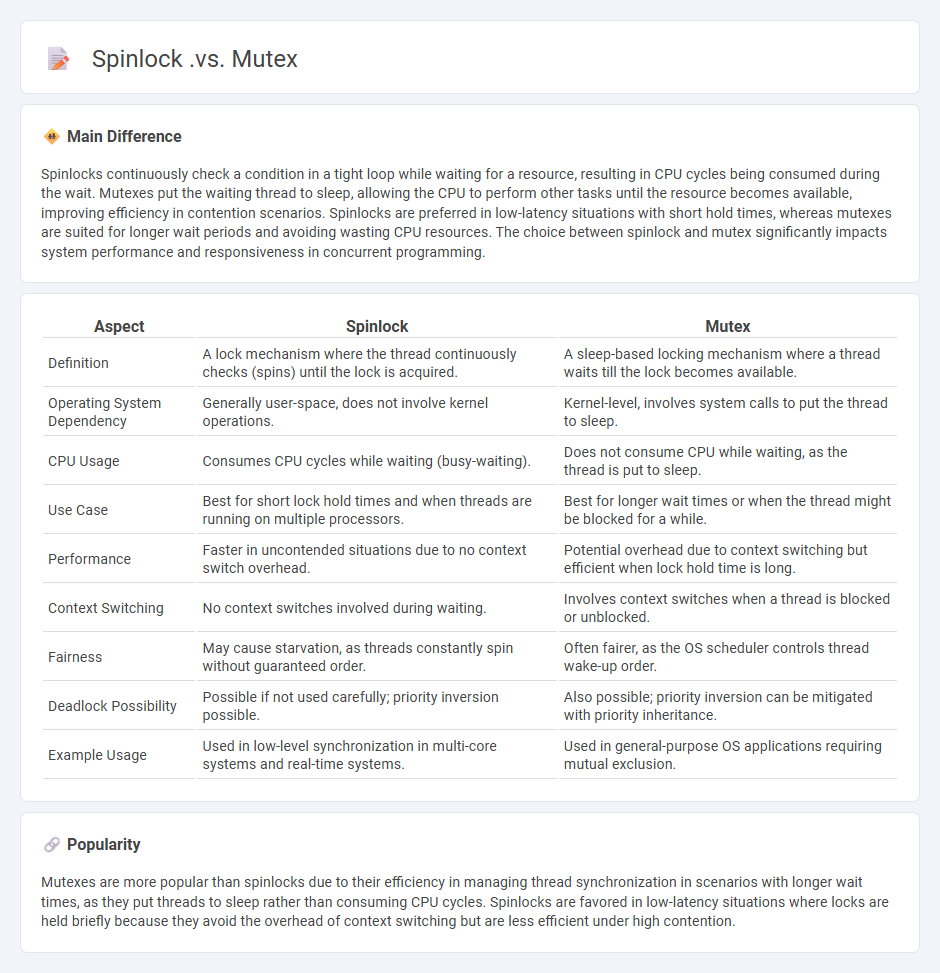
Read sections 5 ('Comparison of Mutex and Spinlocks') and 6 ('Which One for Which Scenario?'). Focus on the table, as it summarizes the key differences in performance, CPU usage, and complexity.
Here is a visual summary of these key differences:
System Architecture Matters: Single-Core vs. Multi-Core
The effectiveness of a spinlock is highly dependent on the system's architecture.
- On a single-core system: A spinlock is generally a bad idea. If thread A holds a lock and is preempted, thread B might get scheduled and start spinning. Since there's only one core, thread A cannot run to release the lock. Thread B will spin uselessly for its entire time slice, accomplishing nothing. This is the priority inversion problem we discussed in the last lesson, but it applies even without explicit priorities.
- On a multi-core system: Spinlocks can be very effective. Thread B can spin on one core while Thread A makes progress on another core. If the critical section is short, Thread A will release the lock quickly, and Thread B can acquire it without the overhead of a context switch.
Test your understanding!
Scenario: A developer is writing code for a system that logs messages to a file. The critical section involves formatting a string and writing it to disk. This runs on a 16-core server under heavy load.
Should the developer use a mutex or a spinlock to protect access to the log file? Justify your answer.
Show answer
A mutex should be used. Writing to a disk is an I/O operation, which is very slow compared to CPU speed. The thread holding the lock will be blocked for a long time waiting for the disk. If a spinlock were used, other threads would waste significant CPU time spinning on other cores. With a mutex, waiting threads are put to sleep, freeing up all 16 cores to do other useful work.
Test your understanding! (GATE-Style)
Consider a user-space thread T1 that has successfully acquired a standard mutex lock. The OS uses a preemptive, time-slicing scheduler. Can T1 be context-switched out by the scheduler before it releases the lock?
(a) No, holding a mutex prevents preemption.
(b) Yes, but only if another thread tries to acquire the same lock.
(c) Yes, the scheduler can preempt T1 for reasons like its time slice expiring.
(d) Only if the system has multiple cores.
Show answer
(c) Yes, the scheduler can preempt T1 for reasons like its time slice expiring.
This is a key concept. Acquiring a lock only prevents other threads from entering the critical section. It does not prevent the operating system's scheduler from preempting the lock-holding thread for other reasons (like its time quantum ending, or a higher-priority thread becoming ready). When T1 is preempted, it is still considered to be holding the lock.
Conclusion
In this lesson, we formalized and compared two fundamental synchronization primitives. Understanding their trade-offs is essential for analyzing the performance of concurrent systems.
Key Takeaways:
- Mutex Lock: A waiting thread is put to sleep (blocked) by the OS and placed in a queue. It does not consume CPU while waiting. This involves context switch overhead. Best for longer critical sections or when I/O is involved.
- Spinlock: A waiting thread busy-waits in a loop, consuming CPU cycles. This avoids context switch overhead. Best for very short critical sections on multi-core systems.
- The Choice is a Trade-Off: The decision between a mutex and a spinlock hinges on comparing the cost of wasted CPU cycles (spinning) against the cost of two context switches (blocking/waking).
We have focused on using locks for mutual exclusion—ensuring only one thread does something at a time. However, synchronization problems are often more complex. For example, in the Producer-Consumer problem, a producer needs to wait if the buffer is full, and a consumer needs to wait if it's empty. A simple lock isn't expressive enough to manage these conditions.
In our next lesson, we will introduce semaphores, a more generalized and powerful synchronization tool that can handle not just mutual exclusion but also these more complex coordination scenarios.