Welcome to your second lesson. In our previous discussion, we established the fundamental anatomical reasons why a high-performance bra is crucial for protecting the breast's delicate internal structures, particularly the Cooper's ligaments, during intense movement. We learned that the primary goal is to minimize independent motion by anchoring the breast mass to the stable torso.
Today, we move from the general principle to its specific application. If the goal is to anchor the breast to the torso, we must understand that both breasts and torsos come in a wide variety of shapes and volumes. A design that works perfectly for one actress may be uncomfortable or unsupportive for another, even if they wear the same nominal bra size. This lesson will equip you to differentiate between these variations and understand how they inform the necessary custom pattern adjustments. We'll ground this in a practical case study, simulating the exact challenge you'd face when fitting multiple performers for the same production number.
Beyond Size: The Importance of Shape
The ready-to-wear industry has trained us to think about fit in terms of two measurements: band size and cup letter. However, this is a vast oversimplification. Two individuals with the same 34C measurement can have entirely different breast shapes that require fundamentally different bra structures. As a designer, your expertise lies in seeing beyond the numbers and analyzing the geometry of the body.
Let's begin by visualizing the most common variations.
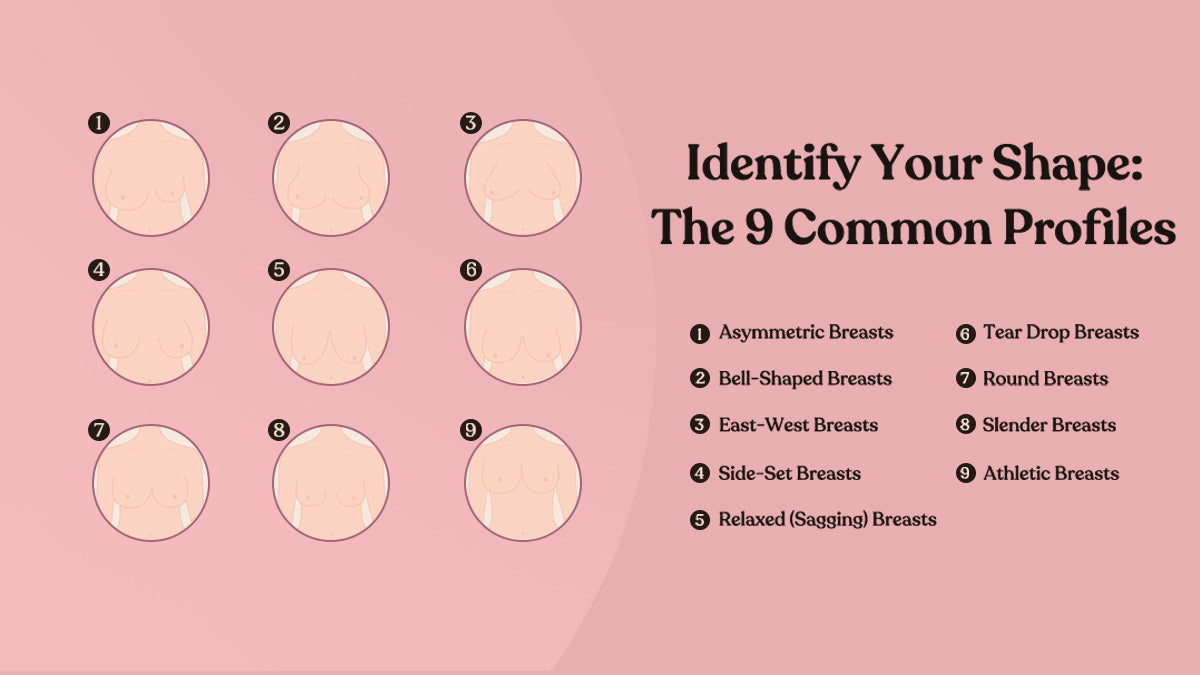
These profiles differ in several key aspects:
- Fullness Distribution: Is the breast tissue fuller on the top, fuller on the bottom, or evenly distributed?
- Breast Root: Where the breast tissue begins on the chest wall. Is the base of the breast narrow or wide?
- Projection: How far the breast extends from the chest wall.
- Separation: Are the breasts close-set or wide-set?
Most commercial bras are designed for a "round" shape with even fullness. When an actress's body deviates from this standard, common fitting issues like gaping cups, spillage ("quad-boob"), or poking underwires arise. To design effectively, you must diagnose the shape to prescribe the correct pattern solution.
Let's explore some of these key shapes and their associated fitting challenges.
All About Bra Fitting: Breast Shapes and Underwires
This blog post by Amanda Wynn provides an excellent, illustrated overview of common breast shapes and the specific fitting problems they cause.
Please read the following sections to build a qualitative understanding of these variations. Start with the section under the heading "With that said, on to breast shapes," which describes the "standard" round shape. Continue to the descriptions of narrow root and wide root shapes. Pay attention to how the underwire interacts with the base of the breast. Next, read about fullness distribution, specifically the teardrop shape (fuller on bottom) and the full on top shape. Notice the different types of fit issues they cause (gaping vs. spillage).
As you can see, identifying an actress's breast shape is the first step in diagnosing why a standard pattern might fail. A teardrop shape might need a cup with less volume at the top (like a demi-cup), while a full-on-top shape might require a more open neckline or the use of stretch materials to avoid cutting in. A wide root may require a wider underwire and a cup pattern that is broader and shallower.
A Quantitative Approach: From Shape to Data
While qualitative descriptions are useful, a more rigorous, data-driven approach is necessary for precise patternmaking. Your background in statistics and experimental design is highly relevant here. By quantifying body shape, we can move from subjective assessment to objective analysis, making the design process more systematic and repeatable.
A key insight from modern research is that the shape of the ribcage is just as important as the shape of the breast itself. The breast tissue rests on the torso, so a "flatter" or "rounder" ribcage will cause the same breast volume to distribute differently.
A research paper from The Hong Kong Polytechnic University demonstrates a powerful method for this, combining 3D body scanning with traditional pattern drafting. Let's examine their methodology.
[PDF] Exploring the Impact of Body Shape on Bra Fit
This paper introduces a method to quantify body shape and link it directly to bra pattern drafting. We will focus on how they define and measure shape.
First, read the section of the introduction from this paragraph to understand the connection between rib cage shape and breast distribution. Next, read section C. Body Slicing and Cross-Sectional View Analysis. Focus on the description of the "underbust shape ratio." This is the key quantitative metric they use.
The underbust shape ratio (underbust width / underbust depth) is an elegant way to classify torso shape.
- A high ratio indicates a flatter torso (wider relative to its depth).
- A low ratio indicates a rounder torso (deeper relative to its width).
This single number provides a crucial piece of data that goes beyond standard measurements. It tells you about the canvas upon which you are working. For a Bollywood dance number featuring a troupe of actresses, you could use this ratio to group performers with similar body structures, anticipating their fitting needs before you even touch a measuring tape.
Case Study: Fitting Two Actresses, One Bra Size
Now, let's apply this knowledge to our cinematic scenario. Imagine you are the head designer for a major film. The director has cast two lead actresses, "Subject 1" and "Subject 3," for a pivotal dance number. They both measure as a size 75E. The costume requires a specific, identical-looking bra. However, your initial fitting with a standard 75E prototype reveals problems for both, but the problems are different.
The research paper we just looked at provides a perfect case study that mirrors this exact scenario. It analyzes two 75E subjects: one with a flatter body shape and one with a rounder one.
The Problem: A Standard Bra Fails Differently
First, let's see how the standard 75E bra fits each subject.
[PDF] Exploring the Impact of Body Shape on Bra Fit
This section details the fitting assessment. We will first look at the results for the standard, off-the-shelf pattern.
Navigate to section C. Bra Fitting Assessment. Read the subsections describing the fit of the "Regular 75E Bra Cup": one for Subject 1 (flatter body) and one for Subject 3 (rounder body).
Notice the different failure modes:
- Subject 1 (Flatter Shape): Experiences gapping at the underarm and spillage ("double breast") at the neckline. The cup shape is simply wrong for her.
- Subject 3 (Rounder Shape): Also has spillage, but instead of gapping, she has bulging at the underarm. The bra is too constrictive for her body volume.
The Analysis & Solution: Custom Pattern Adjustments
A skilled designer doesn't just make a bigger or smaller size; they change the shape of the pattern pieces. The researchers drafted two new custom patterns based on the specific 3D scan data of each subject.
[PDF] Exploring the Impact of Body Shape on Bra Fit
Here we see how the measurement data translates into different pattern shapes.
First, look at Table II, which shows the extracted measurements. Notice the significant differences in breast depth and arc lengths between the flat and round subjects, even though they are the same bra size. Next, carefully examine Figure 9, which overlaps the three patterns: the regular 75E, the custom flat-body pattern, and the custom round-body pattern. Read the accompanying text describing the differences in width, height, and curvature. This is the heart of custom pattern adjustment.
This comparison is critical. You can see that the pattern for the round body shape is wider and has a bust point shifted towards the center, accommodating breast tissue that is pushed outward by the rounder ribcage. The pattern for the flat body is shorter and less voluminous overall. These are not changes you can make by simply sizing up or down.
The Result: The Power of a Custom Fit
Finally, let's see the results when each actress tries on the bra designed specifically for her body shape.
[PDF] Exploring the Impact of Body Shape on Bra Fit
This is the payoff. Let's see how the custom patterns performed.
Return to section C. Bra Fitting Assessment. Now, read the results for the custom-drafted bras: Read how the bra for the flat body shape fit Subject 1. Then, read how the bra for the round body shape fit Subject 3.
The results are conclusive. The bra designed for the flat body shape fits Subject 1 perfectly, with no gapping or spillage. The bra for the round body shape gives Subject 3 a supported, smooth profile. The study also notes that when Subject 1 tried the round-body bra, the fit was even worse than the standard one, highlighting that "custom" doesn't mean "better" unless it's custom-tailored to the correct shape.
Conclusion
Today, we have moved beyond a one-dimensional view of bra sizing and embraced the multi-faceted nature of body shape. You now have both a qualitative vocabulary and a quantitative framework for analyzing the torso and breast to inform your design decisions.
Here are your key takeaways:
- Shape is as important as size. Two performers with the same bra size can require completely different pattern adjustments.
- Key differentiators include breast root (narrow/wide), fullness distribution (top/bottom), and torso shape (flat/round).
- A standard bra often fails on non-standard shapes, resulting in common fit issues like gaping, spillage, and underwire discomfort.
- A quantitative metric like the underbust shape ratio allows for objective classification of body types, which is invaluable when working with multiple performers.
- True custom fitting involves altering the curves, dimensions, and apex placement of the pattern pieces, not just scaling the entire pattern up or down.
In our last lesson, we looked at the body's static anatomy. In this lesson, we analyzed its static shape. In our next session, we will put the body in motion. We will explore the biomechanics of high-impact dance, mapping the body's motion paths to identify key areas of garment strain and potential friction, setting the stage for engineering bras that can withstand the most demanding choreography.