Welcome. This module turns from broad chronic-disease claims to particular food policies. Synthetic food dyes are a useful starting point because a narrow claim about children’s behavior is often discussed alongside much broader claims about health. In about 40 minutes, you will assess the behavioral claim using human trials and estimated exposure levels, then identify what those findings cannot establish about other chronic diseases.
Begin with a claim precise enough to test
“Food dyes are harmful” leaves out the dye, the amount consumed, the people exposed, and the outcome. A more useful claim is: At amounts children might consume, some synthetic food dyes can worsen attention or behavior in some children. That is different from saying dyes cause attention-deficit/hyperactivity disorder (ADHD), or that they cause obesity, diabetes, or cancer.
This short news segment puts several claims side by side. Treat its judgments about which risks matter most as judgments to examine, not as results established by the behavioral trials.
How artificial food dyes impact your health
Watch “How artificial food dyes impact your health” from CBS Mornings for a compact example of how behavioral findings, animal cancer findings, exposure, and health priorities can be combined in one discussion.
Watch the health claims for the distinction between possible behavioral effects in children and tumors observed in rats given Red No. 3. Continue with the priorities, noting that the speaker’s comparison with other dietary risks does not itself measure the size of a dye’s behavioral effect.
A claim can be credible yet concern a relatively small effect. Conversely, a policy preference to remove dyes does not require proving that dyes are a leading cause of chronic disease. Keeping evidence of an effect, size of an effect, and reasons for a policy separate will make the rest of the lesson easier to evaluate.
What do the human studies actually measure?
The strongest direct evidence here comes largely from challenge trials. Children receive a known amount of dye or a placebo, often on different occasions while otherwise following a diet low in dyes. In a randomized, blinded crossover trial, each child serves as their own comparison. That design helps distinguish an effect of the challenge from stable differences between children; blinding helps limit expectations about which challenge was received.
It does not solve every problem. Trials may be small, may recruit children already suspected of responding to dyes, and may test mixtures rather than a single dye. They generally measure behavior over short periods—not whether a child later develops a chronic disease.
Read the review’s account of the child challenge trials to see both the basis of the behavioral claim and why individual results differ.
In “Results,” under “Review of clinical trial studies,” begin with the trial criteria; note why broad elimination diets were excluded. Then read the paragraph beginning “The most frequent study locations were in the US” through the sentence ending “the Conners Parent scale” for the crossover designs, doses, and outcome measures. Read the results, including the rest of that paragraph, for the difference between parent and teacher findings. In the subsection “Susceptibility,” read the discussion of variation between children.
The review reports that 16 of 25 challenge studies found some evidence of an association, while 13 reported a statistically significant association. Those counts are informative but are not a vote that settles the question: studies differ in size, quality, challenge mixture, and outcome measure. An effect observed in some children also does not imply that all children respond.
A meta-analysis asks a related question by combining estimates rather than counting studies. The following paper examines many of the same underlying trials as the review, so the two publications should not be treated as independent sets of experiments.
Read the meta-analysis by Nigg and colleagues to compare what parents, teachers or observers, and attention tests detected. Focus on the authors’ reasons for a mixed conclusion rather than trying to reconcile every individual trial.
In “Results,” under “Synthetic Food Additives,” read the subsections “Parent Reports,” “Teacher/Observer Reports,” and “Psychometric Tests of Attention.” Start each at its opening paragraph: parent reports, observer reports, and attention tests. In “Discussion,” find the paragraph beginning “Overall, a mixed conclusion must be drawn” and read the synthesis.
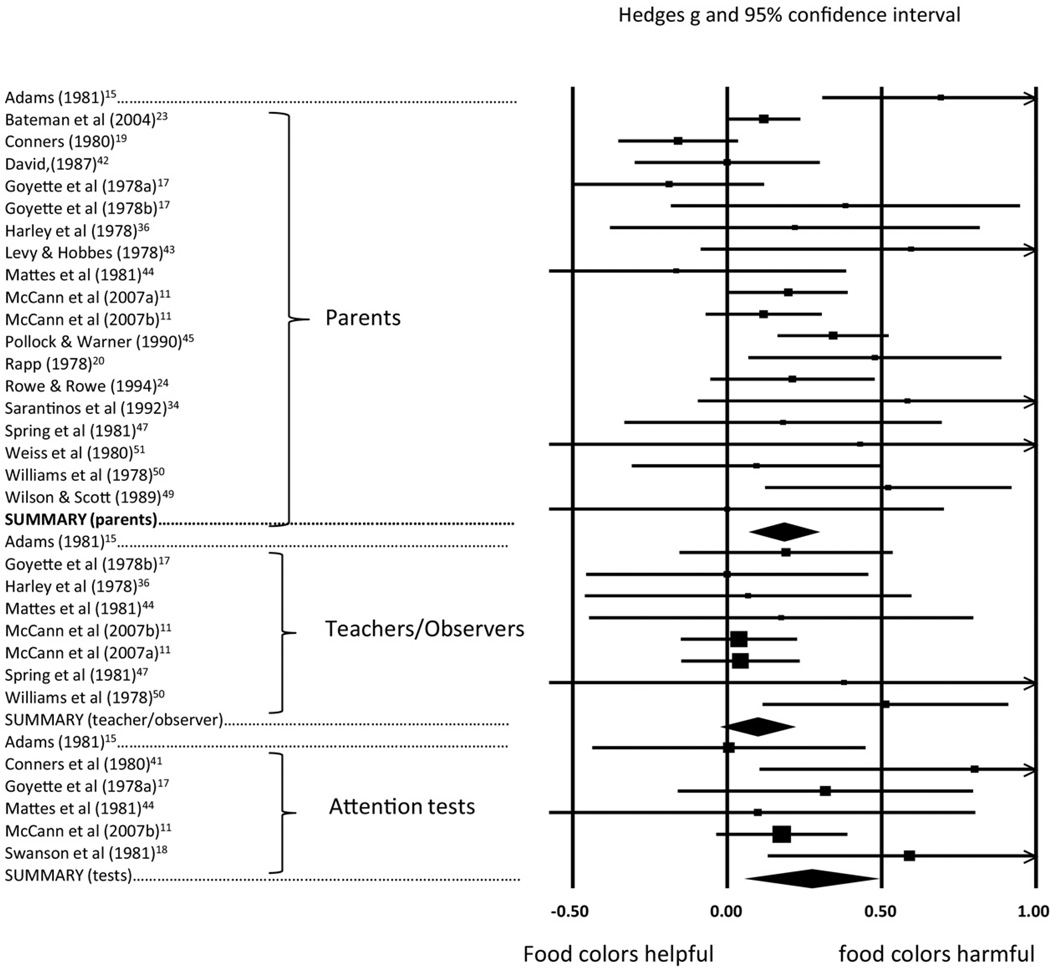
The plot helps prevent two opposite overstatements. The pooled parent-report and attention-test estimates point toward worse outcomes with dye exposure. The pooled teacher/observer estimate is smaller, and its confidence interval includes zero. That contrast warrants investigation; it neither proves parents are mistaken nor makes the attention-test result disappear. Small samples, differences in when and where behavior is observed, and differences in tested mixtures all matter.
The meta-analysis estimates standardized effects of about for parent reports and for attention tests, versus for teacher/observer reports. These are effect-size measures, not percentages of children harmed. The authors also caution that results restricted to FDA-approved colors rest on limited samples and that parent-report findings are sensitive to possible publication bias. Their estimate that some children with ADHD may have dye-related symptoms is not proof that dyes cause ADHD diagnoses.
Does the amount consumed make the findings plausible?
A hazard observed in an experiment matters for everyday decisions only if its dose and route bear some relationship to real exposure. Intake is often expressed in milligrams of dye per kilogram of body weight per day. Dividing by body weight makes a child’s and an adult’s intake more comparable:
For illustration, a 25 kg child given 2 mg of a dye receives mg/kg that day. The arithmetic is straightforward; establishing how often children receive that dose from food is harder.
An acceptable daily intake (ADI) is a regulatory benchmark derived from toxicology evidence with safety factors. It is not a boundary below which no effect is possible or above which an effect is certain. Its relevance also depends on whether the studies used to set it examined the outcome now in question.
Return to the review for its exposure estimates and regulatory comparisons. Read the prose around the tables rather than every entry: the key issue is how estimated intake relates both to ADIs and to behavioral-study doses.
In “Hazard characterization,” go to “Comparing food dye exposures to available regulatory benchmarks.” Read the paragraph beginning “OEHHA [1] derived exposure estimates” for the dietary data and age groups. Then read the two scenarios and the next paragraph, beginning “We divided each individual’s,” through the estimate ending the upper range. Inspect Table 5 for the FDA and JECFA ADIs; read the paragraph immediately below it, beginning “With the exception of FD&C Red No. 3,” for the Red No. 3 exception. Later, under “Comparing US FDA ADIs to key neurobehavioral studies” and “Red no. 40 and yellow no. 5,” find the paragraph beginning the child trial and read through the paragraph ending “There were no significant differences in mean behavioral rating between the groups on the placebo days.”
The review used 2015–2016 dietary interviews and information about dye concentrations in foods to estimate intake; it did not continuously measure each child’s dose. Its typical-exposure scenario represents a mix of products with differing dye concentrations. Its high-exposure scenario assumes products at the highest concentrations, so it should not be mistaken for everyone’s usual intake. The estimates are also dated: they do not automatically describe current products or eating patterns.
For Yellow No. 5, the review reports mean estimated intakes for child age groups of roughly to mg/kg/day under its typical scenario, compared with an FDA ADI of mg/kg/day. Most estimated dye exposures fell below the listed ADIs. Red No. 3 was an exception in some comparisons, particularly against a much lower international benchmark and in some high-exposure estimates. The benchmark and the exposure scenario must therefore be named before claiming an “exceedance.”
Below an ADI does not end the behavioral inquiry. The review notes that older studies used to establish ADIs were not designed to detect the neurobehavioral outcomes measured in later child trials. One Yellow No. 5 challenge trial reported worsening behavioral scores with increasing administered amounts among children classified as responders, with differences appearing at doses far below its FDA ADI. That is a reason to examine whether the benchmark protects susceptible children against this particular outcome. It is not a precise threshold for every child: the trial’s sample and identification of responders limit that inference.
Keep the conclusion within the outcome studied
The review’s conclusion is more affirmative about a behavioral effect than the meta-analysis’s policy conclusion. Reading them together supports a calibrated position: controlled human studies provide evidence that synthetic dyes can adversely affect attention or behavior in some children, while the average effect appears small and important uncertainties remain about susceptibility, individual dyes, and the size of any population-wide benefit from reducing exposure.
Those studies do not establish that dyes cause obesity, type 2 diabetes, cardiovascular disease, or ADHD itself. A short-term change in an attention score is not a new ADHD diagnosis; neither is it a measure of a future metabolic or cardiovascular outcome. The Red No. 3 tumor finding mentioned in the video concerns an animal cancer endpoint, which requires its own assessment of dose, biological relevance, and human evidence. Neither finding can simply be substituted for evidence about a different disease.
Stronger support for the narrow behavioral claim would come from adequately powered, blinded trials that measure children’s doses, test specific dyes as well as realistic mixtures, and include both parent ratings and independently assessed attention. Evidence about long-term disease would additionally require appropriate long-term outcomes. In the meantime, “reduce synthetic dyes in foods” remains a policy preference whose merits can include precaution and practical trade-offs; it should not be presented as if every broad chronic-disease claim has already been demonstrated.
Takeaways
Assess a dye claim by specifying which dye or mixture, how much exposure, which population, and which health outcome. Child challenge trials offer evidence about behavior and attention, with mixed results across measures. Exposure estimates and ADIs add essential context, but an ADI based on other endpoints cannot by itself rule out a behavioral effect. None of this establishes that dyes explain chronic diseases generally.
The next lesson compares school-meal standards with SNAP purchase restrictions. It will apply the same separation of evidence and policy preference while adding affordability, access, and freedom of choice.