In our previous lesson, we established that the core economic problem stems from scarcity—the conflict between our unlimited wants and the limited resources available to satisfy them. We saw how this scarcity forces us to make choices, each with an opportunity cost. Today, we will zoom in on the "limited resources" side of that equation.
Your learning goal for this session is to identify the four fundamental categories of resources that economists call the factors of production. By the end of this lesson, you will be able to define land, labour, capital, and entrepreneurship, and name the specific economic reward each one earns for its contribution to producing goods and services. This is a crucial step before we can understand how these resources flow through the economy.
1. What are the Factors of Production?
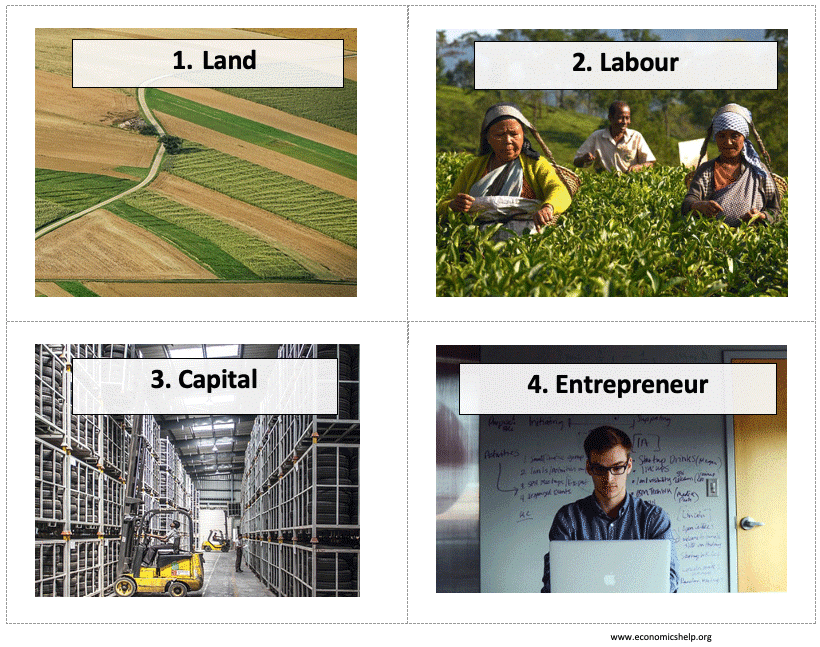
Everything that is produced, from a loaf of bread to a smartphone app, requires a combination of specific inputs. Economists group these inputs into four broad categories. The image below provides a great first look at these four essential ingredients of production.
To get a clear and concise overview of what each of these terms means, let's start with a short video.
The Four Factors of Production
This video from the "Professor Dave Explains" channel offers a quick but comprehensive introduction to each of the four factors of production.
Please watch the video from the beginning to the main explanation. As you watch, take note of the definition and examples provided for: Land Labour Capital (notice the distinction between physical and human capital) Entrepreneurship
As the video explained, these four factors are the building blocks of any economy. Now, let's solidify these definitions with a more detailed reading.
[PDF] Economics_LM_Y1_Section-4_LV.pdf
This reading from an economics learner material provides formal definitions for each factor of production, which will deepen your understanding.
Please read the section titled THE FACTORS OF PRODUCTION. It starts on page 3. Focus on the definitions and examples for Land, Labour, Capital, and Entrepreneurship. Pay attention to how capital is more than just money.
To summarise, the four factors of production are:
- Land: This includes not just physical ground, but all natural resources. This means minerals, water, forests, the air we breathe, and even sunshine. They are the raw materials provided by nature.
- Labour: This is the human effort—both mental and physical—that goes into creating goods and services. It ranges from a construction worker's physical exertion to a software developer's intellectual work.
- Capital: This is a crucial and often misunderstood term. In economics, capital refers to man-made resources used to produce other goods and services. This includes machinery, tools, factories, computers, and infrastructure like roads. It is not money itself, but the things that money can buy to aid production.
- Entrepreneurship: This is the special human skill of bringing the other three factors together. The entrepreneur is the innovator and risk-taker who has the idea, organises the land, labour, and capital, and ultimately drives the production process.
2. The Rewards for the Factors of Production
In an economy, nothing comes for free. When these factors of production are used, their owners are compensated. This compensation is called a reward or income. Each factor of production has a specific name for its reward.
The next video provides an excellent explanation of each factor and its corresponding reward. It also offers a very clear reason why money is not considered a factor of production, which is a key concept to grasp.
Factors of Production | Economics Explained
This video from the Federal Reserve Bank of St. Louis clearly links each factor of production to its specific reward and clarifies a common misconception about money.
Please watch the video from this segment. As you watch, listen for the reward associated with each factor: The reward for Land (is called...) The reward for Labour (is called...) The reward for Capital (is called...) The reward for Entrepreneurship (is called...) Pay special attention to the explanation of why money is not capital.
Let's reinforce this with a final reading that formally defines these rewards.
[PDF] Economics_LM_Y1_Section-4_LV.pdf
This section of the learner material provides clear, written definitions for each of the rewards you just learned about in the video.
On page 6, read the section defining the rewards. This text will give you the formal definitions for rent, wages, interest, and profit.
Here is a summary table for easy reference:
| Factor of Production | Description | Reward |
|---|---|---|
| Land | All natural resources | Rent |
| Labour | Human physical and mental effort | Wages or Salaries |
| Capital | Man-made goods used in production | Interest |
| Entrepreneurship | Organising factors and taking risks | Profit |
3. Practice: Identifying Factors in Scenarios
Now it's time to apply what you've learned. The best way to check your understanding is to identify these factors and their rewards in real-world examples.
Part 1: Categorisation
First, try this sorting activity. Look at the list of items below. For each one, decide if it represents Land, Labour, Capital, or Entrepreneurship. You can jot your answers down on a piece of paper.
List of Items: a laptop, an economics teacher, rain, the air, a projector, a school building, money used to start a business, the skill of time management, savings at the bank, a school nurse, a photocopy machine, a school farm, the idea for a new product, negotiation ability, crude oil, organisational skills.
This list is taken from Activity 4.3 in the Economics LM resource (LINK). Once you've tried it, you can imagine how these would fit into the table from that activity. For example, "crude oil" and "rain" are clearly Land. A "school nurse" and "economics teacher" represent Labour. A "photocopy machine" and "school building" are Capital. "The idea for a new product" and "organisational skills" are elements of Entrepreneurship.
Part 2: Case Study Analysis
Now, let's analyze a simple business scenario. Read the case study below and answer the questions that follow. This will directly test your ability to meet today's learning outcome.
CASE STUDY: The Pineapple Drink Stand
Sarah decides to start a pineapple drink stand in her neighbourhood. She wants to sell fresh pineapple drinks to make some extra money during the school holidays. She sets up a small table on a patch of grass near the local park. She uses her own savings to buy a blender, a cooler box, and cups. She buys fresh pineapples and ice from the market. She spends her afternoons making the drinks and selling them to people passing by. After paying for all her supplies, she is happy to see she has made money at the end of the week.
Now, answer these questions based on the case study:
- Land: What are two examples of the "land" factor of production in Sarah’s business?
- Labour: Who provides the "labour" and what do they do?
- Capital: What are two examples of "capital" that Sarah needs to run her stand?
- Entrepreneurship: How does Sarah demonstrate "entrepreneurship"?
- Rewards: What is the name of the reward Sarah hopes to earn for her entrepreneurial effort?
Take a few minutes to think through your answers before reading the solution below.
Solution:
- Land: The natural resources are the pineapples and the water (used for the drink or ice). The patch of grass she uses could also be considered land.
- Labour: Sarah provides the labour. Her effort includes making the drinks and the service of selling them.
- Capital: The blender, cooler box, and table are all examples of capital goods—man-made items used to produce the final product.
- Entrepreneurship: Sarah demonstrates entrepreneurship by coming up with the idea, organising all the other factors (buying the pineapples, using the blender, providing her own labour), and taking the financial risk (using her savings) in the hope of making a profit.
- Rewards: The reward for her entrepreneurship is profit.
Conclusion
In this lesson, we have broken down the "limited resources" from our previous discussion into the four distinct factors of production. You should now be comfortable with:
- The Four Factors:
- Land: Natural resources.
- Labour: Human effort.
- Capital: Man-made productive resources.
- Entrepreneurship: The organising and risk-taking element.
- Their Rewards:
- Land earns Rent.
- Labour earns Wages.
- Capital earns Interest.
- Entrepreneurship earns Profit.
These factors and their rewards are the fundamental components of any economy. Understanding them is essential as we move on to see how they interact.
In our next lesson, we will begin exploring the circular flow of income. We will identify the main participants in the South African economy and start building a model to show how money, goods, and these very factors of production move between them.