Bonjour! Welcome back.
In our last lesson, we focused on a crucial skill: identifying the gender of French nouns. You learned to look for clues in word endings (like -tion for feminine and -ment for masculine) and in the context of a sentence. This was the perfect preparation for today.
This lesson directly addresses the learning outcome: Use definite (le, la, les) and indefinite (un, une, des) articles correctly. Now that you can determine if a noun is masculine or feminine, you can confidently choose the right article to go with it. Mastering articles is non-negotiable for forming correct sentences and achieving the fluency you're aiming for, whether in a professional or casual setting.
We will cover:
- The two main types of articles: definite and indefinite.
- The different forms of each article and how to choose them.
- Situations where French uses articles differently from English.
- An important exception related to professions, which will be useful for your professional goals.
1. The Two Families of Articles: Definite vs. Indefinite
In French, as in English, articles specify whether you're talking about a particular noun or a noun in general.
- Definite Articles (le, la, l', les): These correspond to "the" in English. You use them when talking about a specific, identified noun.
- Passe-moi le livre. (Pass me the book. — a specific book that we both know about).
- Indefinite Articles (un, une, des): These correspond to "a," "an," or "some" in English. You use them for a non-specific or general noun.
- Je cherche un livre. (I'm looking for a book. — any book, not a specific one).
To see this fundamental difference in action, let's watch a short video.
HOW to Choose the RIGHT ARTICLE in FRENCH (DEFINITE & INDEFINITE ARTICLES) - Lesson for BEGINNERS
This video from SIMPLE FRENCH WITH THOMAS clearly explains the basic forms of both definite and indefinite articles and, most importantly, the difference in meaning between using 'the' (definite) and 'a' (indefinite).
Watch from the beginning (00:00) to 03:23. Pay close attention to the examples he gives for choosing between definite (specific) and indefinite (general) articles, like 'I want the cat' vs. 'I want a cat'.
2. Choosing the Correct Form
Your work in the last lesson on noun gender is about to pay off. The article you choose must agree in gender (masculine/feminine) and number (singular/plural) with the noun it accompanies.
This chart is a great visual summary.
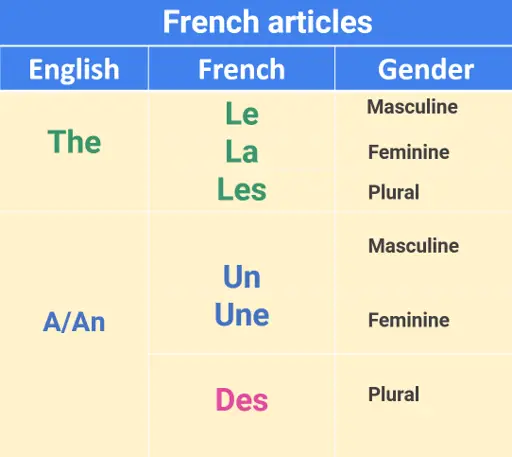
Let's break it down:
| Masculine Singular | Feminine Singular | Plural (Masc. & Fem.) | |
|---|---|---|---|
| Definite ("the") | le (le garçon)l' before vowel (l'ami) |
la (la fille)l' before vowel (l'école) |
les (les garçons, les filles) |
| Indefinite ("a/an/some") | un (un garçon) |
une (une fille) |
des (des garçons, des filles) |
A Critical Difference from English: The Plural Article
One of the most common mistakes for English speakers is forgetting the plural article. In English, you can say "I have friends." In French, you must use an article: "J'ai des amis." Leaving it out (J'ai amis) is grammatically incorrect.
The video you watched earlier has a great segment on this. Let's revisit it to reinforce this crucial point.
HOW to Choose the RIGHT ARTICLE in FRENCH (DEFINITE & INDEFINITE ARTICLES) - Lesson for BEGINNERS
The speaker highlights the mandatory use of an article with plural nouns in French, which is a major difference from English.
Watch from 03:23 to 04:14. Notice the comparison between 'I eat chocolates' (English, no article) and 'Je mange des chocolats' (French, article required).
Test your understanding!
Choose the correct article for each noun. Remember to check gender and number!
(Hint: livre (m.), voiture (f.), ordinateur (m.), amis (pl.))
- I see a book on the table. -> Je vois ___ livre sur la table.
- She drives the car. -> Elle conduit ___ voiture.
- He needs an eraser. -> Il a besoin d'___ gomme. (gomme is feminine)
- I'm using the computer. -> J'utilise ___ ordinateur.
- They have friends in Paris. -> Ils ont ___ amis à Paris.
Show answer
- un livre (a non-specific, masculine singular book)
- la voiture (a specific, feminine singular car)
- une gomme (a non-specific, feminine singular eraser)
- **l'**ordinateur (a specific, masculine singular computer;
l'because it starts with a vowel) - des amis (non-specific, plural friends)
3. When to Use Definite Articles (Even When English Doesn't)
You'll quickly notice that French uses le, la, and les in many situations where English uses no article at all. This is key to sounding natural. The most common case is when talking about things in a general sense (likes, dislikes, general truths).
- I like chocolate. -> J'aime le chocolat.
- Life is beautiful. -> La vie est belle.
- Dogs are loyal. -> Les chiens sont fidèles.
Let's explore these specific cases with a more in-depth video.
Le La Les (L') - French Definite Articles // French Grammar Course // Lesson 6 🇫🇷
This video by 'The perfect French with Dylane' details several important situations where you must use a definite article in French, even if you wouldn't in English.
Watch from 02:09 to 07:40. You don't need to memorize every single case right now. Instead, focus on understanding the main categories where this happens: Abstract nouns and general concepts (e.g., 'time', 'coffee') Languages and school subjects Countries and continents Days of the week (to express a recurring habit)
4. Special Rules and Exceptions
Finally, let's cover two important rules that will be highly relevant as you continue to build sentences.
A. Stating a Profession
Given your goal of using French in professional settings, this is a very practical rule. When you state someone's profession using the verb être (to be), you generally do not use an indefinite article (un/une).
- He is a lawyer. -> Il est avocat. (NOT Il est un avocat.)
- She is a student. -> Elle est étudiante.
However, if you add an adjective to describe the profession, the article comes back!
- He is an excellent lawyer. -> C'est un excellent avocat.
- She is a good student. -> C'est une bonne étudiante.
When not to use un/une while stating people's occupations
This article from Kwiziq French Grammar explains this 'zero article' rule for professions very clearly, with plenty of examples. It's a small detail that makes a big difference in sounding natural.
Read the sections 'When to omit the indefinite articles with professions in French' and the 'ATTENTION' box right below it. This will solidify the rule and its main exception.
B. Articles in Negative Sentences (A Preview)
When you make a sentence negative, the indefinite articles un, une, and des usually change to de (or d' before a vowel).
- Positive: J'ai un frère. (I have a brother.)
- Negative: Je n'ai pas de frère. (I don't have a brother.)
- Positive: Elle a des livres. (She has books.)
- Negative: Elle n'a pas de livres. (She doesn't have books.)
We will explore negation in detail in our next lesson, but it's good to be aware of this rule now as it's directly related to articles.
Practice
Let's put everything together. The following resource has a short "Fill-in-the-blank" exercise that will test your understanding of all the concepts we've covered today.
French Definite and Indefinite Articles: Rules and Examples
The article 'French Definite and Indefinite Articles' provides a clear set of practice questions to test your knowledge.
Scroll down to the section '5. Practice French articles with exercises' and complete the five 'Fill-in-the-blank' questions. Then, check your answers against the solutions provided in the 'Answers to French article exercises' section at the bottom of the page.
Conclusion
Excellent work today! You've tackled one of the most fundamental aspects of French grammar. Getting articles right is a huge step toward building accurate and natural-sounding sentences.
Here are the key takeaways:
- Definite articles (le, la, l', les) are for specific nouns ("the"), while indefinite articles (un, une, des) are for non-specific ones ("a/an/some").
- You must choose the article that agrees with the noun's gender and number.
- French requires an article in many cases where English doesn't, especially when speaking about things in general (J'aime le sport) or with plural nouns (Elle a des idées).
- For professions, you usually drop the article after the verb
être(Il est professeur), unless you add an adjective (C'est un bon professeur).
Next up: We just got a glimpse of how articles behave in negative sentences. In our next lesson, we will fully explore how to form basic affirmative and negative sentences using the ne...pas structure. This will allow you to start expressing a much wider range of ideas. À bientôt