Bonjour!
In our last lesson, we focused on the social rules of using tu, the informal "you," which is the foundation of casual conversation. Now that you know who to speak with informally, we'll add another layer to make your French sound even more natural and relaxed.
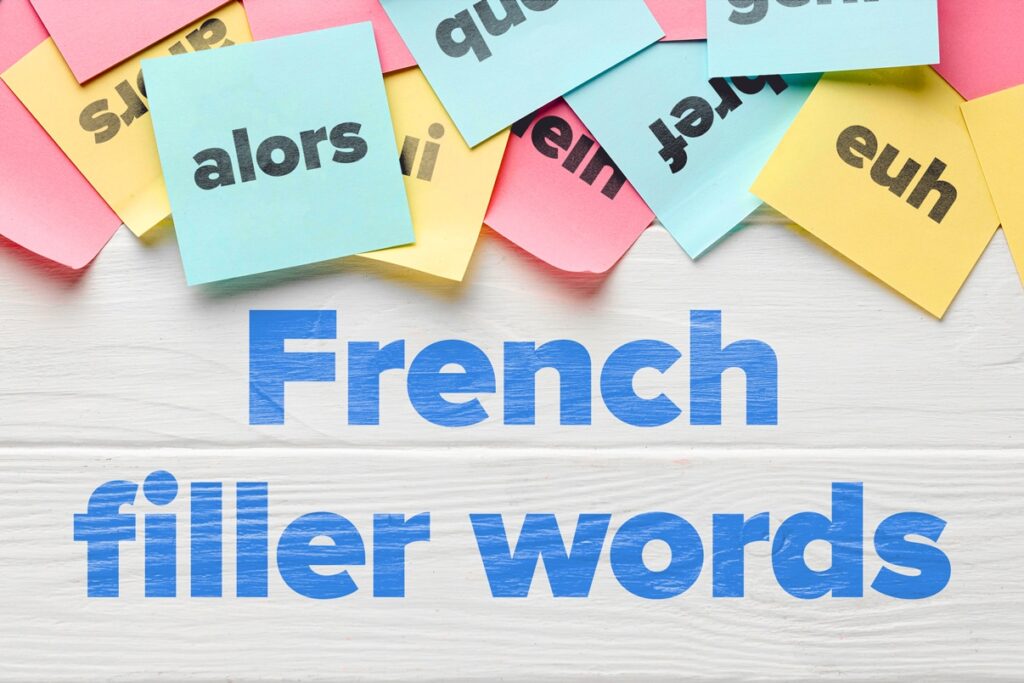
Today's lesson is about something native speakers do without thinking: using filler words. In French, these are called les mots de remplissage. While they might not have a strong meaning on their own, they are crucial for the rhythm and flow of a conversation. They help you pause, think, and express yourself more like a native speaker.
We will focus on recognizing and using four of the most common informal filler words: alors, euh, ben, and en fait. Mastering these will be a significant step in your journey toward social fluency.
1. What Are Filler Words and Why Use Them?
Before we dive into specific words, let's clarify their role. Filler words aren't just mistakes or signs of uncertainty. They are a natural part of spoken language that serve several purposes:
- Buying time to think about what you want to say next.
- Softening a statement or a refusal.
- Adding emphasis to a point.
- Signaling that you're about to continue speaking.
Think about how often you use "um," "well," "like," or "so" in English. French has its own set of equivalents that are just as important.
Let's begin with the most universal filler word of all.
2. The Core Four: Your Essential Filler Words
We'll focus on four key words that you will hear and use constantly in informal conversations.
a) Euh... (The Pause)
This is the direct equivalent of the English "uh..." or "um...". Its function is simple: to fill a pause while you're hesitating or searching for your words.
- When to use: When you need a second to think.
- Example:
— Tu veux manger quoi ce soir ?(What do you want to eat tonight?)
— **Euh**, je ne sais pas, peut-être une pizza.(Um, I don't know, maybe a pizza.)
To see and hear this in a natural context, watch this very short clip.
Master French Filler Words with Real Life Examples | Super Easy French 194
The video 'Master French Filler Words' by Easy French demonstrates the use of 'euh' in a simple, clear dialogue.
Watch the segment from 00:59 to 01:19. Notice how 'euh' is used naturally to show hesitation before answering a question.
b) Alors... (The Transition)
Alors is a very versatile word, most commonly translating to "so" or "well...". It's used to start a sentence, introduce a consequence, or transition to a new topic. Unlike euh, it feels more like a deliberate start to a thought rather than just a pause.
- When to use: To start a story, ask a follow-up question, or draw a conclusion.
- Example:
**Alors**, tu as passé un bon week-end ?(So, did you have a good weekend?) - Example:
Il a commencé à pleuvoir, **alors** on est rentrés.(It started raining, so we went home.)
c) Ben... or Bah... (The Obvious)
Ben is the informal version of bien (well). It's used to start a sentence, often to state something that seems obvious or to express slight hesitation or resignation. Bah is an even more relaxed, oral version of ben.
- When to use: To mean "well..." or to give an answer that should be obvious.
- Example:
— Tu aimes le chocolat ?(Do you like chocolate?)
— **Ben oui** !(Well, yes! / Of course!) - Example:
— Pourquoi tu n'es pas venu ?(Why didn't you come?)
— **Bah**, j'étais fatigué.(Well, I was tired.)
d) En fait... (The Clarification)
En fait translates to "actually" or "in fact." It's incredibly useful for correcting yourself, clarifying a point, or adding a surprising piece of information that contradicts what was just said.
- When to use: To correct or clarify a statement.
- Example:
Je pensais aller au sport ce soir... **en fait**, je crois que je vais rester à la maison.(I was thinking of going to the gym tonight... actually, I think I'll stay home.)
To solidify your understanding of these words, the following article provides excellent explanations and examples.
20 French Filler Words to Help You Sound Natural
The article '20 French Filler Words to Help You Sound Natural' from Fluentu clearly breaks down the usage of our core words. It also includes audio so you can perfect your pronunciation.
Please read the sections for these four words: 'Alors' (Number 1) 'Euh' (Number 2) 'Ben oui, ben non' (Number 6) and 'Bah' (Number 13) - read these together to understand the connection. 'En fait' (Number 7) Pay attention to the example sentences and click the audio icons to hear the native pronunciation.
Test your understanding!
Fill in the blank with the most appropriate filler word from our list (alors, euh, ben, en fait):
You told a friend you finished your project. Then you remember you still have one small part to do. You say:
"J'ai fini mon projet ! ..., il me reste juste la conclusion à écrire."
Show answer
En fait is the best choice. You are correcting or clarifying your initial statement. "J'ai fini mon projet ! En fait, il me reste juste la conclusion à écrire." (I finished my project! Actually, I just have the conclusion left to write.)
3. Combining Fillers for Ultimate Fluency
As you get more comfortable, you'll notice that French speakers often chain these words together. This adds even more natural rhythm to their speech. It might sound complex, but it's a very common pattern.
Common combinations include:
Euh... ben...(Um... well...)Bon, ben, alors...(Okay, well, so...)Euh, bah en fait, non.(Um, well actually, no.)
Watching how native speakers do this is the best way to learn.
Master French Filler Words with Real Life Examples | Super Easy French 194
Let's return to the Easy French video. This time, pay close attention to how they combine filler words in a single sentence to sound completely natural.
Watch the segment from 06:01 to 06:35. The video provides perfect examples of combined filler words in short, realistic dialogues, like Euh bah en fait non and Bon ben voilà.
Don't feel pressured to use these combinations immediately. For now, focus on recognizing them. As you listen more, you'll naturally start to integrate them into your own speech.
Conclusion
You have now learned about four essential French filler words that are key to sounding more authentic in casual conversations.
Key Takeaways:
- Filler words (
mots de remplissage) are a normal and necessary part of spoken French. Euhis used for hesitation ("um...").Alorsis used for transitions ("so...", "well...").Ben/Bahare informal ways to say "well...", often when something is obvious.En faitis used to clarify or correct ("actually...").- Native speakers often combine these words (e.g.,
Euh ben...).
Start by trying to notice these words when you listen to French speakers. Then, try to incorporate them one by one into your own practice. Using a simple euh when you need to think, or starting a story with alors, will instantly make you sound more comfortable and fluent.
In our next lesson, we will move on to the content of your conversations by learning high-frequency vocabulary for hobbies, leisure, and personal interests. This will give you the tools to talk about topics you enjoy, such as sports and nutrition, using the natural, informal style we've been building.
À bientôt !