Bonjour!
In our last lesson, we built a great vocabulary for discussing your hobbies and interests. Now, we'll take the next logical step: learning how to share what you think and feel about those things. This is a fundamental skill for having engaging social conversations, which aligns perfectly with your goal of achieving fluency.
Today, we will focus on expressing preferences and opinions using verbs like aimer, préférer, adorer, and the phrase penser que. By the end of this lesson, you'll be able to say not just what you do, but how you feel about it, allowing for much richer and more personal interactions.
1. Expressing Likes and Dislikes
Let's start with the most direct way to state your preferences. The key verbs are aimer (to like/love), adorer (to adore/love), détester (to hate), and préférer (to prefer).
To get a feel for how these are used in natural speech, let's watch a short video.
Giving your opinion in French - beginner Level
The video 'Giving your opinion in French - beginner Level' from the Clearly French channel provides a quick and clear introduction to these essential verbs.
Watch the video from the beginning (00:11) to 03:25. Pay attention to: The different levels of intensity: aimer (like), adorer (love), détester (hate). The negative form je n'aime pas (or the spoken version j'aime pas). The verb préférer (to prefer).
Key Grammar Rules
As you heard in the video, when you use these verbs to talk about general categories of things (like "sports" or "chocolate"), you almost always follow them with a definite article (le, la, l', les). When you talk about an activity, you use the infinitive form of the verb (e.g., danser, lire).
This is a very important rule. The image below summarizes it perfectly.

To solidify these rules and see more examples, please read the following article. It breaks down the structure clearly.
Expressing Likes & Dislikes in French: Aimer, Adorer, Détester
The article 'Expressing Likes & Dislikes in French' provides a written summary of the verbs we just learned, with clear examples and explanations of the sentence structure.
Read the sections 'Key Verbs for Expressing Preferences' and 'Sentence Structure with Verbs of Preference'. Focus on the example sentences to see the patterns: Subject + Verb + Definite Article + Noun (J'aime le chocolat) Subject + Verb + Infinitive Verb (Elle aime danser)
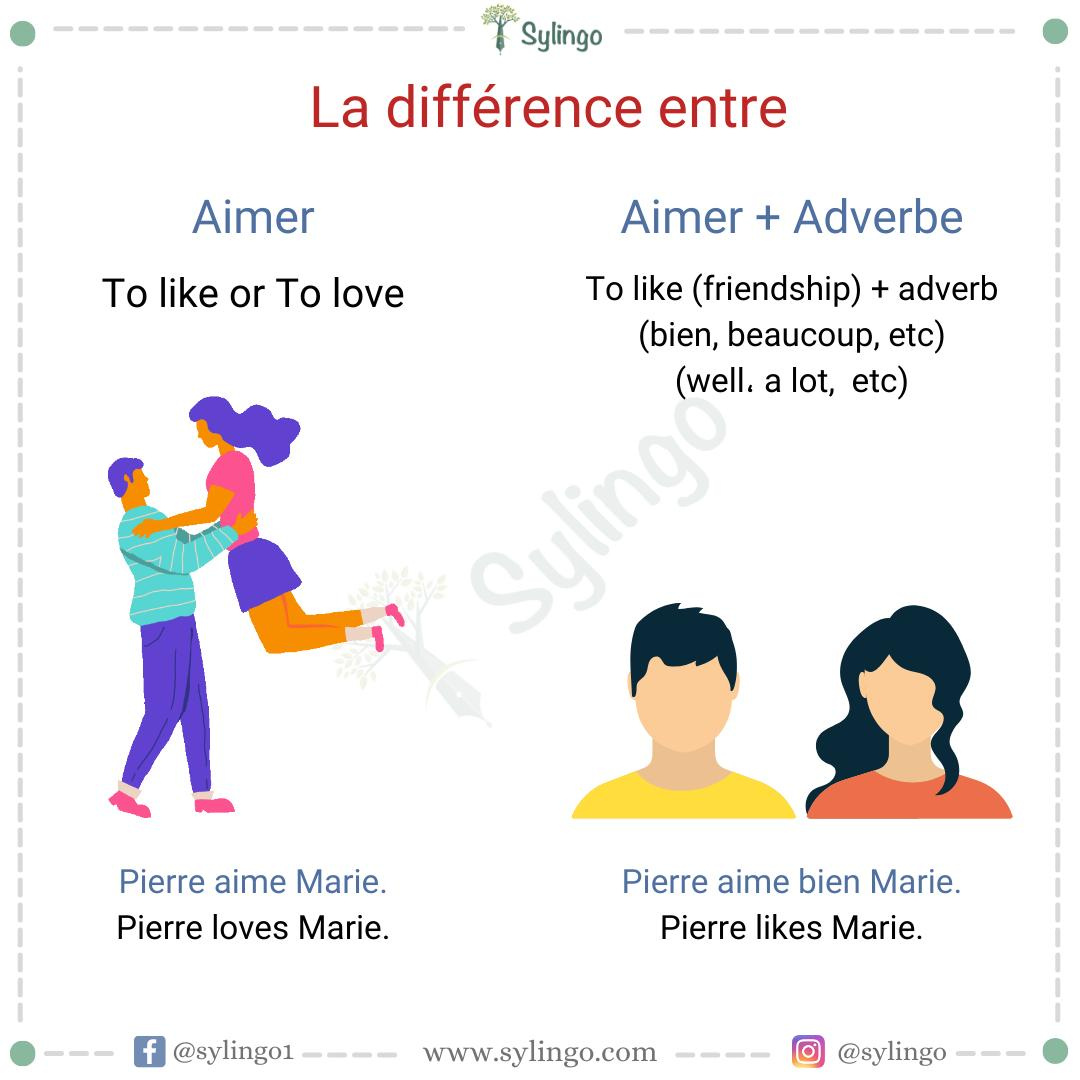
An Important Nuance: Aimer vs. Aimer bien
When talking about people, the verb aimer can be tricky.
J'aime Marie.= I love Marie (romantic love).J'aime bien Marie.= I like Marie (friendly affection).
This is a crucial distinction in social contexts. Using aimer when you mean aimer bien can lead to awkward misunderstandings! This image illustrates the difference well.
2. Expressing a General Opinion
Moving beyond simple likes and dislikes, let's look at how to express what you think or believe. This is where phrases like je pense que come in.
Let's return to the "Clearly French" video, which introduces some of the most common opinion phrases.
Giving your opinion in French - beginner Level
This next segment introduces phrases that are the building blocks of expressing any opinion.
Watch from 03:08 to 04:42. Focus on these three key phrases: Je pense que... (I think that...) Je trouve que... (I find that...) À mon avis... (In my opinion...)
These phrases are your entry point into sharing your viewpoint. Je pense que is probably the most versatile and common of them all.
Now, let's see how these phrases work in a real back-and-forth conversation. The following video uses short dialogues to show how people share and respond to opinions.
How to Express Your Opinion in French | Improve Your French Conversation
The video 'How to Express Your Opinion in French' from CCube Academy is excellent for seeing these phrases in action. Notice how different people use different phrases to express similar ideas.
Watch the first two scenarios in the video (00:09 to 03:41). Listen for phrases like à mon avis, d'après moi, je pense que, and je préfère. You don't need to understand every single word; focus on how the characters share their opinions about games and movies.
Expanding Your Opinion Toolkit
To make your speech more varied, you can use a few other phrases that mean "in my opinion" or "according to me":
À mon avis...D'après moi...Selon moi...
These are largely interchangeable and are great for adding variety to your conversations. You heard some of them in the last video you watched.
Test your understanding!
Imagine you're discussing your interests with a new friend. How would you express the following ideas in French?
- I love sports, especially football.
- I prefer nutrition to cooking.
- In my opinion, networking is very important for a career.
- I think that learning languages is fascinating.
Show answer
J'adore le sport, surtout le football.(Usingadorerfor strong liking, andle sportwith a definite article).Je préfère la nutrition à la cuisine.(Usingpréférer...à...to compare two nouns. Bothnutritionandcuisineneed articles).À mon avis, le networking est très important pour une carrière.(Usingà mon avisto introduce an opinion).Je pense que apprendre les langues est fascinant.(Usingje pense quefollowed by a clause.apprendreis an infinitive verb acting as the subject).
Conclusion
Excellent work today! You have now learned the essential tools for moving beyond stating facts and into the world of sharing your personal viewpoint. This is a huge step toward conversational fluency.
Key Takeaways:
- You can express preferences with verbs like
aimer,adorer,détester, andpréférer. - When these verbs are followed by a noun, you must use a definite article (
le,la,les). E.g.,J'aime **le** sport. - Use
aimer bienwhen you mean "to like" a person in a friendly way. - You can state your opinion using versatile phrases like
je pense que...,je trouve que..., andà mon avis....
In our next lesson, we will continue building your ability to talk about internal states by learning how to express basic emotions and feelings using être + adjective (e.g., je suis content, je suis triste). This will add another layer of depth to your social interactions.
À bientôt !