Bonjour! In our last lesson, you took a major step in learning to narrate the past by forming the passé composé with avoir. You learned that this "compound past" is built with an auxiliary verb (avoir) and a past participle, and you practiced this with both regular and common irregular verbs.
Today, we will complete the picture by focusing on the second auxiliary verb: être (to be). While most verbs use avoir, two specific and very important groups use être. Your goal for this lesson is to learn how to form the passé composé with être for these two groups: verbs of movement and reflexive verbs.
This lesson is crucial because using être introduces a new, fundamental rule: agreement. Unlike with avoir, the past participle must change to match the subject. Let's dive in!
1. The First Group: Verbs of Movement & Change of State
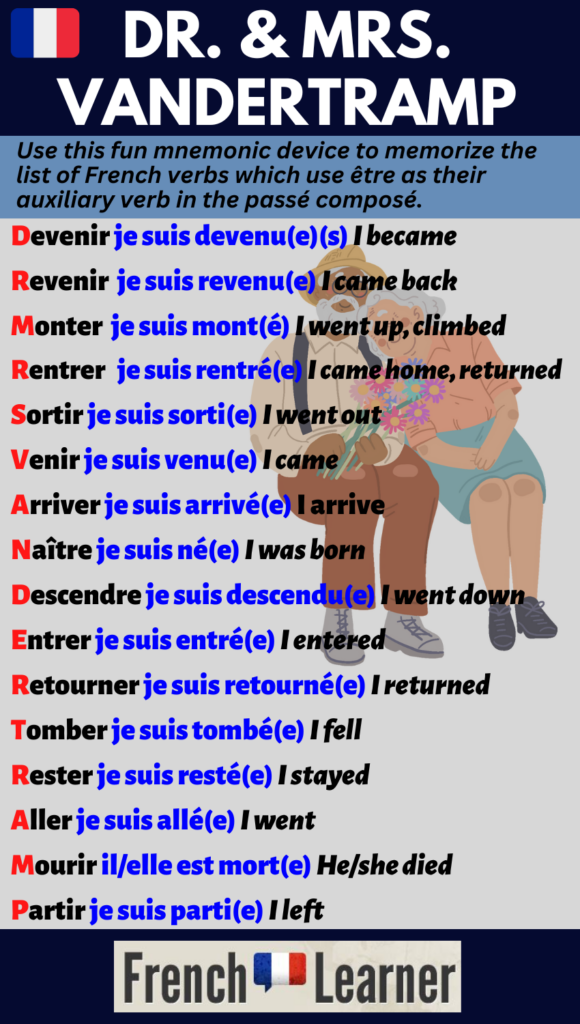
A small set of about 16 common verbs uses être in the passé composé. These verbs generally describe movement from one place to another (like arriving or leaving) or a change of state (like being born or dying).
To help remember them, French learners use a popular mnemonic: Dr. & Mrs. Vandertramp. Each letter in this name stands for one of the verbs.
Let's watch a video that introduces this concept and lists the verbs for you.
French Verbs of Movement (Learn French With Alexa)
The video 'French Verbs of Movement' by Learn French With Alexa is an excellent introduction to this topic. It will explain why these verbs are special and walk you through the 'Dr. & Mrs. Vandertramp' acronym.
Watch from 01:28 to 04:18. Focus on: Understanding that the acronym is a memory tool. Listening to the pronunciation of each verb as she lists them.
Here are two images that present these verbs in a clear, visual format. The first is a list based on the "Dr. & Mrs. Vandertramp" acronym, and the second, often called "la maison d'être" (the house of being), tells a story to help you remember them.

2. The Golden Rule of Être: Agreement
Here is the most important difference when using être: the past participle must agree in gender and number with the subject. This works just like a regular adjective.
- If the subject is feminine, add an -e.
- If the subject is plural, add an -s.
- If the subject is feminine and plural, add -es.
Let's read a clear explanation of this rule.
The article 'Understanding Passé Composé' from French Today has a fantastic, clear table explaining the agreement rule. This is a core concept for today's lesson.
Read the section titled 'Passé composé agreement with être'. Pay close attention to the table showing how the endings of allé, parti, and venu change for masculine, feminine, singular, and plural subjects. Note that in most cases, these changes are silent in pronunciation.
Let's see this in action with the verb aller (to go):
Il est allé.(He went.)Elle est allé**e**.(She went.)Ils sont allé**s**.(They [masculine or mixed] went.)Elles sont allé**es**.(They [feminine] went.)
This agreement is mandatory in writing. While the -e, -s, and -es are often silent, getting this right is a key sign of proficiency.
Test your understanding!
A woman is telling a friend what she did. How would she say, "I arrived yesterday"? (The verb is arriver).
Show answer
Je suis arrivée hier. (Because the speaker, Je, is a woman, you must add an -e to the past participle arrivé.)
3. The Second Group: All Reflexive Verbs
The second group of verbs that uses être is much simpler to identify: all reflexive verbs.
Remember from Module 2, reflexive verbs are actions the subject does to themselves (e.g., se lever - to get up, s'habiller - to get dressed). In the passé composé, they always use être.
The structure is: Subject + Reflexive Pronoun + être + Past Participle
And, of course, the agreement rule still applies! The past participle agrees with the subject.
Watch this very short clip for a clear explanation.
Être or Avoir in the Passé Composé in French... French PAST TENSE explained!
In this clip from 'Être or Avoir in the Passé Composé', Alexa quickly explains that reflexive verbs use être.
Watch from 04:43 to 05:20. Notice the example Je me suis lavé(e) and how the reflexive pronoun me comes before the auxiliary verb suis.
Here's an example with se lever (to get up):
Je me suis levé.(I [a man] got up.)Elle s'est levé**e**.(She got up.)Nous nous sommes levé**s**.(We [men or mixed group] got up.)Elles se sont levé**es**.(They [women] got up.)
Test your understanding!
How would you say "They (a group of women) got dressed"? (The verb is s'habiller).
Show answer
Elles se sont habillées. (The subject Elles is feminine and plural, so you add -es to the past participle habillé.)
Conclusion
Excellent work! You've now covered the complete system of auxiliary verbs for the passé composé. This skill is essential for narrating past events, a key component of your fluency goals.
Key Takeaways:
- Two groups of verbs use
êtreas the auxiliary in thepassé composé:- Verbs of movement/state change (remembered with "Dr. & Mrs. Vandertramp").
- ALL reflexive verbs (e.g.,
se laver,s'habiller).
- The fundamental rule when using
êtreis agreement: the past participle must agree in gender and number with the subject (add-e,-s, or-es). - The structure for reflexive verbs is: Subject + Pronoun (
me,te,se...) +être+ Past Participle.
Next Lesson Preview:
You now know the main agreement rule with être. In our next lesson, we will look at how this rule works in more complex situations, particularly when a direct object is involved. We will also start combining avoir and être verbs to build more detailed stories about the past.
Keep practicing! Try making a few sentences about your own day using verbs like je me suis levé(e), je suis allé(e), and je suis rentré(e). À bientôt