Bonjour ! Welcome back to our module on French for Academic Settings.
In the last lesson, we built a foundation by learning the core vocabulary of university life—terms like cours magistral, examen, semestre, and the LMD degree system. You now know the "nouns" of the academic world. Today, we'll focus on the "verbs." To achieve your goal of academic fluency, you need to be able to build arguments, analyze texts, and present your ideas clearly.
This lesson will equip you with the essential verbs to do just that. We will focus on how to use key verbs for analysis and argumentation, such as analyser, démontrer, and conclure. These are the action words that drive academic discourse.
1. The Three Pillars of Academic Argumentation
At the heart of any academic task, whether it's writing an essay or participating in a debate, are three core intellectual operations. Let's define them using the clear, formal definitions provided by French educational resources.
-
Analyser- Definition: To break down a topic or document into its structured parts (e.g., ideas, facts, components) and establish the links between them.
- In practice: When you
analysea text, you're not just summarizing it. You are identifying the main thesis, the supporting arguments, and the evidence used, and then explaining how they all work together.
-
Démontrer- Definition: To show that something is indisputable or verified by using solid evidence, such as data, research, or logical reasoning.
- In practice: This is a stronger action than simply explaining. When you
démontresomething, you are proving it. For example, "The study démontre a link between social media use and anxiety."
-
Conclure- Definition: To bring together the elements developed during your analysis into a coherent and concise whole.
- In practice: This is the final step where you summarize your main points and state the final takeaway of your argument. It's more than just stopping; it's the logical endpoint of your reasoning.
2. The Structure of an Argument
These verbs don't exist in a vacuum; they operate within the structure of an argument. To understand where each verb fits best, let's look at how a formal argument is built in French.
First, watch this short clip that outlines the five key stages of a structured argument.
Comment bien argumenter en français - Vocabulaire pour structurer une argumentation
The video 'Comment bien argumenter en français' provides a clear framework for building a convincing argument. Let's look at the overall structure.
Watch from 02:15 to 03:04. Focus on the five parts Alex identifies: introducing the problem, announcing the plan, developing, recapitulating, and concluding.
This structure (Introduction -> Plan -> Development -> Recapitulation -> Conclusion) is the roadmap for your argument. The verbs we're learning are the tools you use to navigate each stage, especially the development and conclusion.
Now let's zoom in on the building block of the "development" phase: the argumentative paragraph.
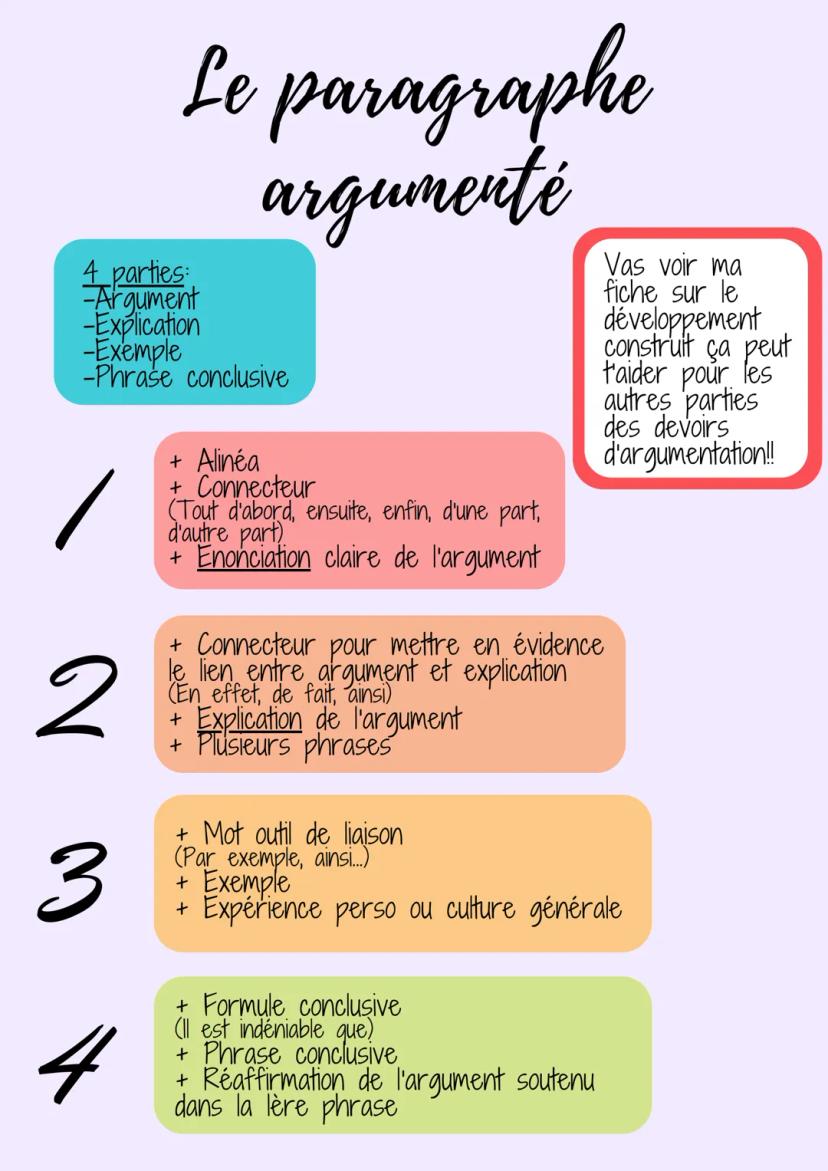
As you can see, a strong paragraph needs more than just a claim. It requires explanation and examples, which is precisely where verbs like démontrer and illustrer come into play.
3. Expanding Your Argumentative Vocabulary
Now that you have the structure, let's build your toolkit with more verbs, grouped by their function in an argument.
A. Verbs for Introducing and Developing Your Argument
When you start developing your point, you need verbs to state what you are going to discuss.
Aborder: To tackle or begin to discuss a subject. (e.g., Dans cet essai, je vais aborder la question de... - In this essay, I will tackle the question of...)Analyser: To analyze, as we've discussed. (e.g., Nous allons maintenant analyser les résultats. - We will now analyze the results.)Examiner: To examine or look at closely. (e.g., Il faut examiner les causes de ce phénomène. - It is necessary to examine the causes of this phenomenon.)Étudier: To study. (e.g., Cette étude étudie l'impact de... - This study studies the impact of...)
This next video clip gives you more examples of these useful "development" verbs.
Comment bien argumenter en français - Vocabulaire pour structurer une argumentation
Let's return to the 'Comment bien argumenter en français' video to hear how these development verbs are used in context.
Watch from 08:27 to 10:00. Listen for the verbs 'aborder', 'analyser', 'considérer', 'étudier', and 'examiner'.
B. Verbs for Supporting Your Point (Providing Evidence)
A claim is weak without evidence. These verbs help you introduce facts, data, and examples to support your position.
Démontrer: To demonstrate or prove.Illustrer: To illustrate with an example. (e.g., Pour illustrer ce point, prenons l'exemple de... - To illustrate this point, let's take the example of...)Souligner: To underline or emphasize the importance of something. (e.g., L'auteur souligne l'urgence de la situation. - The author emphasizes the urgency of the situation.)Soutenir: To support or uphold an idea. (e.g., Il soutient que cette politique est nécessaire. - He supports the idea that this policy is necessary.)
This video provides excellent examples of how to use these verbs to strengthen your arguments.
Améliorez facilement votre argumentation : niveau B2
The video 'Améliorez facilement votre argumentation' is packed with verbs for different argumentative purposes. Let's focus on verbs for providing evidence.
Watch from 07:11 to 11:41. Pay close attention to how 'illustrer', 'souligner', and 'démontrer' are used to give weight to an argument.
C. Verbs for Critiquing an Argument
Academic work isn't just about presenting your own ideas; it's also about analyzing and critiquing the ideas of others.
Contredire: To contradict. (e.g., Ces résultats contredisent la théorie précédente. - These results contradict the previous theory.)Nier: To deny. (e.g., On ne peut pas nier l'évidence. - One cannot deny the evidence.)Réfuter: To refute or disprove. (e.g., Il a réfuté l'argument de son adversaire. - He refuted his opponent's argument.)Rejeter: To reject. (e.g., Le comité a rejeté la proposition. - The committee rejected the proposal.)
Test your understanding!
You are writing an essay about a new government policy. You want to say that while the government supports the policy for economic reasons, a recent study proves that it will have negative environmental consequences.
Which two verbs from the lists above would you use?
Show answer
You would use soutenir to describe the government's position and démontrer to describe the study's findings.
For example: Le gouvernement soutient cette politique pour des raisons économiques, mais une étude récente démontre qu'elle aura des conséquences négatives sur l'environnement.
4. From Verbs to Analysis: A Practical Guide
These verbs are the engine of analysis. The image below shows a guide French students might use to analyze a text. Look closely at the questions it asks—they are built around the very verbs we are learning.

This shows you how these verbs are not just vocabulary to memorize, but active questions to ask when you engage with academic material. When you read a text, ask yourself:
- Quelle thèse est-ce que l'auteur soutient ? (What thesis does the author support?)
- Qu'est-ce qu'il démontre avec ses exemples ? (What does he prove with his examples?)
- Qu'est-ce qu'il réfute ou critique ? (What does he refute or critique?)
Conclusion
You've done an excellent job today! You've moved beyond static vocabulary and started mastering the dynamic verbs that power academic thought and writing in French.
Key Takeaways:
- The core verbs of argumentation are
analyser(to break down and connect),démontrer(to prove with evidence), andconclure(to synthesize and summarize). - Argumentative verbs can be grouped by function:
- Developing:
aborder,examiner,étudier - Supporting:
illustrer,souligner,soutenir - Critiquing:
contredire,réfuter,rejeter
- Developing:
- These verbs are essential tools for asking critical questions when you read and for structuring your own arguments when you write or speak.
Next Lesson Preview:
You now have the verbs to build your points. But how do you link them together into a smooth, logical flow? In our next lesson, we will focus on structuring arguments using logical connectors like donc (therefore), cependant (however), and par contre (on the other hand). This will help you build complex sentences and sophisticated arguments.
À bientôt !