Bonjour ! Welcome back to your French studies.
In our last lesson, we focused on the future, learning to distinguish between what is going to happen (futur proche) and what will happen (futur simple). Now, we'll add a layer of nuance by exploring what would happen.
Today's lesson will teach you how to form the conditional tense to make polite requests and give advice. This is an incredibly useful tense that will immediately make your French sound more sophisticated and considerate, a key skill for your goals in professional, academic, and social settings.
Let's begin.
1. What is the Conditional and Why Use It?
In English, we use words like "would," "could," and "should" to express politeness, give advice, or talk about hypothetical situations. French doesn't use separate words like this; instead, it changes the verb ending. This is the conditional tense (le conditionnel).
For today, we'll focus on two of its most common and important uses:
- Making polite requests: Using "I would like" instead of "I want."
- Giving advice: Using "You should" instead of "You must."
These uses are essential for navigating social and professional interactions gracefully. For example, in a professional context, asking "Je voudrais une clarification" (I would like a clarification) is much more polite than "Je veux une clarification" (I want a clarification).
To see these uses explained, watch the following short clips from a lesson by Learn French With Alexa.
Understand the Conditional Tense in French | Free Full Live Lesson
This video introduces the conditional tense and provides clear examples of how it's used for polite requests and giving advice.
Please watch two separate clips from the video: From 06:10 to 06:47 to see how the conditional is used for polite requests. From 20:18 to 22:38 to understand how to give advice using the verb 'devoir' (to have to) in the conditional, which translates to 'should'.
2. How to Form the Conditional Tense
The good news is that forming the conditional leverages knowledge you already have from previous lessons on the futur simple and the imparfait.
The rule is simple: Conditional Stem + Imperfect Endings
Let's break that down.
The Stem
The "stem" is the base of the verb you'll be using.
- For most verbs, the stem is simply the infinitive (e.g., parler, finir).
- For verbs ending in -re, you drop the final 'e' (e.g., prendre becomes prendr-).
- For irregular verbs, the conditional stem is the exact same stem used for the futur simple. You've already learned these! For example,
avoir->aur-,être->ser-,aller->ir-.
The Endings
You then add the endings from the imparfait tense:
- je: -ais
- tu: -ais
- il/elle/on: -ait
- nous: -ions
- vous: -iez
- ils/elles: -aient
The following article provides an excellent summary of this formation rule and a helpful list of the irregular stems you should recognize from our lessons on the future tense.
Le Conditionnel: Learn the French Conditional
The article 'Le Conditionnel: Learn the French Conditional' from Busuu clearly explains the formation and provides a great list of common irregular stems.
Please read the sections 'Building blocks: How to conjugate the conditionnel présent' and 'Irregular verbs and their stems'. Focus on the formula (infinitive + imparfait endings) and review the table of irregular stems, which should be familiar to you from the 'futur simple'.
Here is a visual chart that summarizes the formation rules for quick reference.
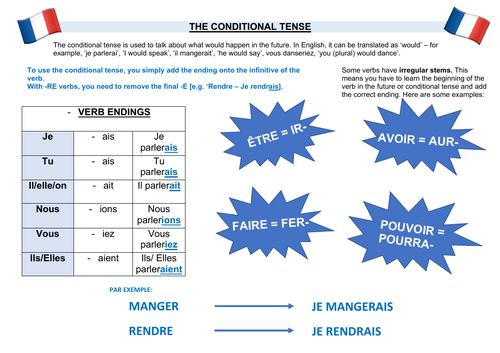
Let's see it in action with the verb manger (to eat):
- Stem: manger
- Endings: -ais, -ais, -ait, -ions, -iez, -aient
- Result: je mangerais (I would eat), tu mangerais, il mangerait, nous mangerions, vous mangeriez, ils mangeraient.
And with the irregular verb avoir (to have):
- Stem: aur-
- Endings: -ais, -ais, -ait, -ions, -iez, -aient
- Result: j'aurais (I would have), tu aurais, il aurait, nous aurions, vous auriez, ils auraient.
Test your understanding!
How would you form the conditional for "we would go" (nous + aller)?
- Find the irregular stem for aller.
- Add the correct ending for nous.
Show answer
- The future/conditional stem for aller is ir-.
- The imparfait ending for nous is -ions.
- Result: Nous irions.
3. Putting It into Practice: Requests and Advice
Now let's focus on using this new tense in contexts relevant to your goals.
Making Polite Requests
This is often called the conditionnel de politesse (conditional of politeness). The most common verbs used are vouloir (to want), aimer (to like), and pouvoir (to be able to).
-
Je voudrais... (I would like...)
- Au restaurant : Je voudrais un café, s'il vous plaît. (I would like a coffee, please.)
- Dans un cadre professionnel : Je voudrais poser une question. (I would like to ask a question.)
-
J'aimerais... (I would like..., expressing more of a wish)
- Pour vos études : J'aimerais étudier la cybersécurité en France. (I would like to study cybersecurity in France.)
-
Pourriez-vous... ? (Could you...?)
- Dans un e-mail professionnel : Pourriez-vous m'envoyer le rapport ? (Could you send me the report?)
Giving Advice
The most direct way to give advice is by using the verb devoir (must/to have to) in the conditional. Devoir in the conditional is the equivalent of "should."
- Tu devrais... / Vous devriez... (You should...)
- Conseil pour la recherche d'emploi : Vous devriez personnaliser votre lettre de motivation. (You should personalize your cover letter.)
- Conseil à un ami : Tu devrais te reposer un peu. (You should rest a bit.)
This article provides more excellent, practical examples.
Understanding The French Conditional
This article from French Today explains and gives examples of how to use the conditional to give advice.
Read the short section titled 'Giving Advice with the Conditional'. It provides clear examples using 'devoir'.
Practice Exercise
Translate the following sentences into French, using the conditional.
- I would like a glass of water, please. (Use vouloir)
- You (formal) should speak French every day. (Use devoir)
- Could you (informal) help me? (Use pouvoir)
Show answers
- Je voudrais un verre d'eau, s'il vous plaît.
- Vous devriez parler français tous les jours.
- Tu pourrais m'aider ?
Conclusion
Félicitations ! You have learned a fundamental tense for expressing nuance and politeness in French.
Key Takeaways:
- The conditional tense is the French equivalent of "would," "could," and "should."
- It is essential for making polite requests and giving advice.
- Formation Rule: Use the same stem as the futur simple and add the imparfait endings (-ais, -ais, -ait, -ions, -iez, -aient).
- Key phrases to remember: Je voudrais... (I would like...), Pourriez-vous...? (Could you...?), and Vous devriez... (You should...).
Next Lesson Preview:
We've just scratched the surface of the conditional. In our next lesson, we will build directly on this foundation to express hypothetical situations using 'si' + imparfait + conditionnel—for example, "If I had time, I would travel." This will open up a whole new range of expression for your conversations.
À bientôt !