Hello! Welcome to the first lesson of your personalized guitar course.
I'm excited to get started on this journey with you. Based on our conversation, we've designed this course to give you a deep and broad understanding of the guitar, focusing on the rock and blues styles you love. We'll build a solid foundation in music theory—the "why" behind the music—and connect it directly to practical techniques on both your acoustic and electric guitars.
This first module, Music Theory Foundations, is all about learning the language of music. Today, we'll start with the most fundamental building block: the notes on the fretboard.
Your Goal for This Lesson
By the end of this 60-minute session, you will be able to identify all the natural notes (A, B, C, D, E, F, G) on each of the six strings up to the 12th fret.
Think of this as learning the alphabet. Before you can build chords, scales, and solos, you need to know the individual letters and where to find them. Mastering this will transform the fretboard from a mysterious grid of frets and strings into a familiar map, giving you the freedom and confidence to play what you hear in your head.
The Musical Alphabet and Your Guitar
In Western music, we use a system of 12 notes. For this lesson, we will focus on the seven natural notes:
A - B - C - D - E - F - G
After G, the cycle repeats back to A, but at a higher pitch. The distance between repeating notes is called an octave.
A crucial rule to memorize is how these notes are spaced. Most natural notes are separated by a whole step (two frets on the guitar). However, there are two exceptions:
- There is only a half-step (one fret) between B and C.
- There is only a half-step (one fret) between E and F.
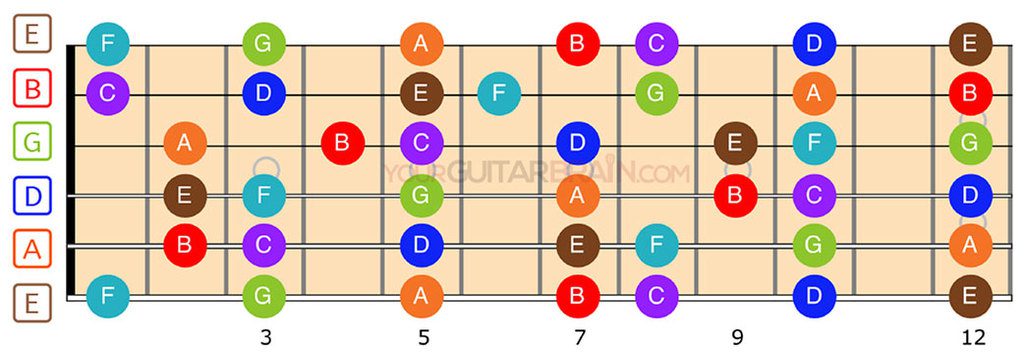
Your starting points for navigating this map are the open strings of your guitar, which in standard tuning are:
- 6th string (thickest): E
- 5th string: A
- 4th string: D
- 3rd string: G
- 2nd string: B
- 1st string (thinnest): E
Notice the notes on the 12th fret are the same, just an octave higher. This means the entire fretboard pattern repeats after the 12th fret. For that reason, our focus today is on mastering the first 12 frets.
To get a clear understanding of these foundational concepts, please watch the beginning of the following video.
Learn The Fretboard - How To Memorize The Notes Of The Fretboard
This video from GuitarZero2Hero provides a concise explanation of the musical alphabet and how it applies to the fretboard.
Watch from the beginning until 04:44. Focus on understanding the 12 notes of the musical alphabet, the special relationship between B-C and E-F, and how the open strings act as your reference points.
The Most Effective Way to Learn the Fretboard
Instead of trying to memorize all the notes on one string at a time, a more effective method is to focus on one note across all six strings. This approach helps you see the fretboard as a unified whole rather than six separate lines.
Your main exercise for this week is simple:
- Pick one natural note (e.g., F).
- Find and play that note on every string, from the 6th string down to the 1st.
- Then, play them back in reverse order, from the 1st string to the 6th.
- Say the name of the note out loud as you play it.
The following video provides an excellent demonstration and explanation of this core exercise.
How To MEMORIZE Your Guitar FRETBOARD: The No-Nonsense Exercise That Actually Works
The instructor from MusicTheoryForGuitar explains the 'No-Nonsense' exercise that we will be using. Pay close attention to his advice about not trying to memorize patterns, but rather letting the knowledge build through consistent physical practice.
Watch the section from 02:58 to 05:57. The instructor will walk you through the basic exercise of finding one note on all six strings.
Your Practice Plan
To make this manageable and align with your preference for a structured approach, we will use a "note of the day" system. Don't worry about sharps or flats for now; focusing on the seven natural notes is the priority.
I recommend you begin by reading through the tips in the following article, which reinforces our approach.
Guitar Fretboard Notes: Learn & Memorize Notes Easily
The article 'Guitar Fretboard Notes' from Pickup Music offers a clear, concise summary of the learning strategy we're adopting. It also includes a helpful practice schedule.
Read the sections titled '#1 – Forget about sharps and flats (for now)', '#2 – Learn up to the 12 fret', and '#3 – Focus on one musical note at a time'. The table in section #3 gives you a great 7-day practice plan.
Now, let's put it into practice.
- Grab your guitar.
- Using the chart from the Pickup Music article, let's start with Day 1: F notes.
- Refer to the fretboard diagram above (or the list below) to find all the F notes up to the 12th fret.
- Play them one by one, from the 6th string to the 1st and back again. Say "F" each time you play a note. Do this for about 5 minutes.
- Now, let's try Day 2: C notes. Repeat the same process.
To help you, here is a "cheat sheet" listing the fret for each natural note on every string. It's perfectly fine to rely on this at first—the goal is to build the connection between your mind, eyes, and fingers.
Easily Learn the Guitar Fretboard Notes
This resource from Applied Guitar Theory provides a straightforward list of where each natural note lies on each string. Use this as your reference while practicing the exercise.
Review the section 'Fretboard Notes By String'. You don't need to memorize it right away, but use it to check your work as you find the 'F' and 'C' notes in the exercise.
Internalizing the Notes: The Role of a Metronome
Knowing where the notes are is the first step. Internalizing them so you can find them instantly is the goal. To bridge this gap, we'll add a simple tool: a metronome.
Practicing with a metronome, even at a very slow speed, adds a small amount of pressure that forces your brain to recall the note locations more quickly. It's a highly effective way to accelerate your learning.
How To MEMORIZE Your Guitar FRETBOARD: The No-Nonsense Exercise That Actually Works
Let's return to the MusicTheoryForGuitar video to see how to incorporate a metronome into your practice.
Watch the segment from 05:57 to 07:22. The key is to start very slow, around 40 BPM. The goal isn't speed, but steady, consistent recall.
Your Daily Practice Routine (5-10 minutes):
- Follow the 7-day schedule from the Pickup Music article (Day 1: F, Day 2: C, etc.).
- For the first few minutes, find the "note of the day" on all six strings without the metronome.
- Then, set a metronome to a slow tempo (40-60 BPM).
- Play the note on each string, one note per beat. Go from string 6 to 1, then 1 to 6.
- If you make a mistake, don't worry. Just keep going. The consistency is what matters.
This short, daily exercise will build a powerful mental model of the fretboard far more effectively than a single, long practice session.
Conclusion
Excellent work today! You've taken the first and most crucial step in demystifying the guitar. Simply knowing that the fretboard is a logical, repeating system is a huge leap forward.
Here are your key takeaways:
- The fretboard is built from the 7 natural notes (A, B, C, D, E, F, G).
- Remember the half-step rule: notes are one fret apart only between B-C and E-F.
- The entire pattern of notes repeats at the 12th fret.
- The most effective practice method is to focus on one note at a time across all six strings.
- A short, daily routine using a metronome will rapidly accelerate your fretboard knowledge.
Looking Ahead:
Now that you're learning to locate individual notes, the next logical step is to understand the distance between them. In our next lesson, we will explore intervals. Intervals are the fundamental building blocks of everything from melodies and riffs to the chords you already know how to play. This will be our first major step in understanding the "why" behind harmony.
Keep up with your daily 10-minute practice on the notes, and I'll see you in the next lesson