Hello! Welcome to our next lesson.
In the previous session, we moved from three-note triads to four-note seventh chords, exploring the formulas for major 7th, minor 7th, and dominant 7th chords. We saw how adding that fourth note creates the rich, complex sounds that are essential to rock and blues.
Today, we're taking a step back to look at the scales that these chords are built from. Our goal is to construct natural minor scales and explain their relationship to relative major keys. This concept is one of the most powerful "aha!" moments in music theory. It explains why a happy-sounding major key and a sad-sounding minor key can be two sides of the same coin, using the exact same set of notes. This is a foundational piece of the puzzle for understanding songwriting and improvisation.
Part 1: Constructing the Natural Minor Scale
The natural minor scale is often associated with a sad, moody, or dramatic feeling, contrasting with the bright sound of the major scale. There are two primary ways to understand its construction.
Method 1: The Step Formula
Just like the major scale has its W-W-H-W-W-W-H formula, the natural minor scale has its own unique pattern of whole (W) and half (H) steps:
W - H - W - W - H - W - W
A whole step is a distance of two frets on the guitar, and a half step is one fret.
To see this in action, let's build the A natural minor scale, which conveniently uses no sharp or flat notes.
- Start on the open A string (our root note).
- Whole step up to B (2nd fret, A string).
- Half step up to C (3rd fret, A string).
- Whole step up to D (5th fret, A string).
- Whole step up to E (7th fret, A string).
- Half step up to F (8th fret, A string).
- Whole step up to G (10th fret, A string).
- Whole step up to A (12th fret, A string), completing the octave.
The resulting notes are: A - B - C - D - E - F - G.
This video provides a great introduction to the natural minor scale and its formula.
Exploring the natural minor scale on guitar
Let's hear this from another perspective. This video from Ry Naylor Guitar clearly defines the natural minor scale and its distinct step formula.
Watch from 00:19 to 01:09. The instructor plays the A minor scale and spells out the whole-step/half-step pattern, which should sound familiar after our exercise.
Method 2: The Parallel Minor Formula
Another powerful way to think of the natural minor scale is in relation to its parallel major. A parallel minor shares the same root note as a major scale but alters certain notes to create its minor quality.
The rule is: To get a natural minor scale, you take the parallel major scale and flatten the 3rd, 6th, and 7th degrees.
Natural Minor Scale = 1, 2, ♭3, 4, 5, ♭6, ♭7
Let's apply this to find the notes of C minor:
- First, we start with the C major scale: C - D - E - F - G - A - B
- Now, we flatten the 3rd, 6th, and 7th notes:
- 3rd: E becomes E♭
- 6th: A becomes A♭
- 7th: B becomes B♭
- So, the C natural minor scale is: C - D - E♭ - F - G - A♭ - B♭
This next clip demonstrates this exact process.
Exploring the natural minor scale on guitar
This clip from the same video illustrates the concept of the parallel minor by transforming a major scale into its minor counterpart.
Watch from 01:09 to 02:51. Pay attention to how he identifies the 3rd, 6th, and 7th degrees of the major scale and then lowers them to create the minor scale.
Part 2: Relative Major and Minor Keys - The Core Idea
Now for the main event. While C major and C minor are parallel keys (same root, different notes), there's another relationship called relative keys.
Relative keys are a major and a minor scale that share the exact same notes, but have a different root note (or tonal center).
Every major scale has a relative minor, and its root note is always the 6th degree of the major scale.
Let's go back to our C major scale: C - D - E - F - G - A - B.
The 6th note is A. This means A minor is the relative minor of C major.
This explains why the A natural minor scale we built earlier (A-B-C-D-E-F-G) contains the exact same notes as the C major scale, just starting from A.
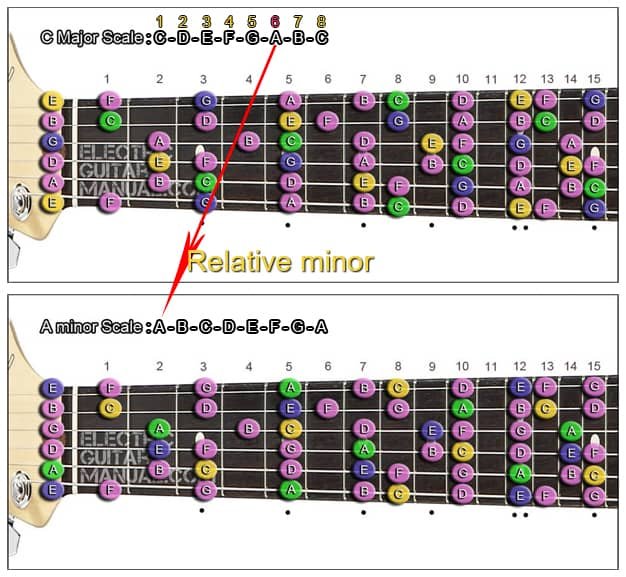
This relationship has a very handy shortcut on the guitar: the root of the relative minor is always three frets lower than the root of the major scale.
The following reading explains this relationship with clear tables and diagrams.
Relative Minor and Relative Major Scales
This article from Applied Guitar Theory provides a very clear, step-by-step explanation of relative keys. It uses tables and fretboard diagrams that will help solidify this concept.
Please read the sections 'What is the Relative Minor Scale?', 'Finding the Relative Minor on the Fretboard', and the examples for C Major and G Major. Focus on the tables that show the shared notes and the "three frets down" shortcut.
Part 3: Finding the Relative Major
This relationship works both ways. Every natural minor scale has a relative major, and its root is the 3rd degree of the minor scale.
Let's look at A minor again: A - B - C - D - E - F - G.
The 3rd note is C. This confirms that C major is the relative major of A minor.
The fretboard shortcut is simply the reverse: the root of the relative major is three frets higher than the root of the minor scale.
Relative Minor and Relative Major Scales
Now let's look at it from the other direction. The same article explains how to find the relative major from a minor scale.
Read the sections 'Finding the Relative Major Scale' and 'Finding the Relative Major on the Fretboard'. Notice it's the inverse of what we just learned: find the 3rd degree of the minor scale, or simply move up 3 frets.
Part 4: Practical Application - Why This Matters
You might be asking, "If C major and A minor have the same notes, are they the same thing?" The answer is no, and the difference lies in the tonal center.
- In the key of C major, the C note and C major chord feel like "home." Melodies and progressions will feel resolved when they land on C. The overall mood is bright.
- In the key of A minor, the A note and A minor chord feel like "home." The music will resolve to A, and the overall mood is dark or melancholic.
Understanding this allows you to make powerful creative choices.
What Are Relative Major/Minor Chords and Scales? Music Theory Guitar Lesson
So, how is this useful in a real playing situation? This video from swiftlessons demonstrates how understanding relative keys helps you in both lead and rhythm playing.
Watch from 04:53 to 06:57. Notice two key applications: For lead guitar, you can use the same scale over a C major chord and an A minor chord, but you change which note you treat as the 'root' or 'home base'. For rhythm guitar, you can sometimes substitute a major chord with its relative minor (or vice versa), as shown in the 'Knocking on Heaven's Door' example.
Practice Exercises
-
Theory Check:
- What is the relative minor of G major? (Hint: Find the 6th note of G major: G-A-B-C-D-E-F#).
- What is the relative major of E minor? (Hint: Find the 3rd note of E minor: E-F#-G-A-B-C-D).
-
On the Fretboard: Let's put this under your fingers.
- Find the note G on the 3rd fret of your low E string.
- Play a one-octave G major scale starting there:
- 6th string: 3-5
- 5th string: 2-3-5
- 4th string: 2-4-5
- Now, find the note E on the open low E string. This is the relative minor of G.
- Play a one-octave E natural minor scale:
- 6th string: 0-2-3
- 5th string: 0-2-3
- 4th string: 0-2
- Notice you are playing the exact same set of notes (G, A, B, C, D, E, F#), just starting and ending in different places. This is the sound of relative keys.
Conclusion
Great job today! You've just unlocked a crucial concept that connects the worlds of major and minor harmony. This relationship is a cornerstone of how keys and chord progressions work in almost all Western music, including the rock and blues you love.
Key Takeaways:
- The natural minor scale has a formula of W-H-W-W-H-W-W and can also be seen as a major scale with a flattened 3rd, 6th, and 7th.
- Relative keys (one major, one minor) share the exact same notes but have different tonal centers, giving them different emotional characters.
- The relative minor is found on the 6th degree of the major scale (or 3 frets down).
- The relative major is found on the 3rd degree of the minor scale (or 3 frets up).
Preview of the Next Lesson:
We've discussed how the "tonal center" determines whether we're in a major key or its relative minor. But how do we figure out the tonal center of a song just by listening? In our next lesson, we will learn how to identify the key of a simple melody or chord progression, which is a vital ear-training skill. This will be the final lesson in our Music Theory Foundations module.