Welcome back. The previous lesson located Diwali around the new moon and distinguished a lunar tithi from a Gregorian calendar day. Now you can put that calendar knowledge to work: this lesson traces one commonly described north or west Indian sequence from Dhanteras to Bhai Dooj. Its purpose is to give each observance a recognizable association—not to make five days into a rule for every family.
A timeline made of lunar days
The image below is a useful map. It places two observances in the waning, or dark, fortnight; the main Diwali night at the new moon; and two more in the waxing, or bright, fortnight. Its time-of-day labels are indicative observance windows, not a timetable to apply to every location or household.
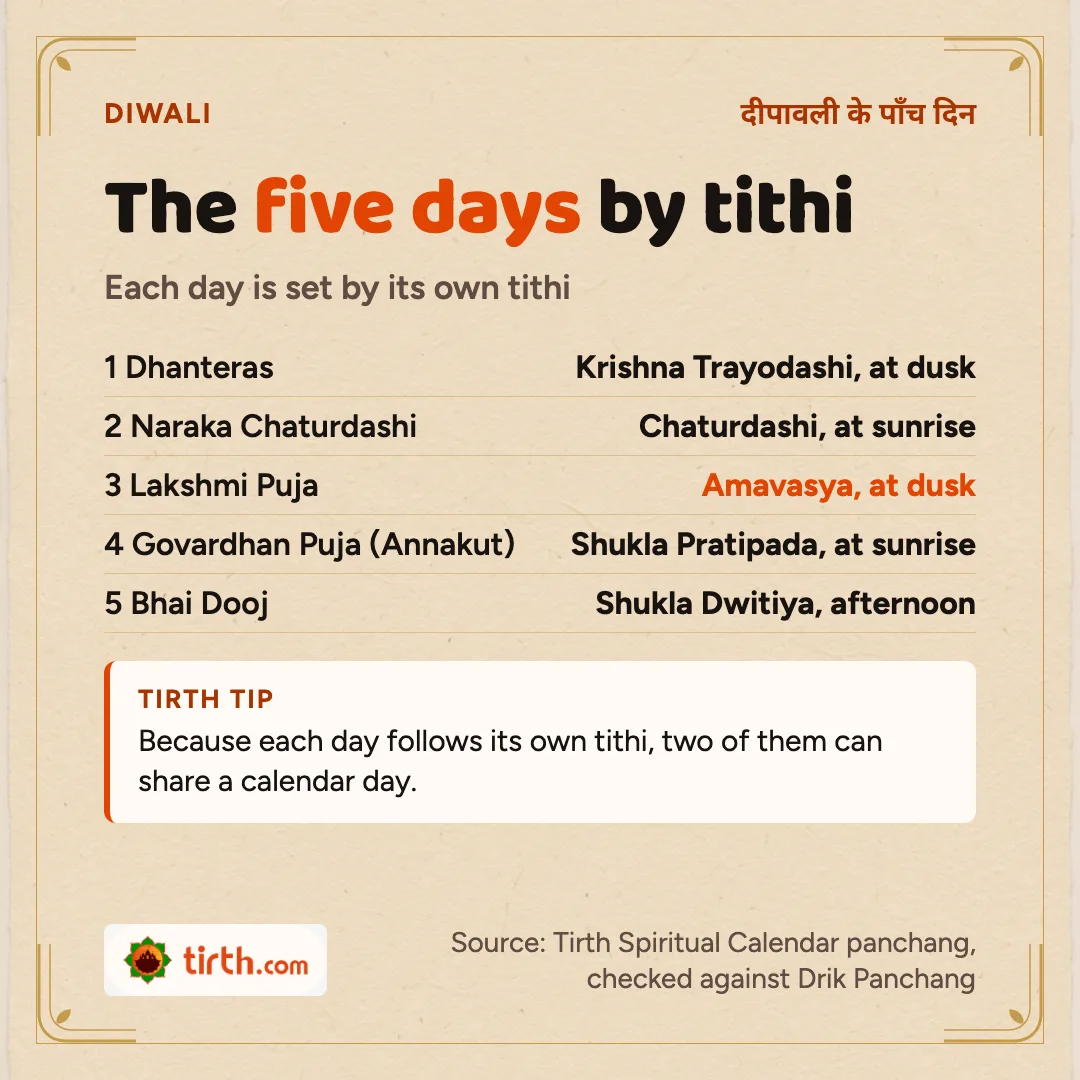
The sequence crosses an important boundary. Trayodashi is the thirteenth lunar day and Chaturdashi the fourteenth. Amavasya is the new moon. Pratipada and Dwitiya are the first and second lunar days after it. The month containing the new moon may be called Ashvina or Karttika under the different naming conventions covered last time; that difference does not change the order shown here.
An observance tied to a tithi need not occupy a whole midnight-to-midnight day. A tithi can begin or end during a civil day, and the relevant morning or evening can matter. That is why “five days of Diwali” is a convenient description of a sequence of observances, not a guarantee of five distinct dates on a Gregorian calendar.
From preparation to the new-moon evening
Read the following overview as one presentation of the sequence. It gives concrete practices to attach to the names, but its examples should not be read as a checklist that every celebrant follows.
Five days of festive fervour - The Hindu
Read The Hindu's “Five days of festive fervour” for its day-by-day account of a representative celebration.
Under “The five days of Deepavali,” read the five descriptions, beginning with the first paragraph under “Dhanteras” and ending with the final sentence under “Bhai Dooj.” Stop before the publication line and “Related Topics.” Notice which descriptions emphasize a deity or sacred story, which emphasize a relationship, and where the fourth day has more than one name.
Dhanteras opens this representative sequence on dark-fortnight Trayodashi. Its association is not simply shopping, though buying utensils or precious metals is a familiar practice in some accounts. The broader themes are prosperity and well-being: Lakshmi is associated with auspicious prosperity, while Dhanvantari is associated with healing. Cleaning, decorating an entrance, lighting lamps, and acquiring something new can express a wish to welcome a flourishing household. None is required for a family to recognize Dhanteras.
Naraka Chaturdashi, on the following dark-fortnight Chaturdashi, is also called Choti Diwali in some settings. Its name recalls Naraka or Narakasura, whose defeat is told in varying traditions involving Krishna, Satyabhama, or other divine figures. A pre-dawn bath, sometimes preceded by applying oil or fragrant preparations, is another association described in festival accounts. For this timeline, hold together the Naraka story and early-morning observance without assuming that every household tells the story—or performs the bath—in the same way. A later lesson will examine one Tamil household example more closely.
The main Diwali evening in this sequence falls at amavasya, the new moon. Here the principal association is Lakshmi puja: worship and welcome of Lakshmi, with lamps illuminating homes on a moonless night. The Hindu's account describes doors opened to welcome her; other household details vary. “Main” is relative to this particular sequence. The previous lesson noted that a family centered on Naraka Chaturdashi morning may use Deepavali chiefly for that earlier observance. Nor does Lakshmi puja exhaust the meanings people give to the new-moon night. Later lessons will consider the account of Rama’s return and a Bengali Kali Puja example.
After the new moon: the fourth and fifth observances
On bright-fortnight Pratipada, the first lunar day after the new moon, two associations are especially worth keeping distinct. Govardhan Puja recalls the sacred account of Krishna sheltering his community and cattle by lifting Govardhan Hill during a destructive storm. Worship associated with Govardhan and offerings of food can express gratitude for protection and sustenance. Bali Pratipada—also called Balipratipada or, in some accounts, Padwa—instead foregrounds King Bali and Vishnu’s Vamana form. The story tells of Bali being humbled and subsequently honored or blessed. These names can refer to observances in the same part of the festival period, but they are not interchangeable names for one story. Families may emphasize one, the other, or additional customs.
Bhai Dooj, associated with bright-fortnight Dwitiya, places a sibling relationship at the center of the closing observance. The account in The Hindu describes sisters welcoming brothers, applying a tilak—a mark on the forehead—and sharing a meal or gifts. Its principal association is affection and good wishes between siblings, rather than worship of the deity prominent on an earlier day. The name and particular ways of gathering can differ across families.
The fourth day makes an especially useful test of what a timeline can and cannot tell you. A label such as “Govardhan Puja” identifies an association, but it does not describe the full range of local practices. The following regional account shows how livestock and other community traditions can sit alongside the familiar five-day outline.
Read this Incredible India account for a concrete example of variation within a five-day framework, not as a description of every household in the region.
In “4. Day Four: Govardhan Puja and Gaura-Gauri Festival,” read the fourth-day example. Begin with the introductory paragraph and continue through “Installation of Mount Govardhan Using Cow Dung” and the first part of “Adornment of Cattle and Tying the 'Sohai'”; stop after the explanation of garlands tied to cattle. Then, under “5. Day Five: Bhai Dooj and 'Maatar' Festival,” read the fifth-day example, ending with the paragraph that notes Maatar alongside Bhai Dooj in several rural areas. Focus on what these additions reveal about the limits of a short festival chart.
In that account, symbolic figures of Govardhan and cattle, along with the adornment of living animals, make the fourth observance tangible in an agrarian setting. Its fifth-day description includes Bhai Dooj and notes Maatar alongside it in several rural areas. Neither detail invalidates the five-day outline; each shows what the outline leaves out. Equally, the source’s regional description is evidence of practices it reports, not proof that every family in that region observes them.
What the timeline is for
You can now annotate the representative sequence in five compact associations: Dhanteras—prosperity and health; Naraka Chaturdashi—the Naraka story and, in some homes, an early bath; new-moon Diwali—Lakshmi’s welcome and worship; Govardhan Puja or Bali Pratipada—distinct fourth-day sacred associations; Bhai Dooj—sibling bonds. The tithis explain their order, while the associations explain why a name on a calendar matters.
Keep the qualifier representative attached to the whole sequence. A family may foreground a different day, use another name, combine observances on one civil date, or add customs that a five-entry chart cannot show. The next module moves from this calendar map into sacred stories and household practices, beginning with how the account of Rama, Sita, and Lakshmana’s return gives welcoming lights meaning in many north Indian celebrations.