Hello! Welcome to your first lesson in multivariable control systems.
In this course, we'll move from the single-input, single-output (SISO) systems you're familiar with to the more general and powerful world of multiple-input, multiple-output (MIMO) systems. The key to this transition is the state-space representation, a universal framework for modeling dynamic systems.
You've mentioned that one of your key questions is how to determine the right number of variables to model a system. This lesson tackles that question head-on. Our goal is to answer: "What is the minimum number of variables I need to completely describe the behavior of a system?" By the end of this lesson, you will be able to identify the minimum number of state variables required to describe a dynamic system. This is the foundational first step before we can build any state-space model.
What is a System's "State"?
Before we can count state variables, let's clarify what the "state" of a system is. Imagine you have an RLC circuit. If you know the input voltage at this exact moment, is that enough to predict the current a second from now? Not quite. You also need to know the initial voltage across the capacitor and the initial current through the inductor. These initial conditions are the "memory" of the circuit.
The state of a system is the smallest set of variables (called state variables) which, along with the future inputs, is sufficient to determine the future behavior of the system. In essence, the state summarizes the entire history of the system into a compact, numerical form.
To get a more formal introduction to this idea, please watch the first few minutes of the following video.
System Dynamics and Control: Module 27b - Choosing State Variables
This video, titled 'System Dynamics and Control: Module 27b - Choosing State Variables' from the Rick Hill channel, provides an excellent intuitive introduction to why we need state variables and what they represent.
Please watch the segment from the beginning until 04:27. Focus on the distinction between a static and a dynamic model and the formal definition of a system's state.
The Core Principle: Counting Energy Storage Elements
So, how do we find this minimum number of state variables? For physical systems, there's a beautifully simple and intuitive rule:
The minimum number of state variables required to describe a system is equal to the number of independent energy storage elements.
Let's break this down for the types of systems you're familiar with.
Mechanical Systems
In a mechanical system, energy is stored in two primary forms:
- Kinetic Energy: Stored in moving masses (or rotating inertias). The energy is .
- Potential Energy: Stored in compressed or stretched springs. The energy is .
Elements like dampers (dashpots) or friction surfaces do not store energy; they dissipate it as heat. Therefore, they do not contribute to the number of state variables.
This means for a simple mechanical system, you can find the number of state variables by counting the number of masses and springs that can store energy independently.
The video you just watched continues with a great example of this.
System Dynamics and Control: Module 27b - Choosing State Variables
Let's continue with the same video, 'Choosing State Variables', to see how this energy principle is applied to a mechanical system.
Watch the segment from 05:44 to 10:05. Pay close attention to how springs and masses are identified as energy storage elements, while the damper is identified as a dissipative element.
Electrical Systems
This is where your background in Electrical Engineering comes directly into play. The same energy principle applies perfectly to electrical circuits. The main energy storage elements are:
- Inductors: Store energy in a magnetic field (). This is analogous to kinetic energy in masses.
- Capacitors: Store energy in an electric field (). This is analogous to potential energy in springs.
Resistors, like dampers, are dissipative elements () and do not add to the count of state variables.
Therefore, to find the number of state variables for an electrical circuit, you simply count the number of inductors and capacitors.
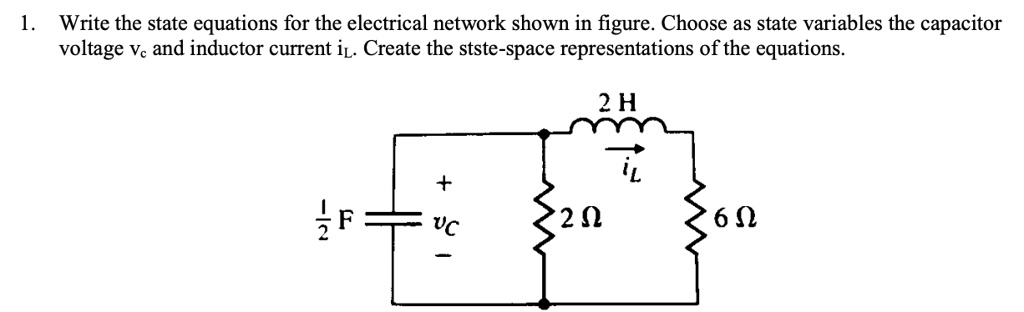
The following video provides a quick, clear example.
State-space model of an electric circuit - STEP BY STEP
This video, 'State-space model of an electric circuit - STEP BY STEP' from the bioMechatronics Lab channel, directly applies the energy storage concept to an electrical circuit.
Please watch from 00:17 to 02:13. Notice how the state variables are identified by simply locating the inductors and capacitors in the circuit diagram.
Alternative Methods: Using the System's Mathematical Description
What if you don't have a physical diagram, but instead have the system's governing equations? There are equivalent rules for this situation.
This document, 'STATE SPACE ANALYSIS' from BMSCE, provides a concise set of guidelines for determining the number of state variables from a mathematical model.
Please read the short section titled 'Selection of state variables'. It presents three clear guidelines. You can stop reading before 'State space Representation using Physical variables'.
As you just read, the number of state variables can also be determined by:
- The order of the system's differential equation. An nth-order differential equation requires n state variables.
- The order of the denominator of the system's transfer function. For a transfer function , the number of state variables is equal to the degree of the denominator polynomial .
This should be very familiar from your work with signal processing and classical controls. The order of the system, which you used to determine stability and response characteristics, is precisely the number of state variables needed for a state-space model.
A Key Caveat: "Independent" Energy Storage
I've emphasized the word independent when counting energy storage elements. This is a crucial detail. If the energy state of one element is constrained by another, they are not independent, and you should not double-count them.
- Mechanical Example: If two masses are rigidly connected, they move with the same velocity. They share one velocity, so their kinetic energies are dependent. You would only count this as one state variable for velocity, not two.
- Electrical Example: Consider two capacitors, and , connected in series. The charge stored in each is identical due to the series connection. Knowing the voltage across and the total voltage allows you to calculate the voltage across . They are not independent. You would treat the combination as a single equivalent capacitance, contributing only one state variable, not two.
The following video segment discusses this concept of dependency with some clear visual examples.
System Dynamics and Control: Module 27b - Choosing State Variables
Let's return one last time to the 'Choosing State Variables' video to understand the concept of dependent elements.
Watch the final part of the video, from 16:35 to 18:25. Focus on the examples given for when elements are constrained and thus not independent.
Test your understanding!
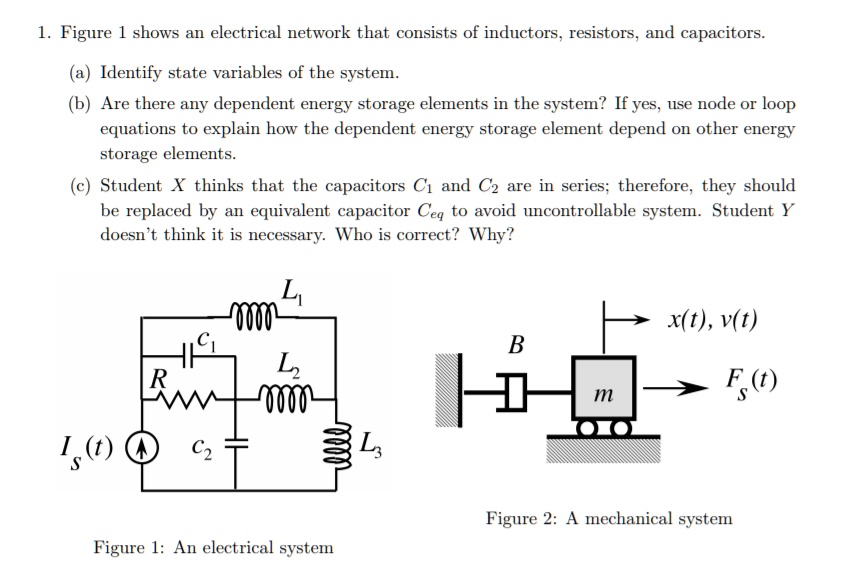
Take a look at the two systems in the image below. For each one, determine the minimum number of state variables required. Justify your answer based on the principles we've discussed.
Show answer
-
Figure 1 (Electrical System):
- There are three energy storage elements: inductor , capacitor , and capacitor .
- However, capacitors and are connected in series. This means the charge on them is dependent. They can be treated as a single equivalent capacitor .
- Therefore, there are only two independent energy storage elements: the inductor and the equivalent capacitance of and .
- The minimum number of state variables is 2.
-
Figure 2 (Mechanical System):
- There is one energy storage element: the mass , which stores kinetic energy.
- The damper dissipates energy and does not count.
- Therefore, the minimum number of state variables is 1. (This would typically be the velocity of the mass).
Conclusion
Excellent work! You've just mastered the first and a very important step in creating state-space models.
Here are the key takeaways from this lesson:
- The state of a system is the minimal information needed (its "memory") to predict its future behavior given the inputs.
- The most reliable way to find the minimum number of state variables for a physical system is to count the number of independent energy storage elements.
- For mechanical systems, these are masses/inertias and springs.
- For electrical systems, these are inductors and capacitors.
- Alternatively, the number of state variables is equal to the order of the system's governing differential equation or the degree of its transfer function denominator.
In our next lesson, we will build directly on this foundation. Now that you know how many state variables you need, we'll focus on how to select appropriate state variables for mechanical and electrical systems and begin writing the actual state equations.