Welcome back. In the previous lesson, you saw why loading taconite and adjusting ballast change the Edmund Fitzgerald’s draft and freeboard. The distinction that matters now is between ballast deliberately carried in tanks and water entering spaces that were meant to stay dry or be kept at a controlled level.
This lesson traces two possible paths for unwanted water: through damaged openings into ballast spaces, and past ineffective hatch closures into the cargo hold. You will see why either path could make a freighter ride lower, and why the Fitzgerald’s largely undivided hold made substantial flooding especially dangerous. This is an explanation of the mechanisms, not yet a verdict on precisely what happened.
Follow the water through the ship
In the diagram below, read the tank top view from above, then the midship section as a slice across the hull. The cargo hold occupies the broad central space; ballast tanks lie along its sides and beneath it. In the side view, the two “screen” bulkheads divide the cargo area into three numbered holds, but they were not watertight barriers.
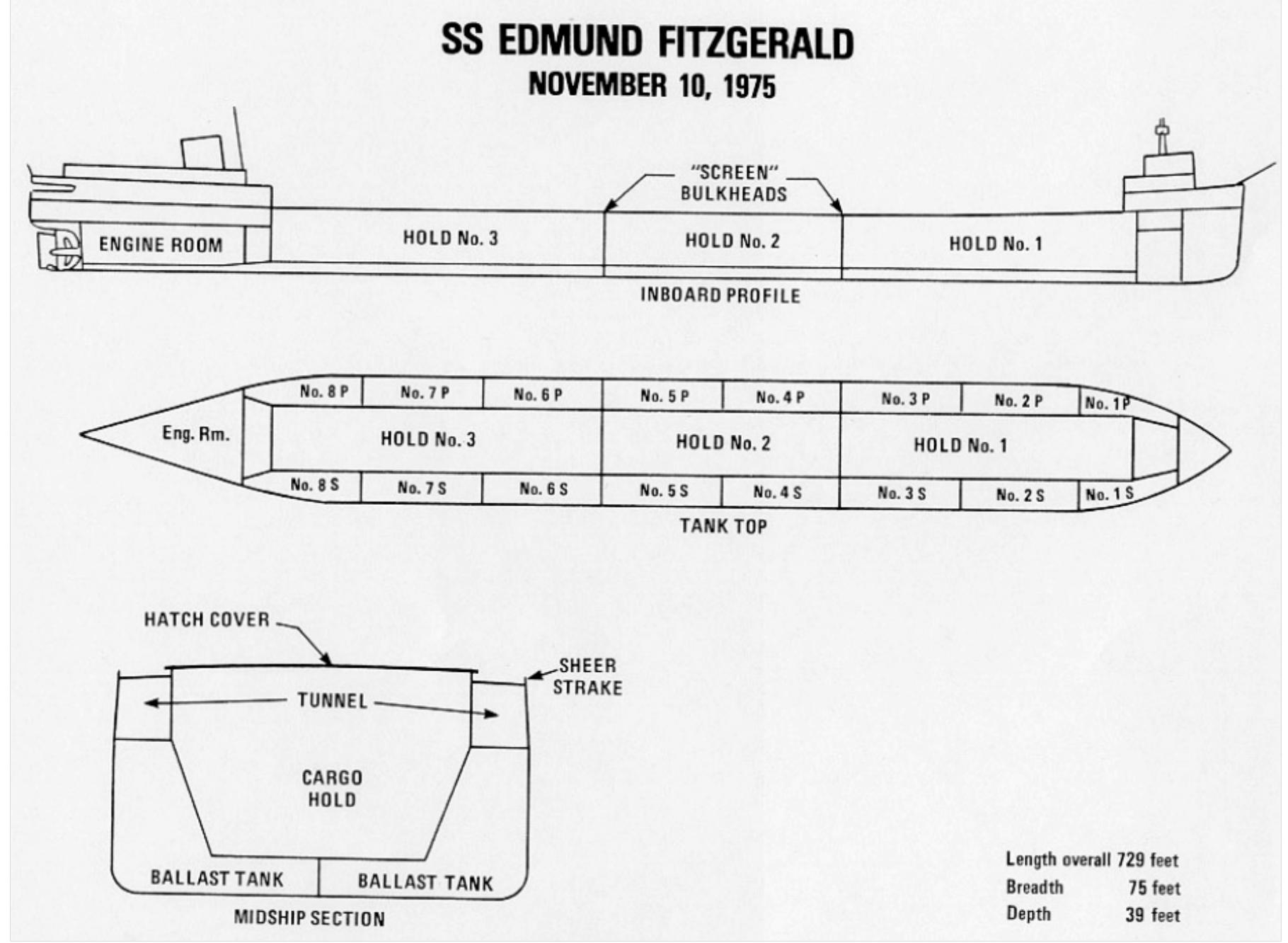
The National Transportation Safety Board (NTSB) report supplies details the drawing cannot show: the ship had 21 cargo hatch openings, each closed by a steel cover with a rubber gasket and manually adjusted clamps. Weathertight means intended to keep out weather and boarding seas under its designed conditions; it does not mean a cover can withstand unlimited water pressure or that its seal will remain effective regardless of condition.
Edmund Fitzgerald: What Really Sank the Mighty Fitz? Full Analysis.
Watch the design explanation in Oceanliner Designs’ “Edmund Fitzgerald: What Really Sank the Mighty Fitz? Full Analysis” to visualize the hold, hatch covers, and flanking ballast tanks. Its later flooding discussion illustrates a possible mechanism; treat it as an explanation to examine, not as proof of the sinking’s exact sequence.
Watch the ship layout for the relationship between hatches, hold, and tanks. Then watch the flooding discussion, focusing on how openings, reduced freeboard, and water moving within the ship could interact. The second segment discusses hypotheses; keep the physical possibilities separate from claims about what investigators established.
Marine Accident Report SS EDMUND FITZGERALD Sinking in Lake ...
Read the NTSB’s description of the vessel to check the drawing against the ship’s documented construction.
In “Vessel Information” (report p. 6), begin where the report calls the Fitzgerald a conventional straightdecker and read through the explanation of the hatch-cover clamps. The vessel description identifies the nonwatertight screen bulkheads, the ballast tanks, the tunnels above them, and the hatch seals. Focus on which boundaries could contain water and which could not.
What flooding does to a floating ship
Recall the equilibrium from the previous lesson: a floating ship displaces water whose weight equals the total weight aboard. If water leaks into an enclosed tank or the cargo hold and remains there, it adds weight. The hull must settle deeper to displace enough lake water to support that weight. Draft rises and freeboard falls.
There is an important precision here. Initial flooding does not mean the lake suddenly exerts less upward force on the hull. As the ship settles, it displaces more water and the upward buoyant force increases to balance the added weight. The danger is that the ship is using up its reserve buoyancy—the capacity to sink deeper while still keeping vulnerable openings above the water and retaining enough stability. Once an opening is submerged and freely connected to the lake, the flooded space can no longer be treated as reliably enclosed buoyant volume.
Where the water collects also matters. Unequal flooding of port and starboard spaces can produce a list, a persistent lean to one side. Flooding concentrated forward can lower the bow relative to the stern, changing the ship’s trim. Water that can move across a wide space as the vessel rolls can further impair stability; the taconite in the hold could obstruct some movement without turning its screen bulkheads into watertight partitions.
These effects can reinforce one another. A lower deck encounters more boarding water. A list puts openings on one side closer to the lake. Either condition can increase water entry through a compromised opening, which lowers the ship further. Pumps interrupt that progression only if they can remove water at least as fast as it arrives from the spaces they can effectively drain.
Two paths, different consequences
A damaged vent presents one possible path into a ballast tank. Water could also reach a tank via an adjoining tunnel or other damaged structure. Because the tanks were arranged on both sides of the ship, flooding on one side could add weight unevenly and contribute to a list. The fact that a vent was damaged, however, does not by itself establish how much water entered through it or whether its opening alone could account for sustained flooding.
A hatch presents a different path. Seas crossing the deck can press water against a cover and its seal. If a closure is ineffective, water can pass into the cargo hold even before any cover collapses. In a loaded hold, water may run down among the pellets rather than remain plainly visible on top. Pumping from that space can also be difficult if cargo obstructs the routes by which water reaches a pump’s suction.
The screen bulkheads make this second path consequential. They separated cargo into three sections but could not confine a major influx of water to one watertight compartment. If a large opening formed at a hatch, flooding could progress through much of the hold. This is why a leak past a closure and the failure of a hatch cover under heavy water loading should not be treated as the same event: they imply potentially different rates of entry, although the first could help create conditions for the second.
Read the NTSB’s analysis with that distinction in mind:
Marine Accident Report SS EDMUND FITZGERALD Sinking in Lake ...
Continue in the same NTSB report for its reconstruction of how flooding in different spaces could affect freeboard, list, and the hatch covers. The report also states important limits on what the wreck could establish.
In the analysis of the final events (report pp. 16–17), start with the paragraph beginning “An analysis of the wreckage itself did not give any conclusive evidence” and continue to the paragraph ending “Two possibilities are discussed below.” Read this analysis. Pay particular attention to the passages on water in the tanks, tunnel, hold, and on deck; why the report questions whether damaged vents alone explain continued flooding; and why detecting or pumping water from a loaded hold was difficult.
The NTSB reasoned that water accumulating in several places could reduce freeboard and increase list or forward trim. Under those conditions, boarding seas could place greater loads on hatch covers. Its proposed final step was a cover failure followed by rapid flooding throughout the hold, which lacked watertight transverse divisions. Notice the difference between a physically coherent progression and a fully observed one: no one survived to describe the final moments, and the report says the wreck did not conclusively reveal the initiating damage or complete sequence.
Carry the mechanism forward
Water entering a ballast space or cargo hold adds weight and generally lowers freeboard; its location can also change trim or produce a list. Damaged vents are a possible entry route, but vent damage alone does not establish the extent of flooding. Ineffective hatch closures offer a route into the central hold, where water could be hard to detect or pump out. Because the hold’s three sections were divided by screens rather than watertight bulkheads, major flooding would not necessarily stay near its point of entry.
Next, the course turns to the Fitzgerald’s final voyage and the November storm. The ship’s layout and flooding mechanisms will help you understand why reports of damage, pumping, and a list mattered—without assuming those reports settle the cause of the sinking.