Hello! Welcome to the final lesson in our historical tour of Seville's landmarks.
In our last session, we explored Seville's "Golden Age," when its monopoly on trade with the Americas made it the wealthiest city in Spain. We saw how the Torre del Oro stood as a guardian of the Guadalquivir River, the artery through which this wealth flowed.
That era of global dominance eventually faded, but its memory was so powerful that Seville would later build one of its most magnificent monuments as a tribute to it. Today, we leap forward to the 20th century to study the spectacular Plaza de España. This lesson will explain its origins and significance, completing our survey of the city's key historical sites.
By the end of this lesson, you will be able to identify the Plaza de España as a 20th-century architectural landmark built for the 1929 Ibero-American Exposition.
1. A World's Fair: The Ibero-American Exposition of 1929
Unlike the other landmarks we've studied, the Plaza de España is not ancient. It is a product of the early 20th century, a time when Spain was looking to redefine its national identity and its relationship with the wider world. By the 1920s, Spain had lost its empire but retained deep cultural and historical ties to the newly independent nations of Latin America.
To celebrate these connections and showcase its own industrial and cultural prowess, Spain hosted the Ibero-American Exposition of 1929 in Seville. This grand international fair was the driving force behind the creation of the Plaza de España.
Plaza de España Sevilla: A Stunning Architectural Gem
To understand the purpose of this event, let's read a brief explanation from the article 'Plaza de España Sevilla: A Stunning Architectural Gem'.
Please read the section titled 'The Role of the Ibero-American Exposition'. This will clarify why the plaza was commissioned and the goals of the exposition.
As you've read, the exposition was a diplomatic and cultural project designed to strengthen bonds between Spain and its former American colonies. Seville, as the historical gateway to the Americas, was the natural choice of host city. The Plaza de España was conceived as the event's breathtaking centerpiece.
2. An Architectural Masterpiece
The task of designing this centerpiece fell to the Sevillian architect Aníbal González. His vision was to create a monumental space that was both modern and deeply rooted in Spanish history and architectural traditions.
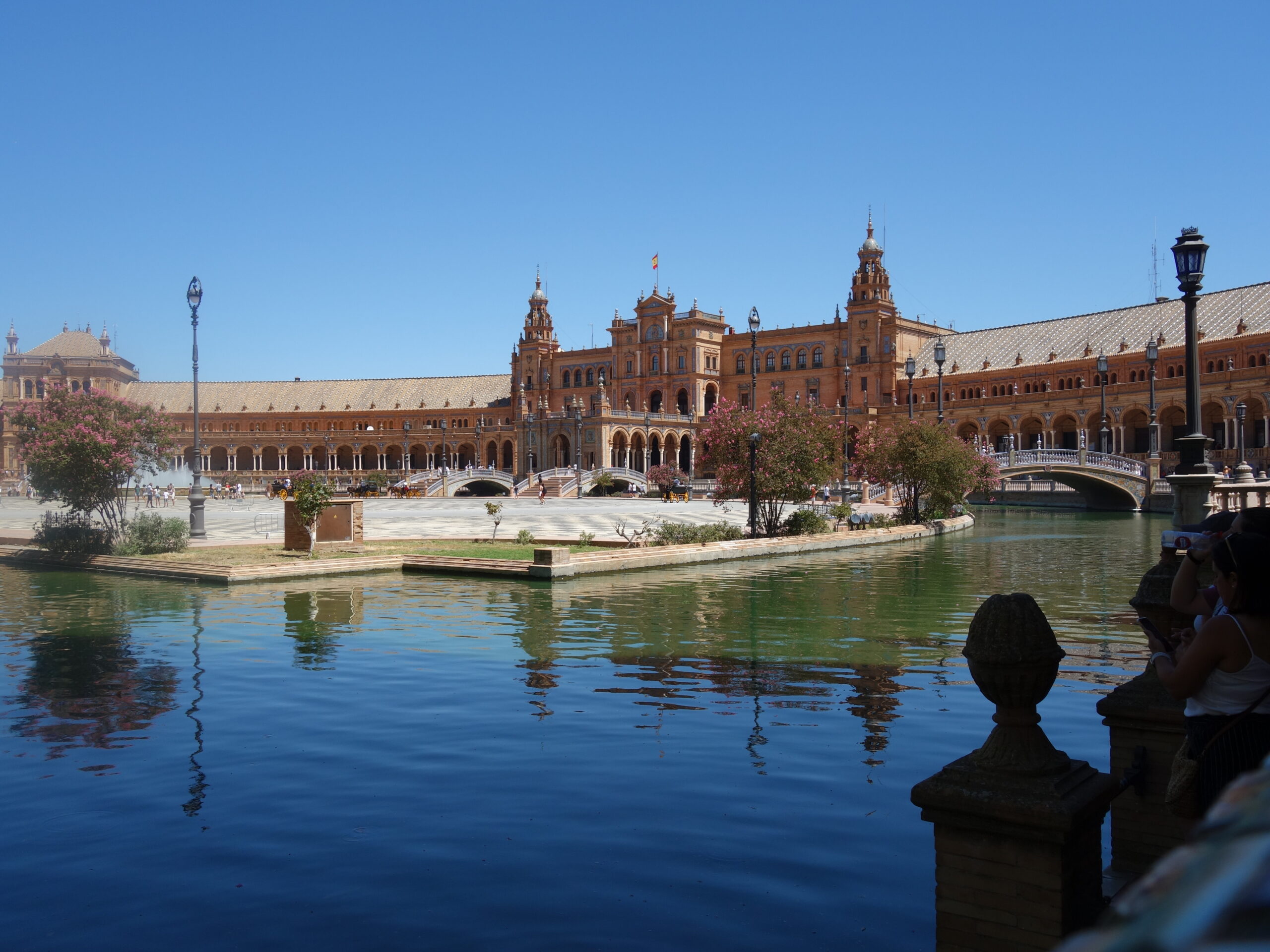
To get a firm grasp of the plaza's key features and architectural style, the main Wikipedia article is an excellent resource.
Let's read the core details from the Wikipedia page for 'Plaza de España, Seville'.
First, read the introductory paragraphs just below the main information table. Then, scroll down to the 'History' section and read the subsection titled 'Plaza de España'. Focus on the architect, the blend of architectural styles, and the symbolic features like the bridges and tiled alcoves.
From this reading, we can pull out the most important elements of González's design:
- Architectural Style: The plaza is a prime example of Regionalism Architecture. It masterfully blends historical Spanish styles, including:
- Neo-Mudéjar: A revival of the Moorish-influenced style you saw in the Real Alcázar.
- Renaissance Revival & Baroque Revival: Styles that evoke the grandeur of Seville's Golden Age.
- Symbolism: The design is rich with meaning. The huge semi-circular building symbolizes Spain embracing its former colonies, with its open side facing the Guadalquivir River—the path to the Atlantic and on to the Americas. The four bridges crossing the canal represent the four ancient kingdoms of Spain: Castile, Aragon, Navarre, and León.
- The Alcoves of the Provinces: Perhaps the most famous feature is the series of 48 tiled alcoves, or azulejos, set into the base of the building. Each one represents a different province of Spain, with a detailed pictorial scene and a map. When you visit, you can try to find the alcove for your favourite Spanish region!

To see the plaza in motion and get a feel for its atmosphere, this short video clip is a great visual summary.
Sevilla - Spain's MOST MAGICAL City (Weekend Guide)
Let's watch a brief segment from the travel guide 'Sevilla - Spain's MOST MAGICAL City' by Pakspan. It provides a great visual tour of the plaza.
Please watch the clip from 09:19 to 10:17. It highlights the fusion of architectural styles and the famous ceramic tiles.
As the video and readings show, the Plaza de España is not just a building; it's a narrative in brick and tile, telling the story of Spain's history, geography, and enduring connection to the wider world. It's a nostalgic look back at the Golden Age, built with the technology and artistic sensibilities of the 20th century.
Today, the building houses government offices, but its primary function is as one of Spain's most beloved public spaces and a must-see for any visitor to Seville.
Conclusion
This lesson concludes our historical tour of Seville's most important landmarks. We've journeyed from Roman Hispalis to the 20th century, seeing how each era left its indelible mark on the city's landscape. With the Plaza de España, we see a modern monument that consciously chose to celebrate that rich past.
Key Takeaways:
- The Plaza de España is a 20th-century landmark, built between 1914 and 1928.
- It was constructed as the principal building for the 1929 Ibero-American Exposition, an event designed to strengthen ties between Spain and Latin America.
- Designed by Aníbal González, its architectural style is a grand fusion of historical Spanish designs, including Neo-Mudéjar and Renaissance Revival, meant to evoke the nation's history.
- Its features, from the semi-circular shape to the provincial tile alcoves, are rich with symbolism representing a unified Spain and its global connections.
Preview of the Next Module
Having explored the stones and structures that tell the story of Seville's past, we will now turn to its living culture. Our next module, "Experiencing Sevillian Culture," will introduce you to the soul of the city. We will begin with its most famous art form: flamenco. You will learn about its origins and its essential components of song, guitar, and dance.