Following our discussion on the immense genetic diversity of HLA genes at the population level, this lesson brings the focus down to the individual. We've established that thousands of HLA alleles exist, but how are they organized and passed down through generations? Answering this is crucial for understanding why every person presents a unique immunological challenge for a therapeutic protein like Cas9.
Today, we will delve into the concept of the HLA haplotype. You will learn how these gene sets are inherited, how they are expressed, and why this mechanism is a cornerstone of individual immune identity. This knowledge forms the bridge between the population-level concept of polymorphism and the specific set of molecules that will survey foreign proteins in any given patient.
What is an HLA Haplotype?
The HLA genes we've discussed—HLA-A, -B, -C, -DR, -DP, -DQ—are not scattered randomly across our DNA. They are tightly clustered together in a specific region on the short arm of chromosome 6. Because of this close physical proximity, they are typically inherited as a single, linked block. This block of HLA alleles on one chromosome is called a haplotype.
Think of a chromosome as a string, and the HLA genes as a set of different colored beads grouped closely together. During reproduction, this entire group of beads is usually passed on as a single unit, not as individual beads.
The term for this tendency of genes located near each other on a chromosome to be inherited together is linkage disequilibrium. The NCBI Bookshelf resource "Major histocompatibility complex: Antigen processing and presentation" formally defines the inheritance pattern that results from this linkage.
Major histocompatibility complex: Antigen processing and presentation
This excerpt provides a concise definition of HLA haplotypes and their inheritance.
Please read the section titled "Inheritance". Focus on how the text defines a haplotype and its inheritance as a group.
As you just read, each person has two copies of chromosome 6 and therefore possesses two HLA haplotypes: one inherited from their mother and one from their father.
Inheritance Patterns: A Family Affair
The inheritance of haplotypes follows straightforward Mendelian genetics. A parent with two different haplotypes has a 50% chance of passing on either one to their child. Since a child receives one haplotype from each parent, there are four possible combinations of haplotypes for the offspring of any two parents.
This is best understood visually. Let's analyze a classic pedigree chart.
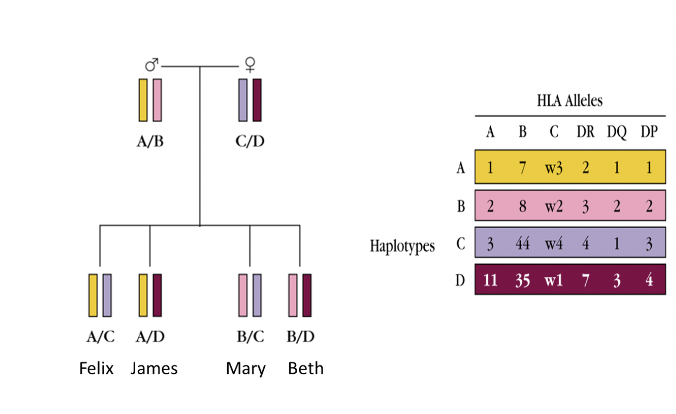
As shown in the diagram:
- The father's two haplotypes are A and B.
- The mother's two haplotypes are C and D.
Their children can inherit one of four possible combinations:
- Felix: Inherited A from the father and C from the mother (A/C).
- James: Inherited A from the father and D from the mother (A/D).
- Mary: Inherited B from the father and C from the mother (B/C).
- Beth: Inherited B from the father and D from the mother (B/D).
This simple pattern has profound implications, particularly in medicine. For siblings, the probability of sharing HLA haplotypes is:
- 25% chance of being HLA-identical (e.g., if a fifth child inherited the A/C combination, they would be an identical match to Felix).
- 50% chance of being a half-match, or "haploidentical" (e.g., Felix and James both share haplotype A).
- 25% chance of being a complete mismatch (e.g., James (A/D) and Mary (B/C) share no haplotypes).
This is why siblings are often the first choice for bone marrow or organ donors—they have the highest probability of being a complete HLA match within a family.
Co-dominant Expression: Maximizing Your Arsenal
Now that we understand how haplotypes are inherited, the next crucial concept is how they are expressed. The genes within both the maternal and paternal haplotypes are co-dominantly expressed. This means that the protein products of the alleles on both chromosomes are produced in equal measure. Your cells don't choose to express only your mother's HLA-A allele and your father's HLA-B allele; they express both.
The functional consequence is a significant increase in the diversity of MHC molecules on the surface of your cells. A person who is heterozygous at the HLA-A locus (having inherited two different HLA-A alleles) will express both types of HLA-A protein.
The following video segment reinforces this concept and explains why it's so beneficial.
MHC gene expression | MHC polymorphism | HLA cluster | USMLE step 1
This clip from "Animated biology With arpan" clearly explains co-dominant expression and its role in increasing MHC diversity within an individual.
Please watch the explanation of codominant expression and its benefits.
By expressing alleles from both haplotypes, a typical heterozygous individual can display a formidable array of antigen-presenting molecules:
- Two types of HLA-A
- Two types of HLA-B
- Two types of HLA-C
This gives a total of six different classical MHC class I molecules.
For MHC class II, the situation is similar, and can even be more complex. Since class II molecules are heterodimers of α and β chains, and both chains can be polymorphic, a heterozygous individual can express at least eight different classical MHC class II molecules (HLA-DR, HLA-DP, HLA-DQ). In some cases, pairing between chains encoded on different chromosomes (trans-complementation) can create even more unique molecules.
The textbook Immunobiology provides a clear summary of how polymorphism and co-dominance work together.
The major histocompatibility complex and its functions - NCBI - NIH
This reading formally defines haplotypes and co-dominant expression in the context of MHC polymorphism.
In the section "The protein products of MHC class I and class II genes are highly polymorphic," please read the paragraph starting "The term polymorphism...".
This combination of having multiple gene loci (polygeny), many versions of each gene in the population (polymorphism), and expressing the versions from both parents (co-dominance) is a powerful strategy. It equips each individual with a diverse set of MHC molecules, maximizing the range of peptides they can present to T cells. For your goal of deimmunization, this means a therapeutic protein must evade detection by this entire personalized set of HLA molecules, which varies from person to person.
Conclusion
In this lesson, we've untangled how the vast library of HLA alleles in the human population is packaged and expressed at the individual level.
Key Takeaways:
- An HLA haplotype is the set of linked HLA alleles found on a single copy of chromosome 6, which is inherited as a block.
- Every individual inherits one haplotype from their mother and one from their father, resulting in four possible combinations for offspring.
- HLA genes are co-dominantly expressed, meaning protein products from both the maternal and paternal alleles are produced.
- This system maximizes the number and variety of MHC molecules on an individual's cells, creating a robust and highly personalized antigen presentation system.
We have now established the genetic foundation of the HLA system: we know the genes, their incredible diversity, and how they are inherited and expressed. In our next lesson, we will move from the genes to the proteins they encode. We'll compare the molecular structures of MHC class I and class II molecules to understand how their distinct shapes allow them to perform their different, but complementary, roles in the immune system.