Introduction
In our last lesson, we explored the two-pointer technique, a powerful method for optimizing problems on sorted arrays. Today, we'll build on that foundation by diving into a closely related and equally important pattern: the sliding window technique. This technique is a cornerstone of solving many array and string problems efficiently, making it a frequent topic in coding interviews.
This lesson is all about applying this technique to solve problems involving contiguous subarrays or substrings. You will learn to visualize a "window" moving across your data, and how to update its state efficiently. We will cover two main variations: the fixed-size window, where the window's length is constant, and the more dynamic variable-size window, which expands and shrinks based on specific conditions. By the end, you'll be able to recognize when to use this pattern and implement it to transform brute-force solutions into linear-time, optimal ones.
The Fixed-Size Sliding Window
The simplest form of the sliding window technique involves a window of a fixed size, let's say k, that "slides" across an array or string. A naive approach to problems like this might involve nested loops: an outer loop to set the starting point of a subarray and an inner loop to process the k elements within it. This typically results in an O(N×k) time complexity.
The sliding window technique optimizes this by reusing information from the previous window. Instead of re-calculating everything for each new window, we can get the new window's state by making a small, constant-time adjustment.
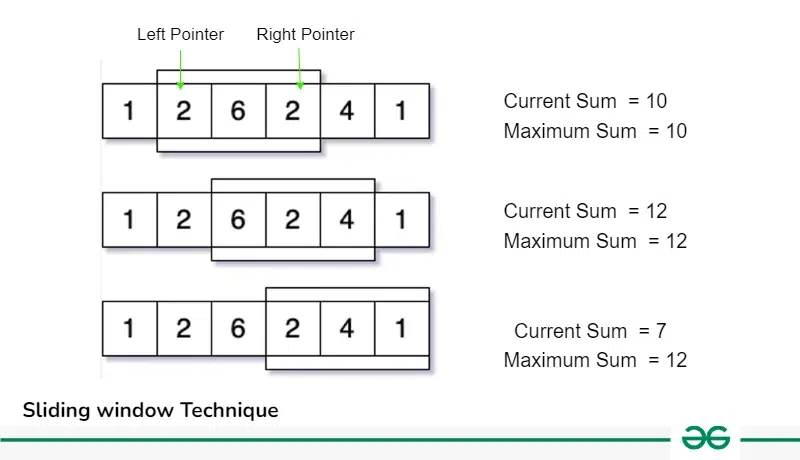
Let's consider a classic problem: Given an array of integers, find the maximum sum of any contiguous subarray of size k.
Sliding Window Technique - GeeksforGeeks
This article from GeeksforGeeks introduces the problem and the brute-force approach.
Start by reading the problem description and naive approach. Pay close attention to the time complexity analysis of the brute-force method. You can skim the C++ code for now, as we'll focus on the logic first.
The key insight is that as the window slides one position to the right, only two things change: one element is removed from the left, and one new element is added to the right.
To truly grasp this optimization and its impact on complexity, let's watch a detailed whiteboard explanation.
Sliding Window Algorithm for Tech Interviews - Full Course
This segment from a freeCodeCamp.org course provides an excellent visualization and analysis of the fixed-size sliding window.
Watch the section from the beginning of the problem explanation. The instructor, Alvin, first walks through the naive O(N*k) approach and then clearly explains the optimized O(N) sliding window logic by tracking a current_sum. The complexity analysis at the end is particularly important.
Now that you understand the logic, let's look at a C++ implementation.
Sliding Window Technique - GeeksforGeeks
This part of the GeeksforGeeks article shows the implementation of the optimized approach.
Read the section explaining the optimized method and study the accompanying C++ code. Notice how the code first calculates the sum of the initial window and then iterates from k to n-1, updating the window_sum in O(1) time at each step.
This fixed-size pattern is a great starting point, but the real power of sliding windows comes from its dynamic variant.
The Variable-Size Sliding Window
In many problems, the size of the subarray or substring we're looking for is not given. Instead, we need to find the longest or shortest one that satisfies a certain property. This is where the variable-size sliding window comes in.
This pattern also uses two pointers, typically start and end (or left and right), which define the current window. The logic works as follows:
- Expand: We always move the
endpointer to the right, expanding the window and including new elements. - Check Condition: After each expansion, we check if the current window satisfies the problem's condition.
- Shrink: If the condition is violated, we move the
startpointer to the right, shrinking the window from the left until the condition is met again.
This expansion and contraction allow the window to dynamically change its size to find the optimal solution. The following video provides a superb introduction to this template.
L1. Introduction to Sliding Window and 2 Pointers | Templates | Patterns
This video from the "take U forward" channel explains the general template for variable-size sliding windows, focusing on problems that ask for the "longest" subarray/substring with a condition.
Watch the segment from the discussion of the better approach. It lays out the core logic of expanding with the right pointer and shrinking with the left pointer when a condition is violated. The provided template is a powerful mental model for these types of problems.
Let's solidify this with a concrete example. Consider the problem: Given an array of non-negative integers, find the smallest subarray with a sum greater than or equal to a given value x.
The logic is:
- Expand the window by moving
endto the right, addingarr[end]tocurrent_sum. - While
current_sum >= x:- The condition is met. This window is a potential answer. Update the minimum length found so far.
- Now, try to find an even smaller window. Shrink the window by subtracting
arr[start]fromcurrent_sumand incrementingstart.
- Repeat until
endreaches the end of the array.
This approach ensures that for every possible end position, we find the shortest valid subarray ending at that position. The article below provides a clear C++ implementation of this pattern.
Sliding Window Technique Simplified (C++)
This Medium article provides a C++ implementation for finding the smallest subarray with a sum greater than a given value.
Read Example 2, titled Smallest Subarray with Sum. Analyze the C++ code. Note the outer while loop that expands the window (end++) and the nested while loop that shrinks it (start++) once the sum condition is met.
One of the most powerful aspects of this technique is its time complexity. It might seem like the nested while loops would lead to an O(N²) complexity, but it's actually O(N). The freeCodeCamp video explains why this is the case. Although it discusses a slightly different problem, the complexity analysis is universal for this pattern.
Sliding Window Algorithm for Tech Interviews - Full Course
This video segment provides an excellent, detailed analysis of why the variable-size sliding window has a linear time complexity.
Watch from the complexity analysis. The key takeaway is that each pointer, start and end, only traverses the array once from left to right. They never move backward. Therefore, the total number of operations is proportional to N, not N², resulting in an O(N) solution.
Application: A Classic Interview Problem
Now let's apply this to a classic coding interview question: Longest Substring Without Repeating Characters. Given a string, find the length of the longest substring that does not contain repeating characters.
This is a perfect fit for a variable-size sliding window:
- The "window" is the current substring we are examining.
- The condition is "the substring must have unique characters."
- We need a way to efficiently track the characters within the current window to check for duplicates. An
unordered_setorunordered_mapis ideal for this.
The logic proceeds as follows:
- Initialize
left = 0,max_length = 0, and an empty character set/map. - Iterate with a
rightpointer from0ton-1(this expands the window). - Inside the loop, check if
s[right]is already in our character set. - While
s[right]is a duplicate:- The uniqueness condition is violated.
- Shrink the window from the left: remove
s[left]from the set and incrementleft.
- Once the loop finishes,
s[right]is no longer a duplicate in the window. Adds[right]to the set. - The current window
[left, right]is valid. Updatemax_length = max(max_length, right - left + 1). - After the main loop finishes, return
max_length.
The following resource provides a concise C++ implementation of this logic.
Sliding Window Technique Simplified (C++)
This section of the article provides a full solution for the "Longest Substring Without Repeating Characters" problem.
Read Example.2, which covers the problem and its solution. The provided C++ code uses an unordered_set to keep track of characters in the current window. Trace the code with an example like "abcabcbb" to see how the left and right pointers move and how the set changes.
Conclusion
In this lesson, we added the sliding window technique to your algorithmic toolkit. It's an essential pattern for efficiently solving a wide range of problems on contiguous subarrays and substrings, making it a favorite in technical interviews.
Key Takeaways:
- Core Idea: The sliding window technique maintains a "window" over a portion of data and slides it across the sequence, updating its state efficiently at each step.
- Fixed-Size Window: Used when the problem specifies a fixed window size
k. The key is the O(1) update: subtract the outgoing element and add the incoming element. - Variable-Size Window: A more general pattern where the window expands (by moving the
endpointer) and shrinks (by moving thestartpointer) based on a condition. This is used for "longest/shortest subarray/substring" problems. - Time Complexity: The main benefit of this technique is its efficiency. Both fixed and variable-size patterns typically run in O(N) time because each element is visited by the
startandendpointers at most once. - Data Structures: Auxiliary data structures like hash maps (
unordered_map) or sets (unordered_set) are often used to maintain the state of the window, such as character counts or uniqueness checks.
In our next lesson, we'll tackle another common array problem: traversing a 2D matrix in a spiral pattern. This will complete our first module on core algorithmic concepts and array manipulations.