Welcome to the final lesson of our foundational module. Over the past seven lessons, we have assembled a powerful lexicon of Japanese aesthetic and philosophical concepts, from the pathos of mono no aware to the process of mastery in shuhari. We have explored how these ideas shape perceptions of beauty, time, and knowledge.
Today, we will complete this analytical toolkit by examining the last set of terms from your list. Our objective is to draw a critical distinction: we will separate the deep-seated philosophical concepts that form the bedrock of Japanese ethics and aesthetics from a category of more modern, often humorous, cultural observations. This skill of differentiation is vital for applying these terms with the right weight and context as we analyze literary works.
The Lighter Side: Modern Cultural Observations
Not every untranslatable word carries the weight of centuries of philosophy. Some are brilliant, witty neologisms that capture universal human experiences with a unique cultural flair. These words offer texture and insight into contemporary life, but they serve a different analytical purpose than concepts like wabi-sabi or yūgen.
Let's begin with a term that might feel particularly relevant as you embark on this course.
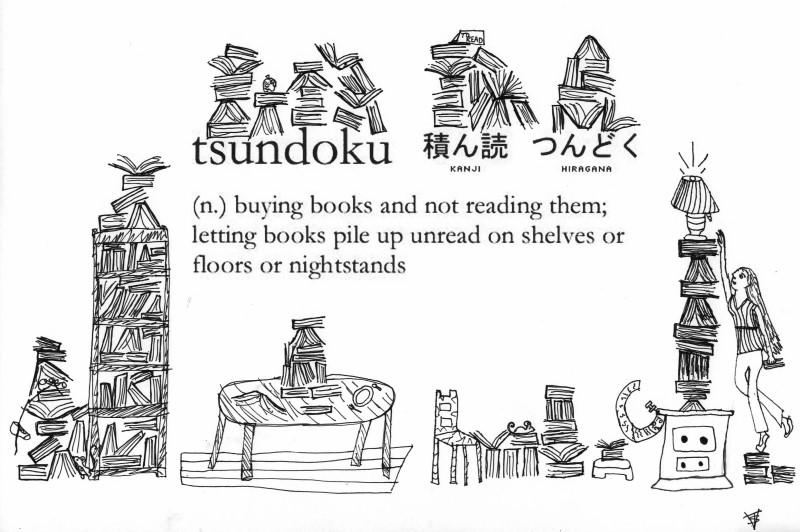
The word is tsundoku (積ん読), the act of acquiring books and letting them pile up, unread. As you can probably guess, it's a portmanteau, combining tsunde-oku (to pile things up and leave them) and dokusho (reading).
This is a perfect example of our first category. It's a modern, relatable observation. Two other words on your list fit neatly here:
- Age-otori (上げ劣り): The specific feeling of looking worse after getting a haircut.
- Bakku-shan (バックシャン): A person who looks attractive from behind but not from the front. This is a hybrid word, combining the English "back" with the German "schön" (beautiful).
To quickly familiarize yourself with these, please read the short definitions in the article "Funny & Unconventional Words in Japanese."
Funny & Unconventional Words in Japanese - Talkpal
This article provides concise definitions for several of the cultural terms on our list.
Please locate and read the definitions for the following three terms: Tsundoku (積ん読) Bakkushan (バックシャン) Age-otori (上げ劣り)
These words are descriptive, insightful, and often playful. When analyzing literature, you might find a character who embodies the spirit of tsundoku, or a scene that captures the cringeworthy feeling of age-otori. However, they describe situations rather than providing the deep ethical or aesthetic framework that shapes a story's core meaning. Understanding this distinction prevents us from over-analyzing a fleeting moment as a profound philosophical statement.
The Foundational Pillars: Core Philosophical Concepts
Now, we turn to concepts that operate at a much deeper level. These are not just observations; they are principles that guide action, define purpose, and shape a worldview. They are the load-bearing walls of the cultural edifice we are exploring.
1. Ikigai (生き甲斐): The Reason for Being
The concept of ikigai, or a reason for being, has become globally popular, largely through a specific, work-oriented interpretation. This popular version is often presented as a Venn diagram where four elements intersect: what you love, what you're good at, what the world needs, and what you can be paid for.
However, this popular model is a Western adaptation. The traditional Japanese understanding of ikigai is more subtle and personal. The image below starkly illustrates the difference.

The Japanese concept of ikigai is not necessarily about finding a grand, singular purpose or a perfect career. It's often about the small joys, the sense of being alive in the moment, and the process itself, independent of external reward or recognition.
To understand this crucial distinction, we'll watch a video that directly addresses this common misconception.
Ikigai Is Not What You Think | A Japanese Life Philosophy Explained
The video "Ikigai Is Not What You Think" from the channel Zen to Manabi explains the authentic Japanese understanding of the concept, contrasting it with the popular four-circle diagram.
Please watch the following key segments: The Misconception: First, watch the section that sets up the contrast between the four-point definition and the real meaning. True Ikigai: Next, focus on the explanation of how an ikigai based on external benefit can burn out, and what "true ikigai" feels like. The Process: Finally, observe the beautiful metaphor of how ikigai grows not through a sudden discovery, but like "adding thin sheets of paper" one by one.
As the video explains, the true measure of ikigai is internal. It’s the feeling of vitality and joy in the process. This aligns it more with concepts like "flow" rather than a strategic career plan. An elderly person tending their garden, a craftsman honing a skill, or a parent raising a child can all have profound ikigai without ever ticking all four boxes of the Western diagram.
For literary analysis, this distinction is powerful. When a character in a Japanese novel searches for meaning, are they pursuing an ambitious goal in the Western sense, or are they finding their reason for being in the quiet, dedicated performance of a task, a relationship, or a daily ritual? We will see this theme explicitly in works like Ōe Kenzaburō's A Personal Matter.
2. Majime (真面目): Sincere Reliability
Where ikigai speaks to personal purpose, majime speaks to character and social conduct. The word describes someone who is serious, earnest, diligent, and reliable. In Japanese culture, being called majime is generally a high compliment, signifying that you are a responsible person who can be trusted to do the right thing without fuss or fanfare.
A majime person is not necessarily rigid or humorless, but they possess an underlying sincerity. They take their duties seriously and approach tasks with integrity. In literature, a majime character is one who grapples honestly with their obligations and the world around them. This concept is the philosophical soil for the shishōsetsu, or "I-novel," a major genre we will explore in Module 4, which is predicated on the author's sincere, unvarnished self-examination.
3. Mottainai (勿体無い): Aversion to Waste, Respect for Being
Finally, we arrive at mottainai. While often translated as "what a waste," this translation barely scratches the surface. Mottainai is a deep, almost spiritual feeling of regret concerning the misuse or neglect of something that has inherent value. This value is not merely economic; it is a recognition of the life, energy, and essence within all things.
This concept is rooted in a Shinto and Buddhist worldview that sees spirit in nature and even in inanimate objects. The following video masterfully explains this profound philosophy.
MOTTAINAI : The Japanese Philosophy of Waste and Spirit
The video "MOTTAINAI : The Japanese Philosophy of Waste and Spirit" from mono Japan explores the deep cultural and spiritual roots of the concept.
Please watch these three segments to grasp the full meaning: Spiritual Roots: Watch the introduction explaining the Harikuyo (needle memorial) and how mottainai is a "religious resonance" of awe for value. Object Spirits: See how the historical belief in tsukumogami (tool spirits) informs a sense of guilt toward objects, which is a root of mottainai. The Beauty of the Past: Absorb the beautiful metaphor of shukushi—recycled paper with traces of old ink—and how it teaches us to see our past not as a stain, but as cherished "ink clouds."
Mottainai is a feeling of "helpless empathy" for the essence of a thing. It’s the regret you feel when food is thrown out, not just because it costs money, but because it represents the sun, water, and labor that went into it—a life given for our sustenance. It extends to wasting one's potential, a precious relationship, or a moment in time.
In our later readings, particularly Yōko Ogawa’s The Memory Police, we will see mottainai elevated to a central theme, where the very loss of memory and meaning becomes the ultimate form of waste to be mourned.
Conclusion
This lesson concludes our journey through the foundational aesthetic and philosophical lexicon of Japan. We have not just defined words, but have learned to weigh them, creating a two-tiered analytical framework for our literary explorations.
Key Takeaways:
- We distinguished between two types of concepts: deep philosophical pillars and modern cultural observations.
- Core Philosophical Concepts (ikigai, majime, mottainai) are foundational values that shape ethics, purpose, and worldview. They will serve as primary lenses for thematic analysis.
- Modern Cultural Observations (tsundoku, age-otori, bakku-shan) are witty, descriptive terms that capture specific social phenomena. They provide cultural texture and character detail but are not deep structural themes.
- We clarified that the authentic Japanese concept of ikigai is about daily joy and process, not necessarily the career-focused goal of the Western Venn diagram.
- We understood mottainai not just as "wastefulness" but as a profound spiritual regret over neglecting the inherent value and essence in all things.
You are now equipped with the complete 18-concept framework you set out to learn. The task ahead is to move from theory to practice, from definition to application.
In our next module, we officially begin our literary journey. We will enter the Shu (守) stage—obeying and learning the fundamentals—by turning to the very genesis of the Japanese novel and one of the world's first novels: Murasaki Shikibu’s The Tale of Genji. There, we will immediately put our knowledge to use, analyzing its world through the lens of mono no aware.