Hello! Welcome to your first lesson in our exploration of the human body.
This course is designed to build your understanding from the ground up, so we can later explore complex topics like the effects of stress and nutrition. In this introductory lesson, we will focus on the big picture: how the human body is structured. Just as a large corporation has a clear organizational chart—from individual employees to teams, departments, and entire divisions—the human body has a similar, multi-layered structure.
Today, you will learn to describe this hierarchy of organization, starting from the most basic unit, the cell, and building up to complex organ systems that work together to keep you alive. Understanding this framework is the essential first step for everything we will cover later in the course.
From Atoms to Organisms: The Body's Blueprint
To begin, let's get a comprehensive overview of the different levels of organization in the body. The following video provides a clear, step-by-step journey from the smallest chemical components to the complete organism.
Anatomical Organization of the Human Body From atoms and molecules to the entire organism as a whole
Please watch this video, 'Anatomical Organization of the Human Body' by Scientist Cindy. It provides an excellent overview of all the levels of organization we will be discussing today.
Watch the entire video (about 13 minutes). Pay attention to the name of each level and how it builds upon the previous one. You don't need to memorize every detail (like the 12 organ systems), but focus on understanding the sequence: Atoms -> Molecules -> Cells -> Tissues -> Organs -> Organ Systems -> Organism.
As you saw in the video, the body is constructed in a logical, hierarchical manner. Let's break down these levels one by one.
1. The Chemical and Cellular Levels: The Basic Building Blocks
Everything starts at the chemical level. Our bodies are composed of atoms (like oxygen, carbon, and hydrogen) that bond together to form molecules (like water) and much larger macromolecules (like proteins and carbohydrates). These are the non-living raw materials.
These chemicals then assemble in a highly organized way to form cells, which are the fundamental, living units of the body. Think of a cell as the smallest independent employee in our corporate analogy. The human body contains trillions of cells, and they are specialized for different jobs—a muscle cell is built for contraction, while a nerve cell is built for communication.
2. The Tissue Level: Assembling the Teams
When groups of similar, specialized cells work together, they form a tissue. This is like employees with similar skills forming a team (e.g., a team of accountants). There are four primary types of tissues in the human body, each with a distinct function.
To learn more about these four tissue types, please read the following text from Khan Academy.
Tissues, organs, & organ systems (article)
This article, 'Tissues, organs, & organ systems,' provides a clear, detailed explanation of the four main tissue types. It's a great way to solidify what was introduced in the video.
Please read the section titled 'Types of tissues'. Focus on understanding the primary function of each of the four types: epithelial, connective, muscle, and nervous tissue. The examples provided will help make their roles more concrete.
Here's a quick summary of the four tissue types:
- Epithelial Tissue: Forms coverings and linings. Think of your skin or the lining of your digestive tract. It acts as a protective barrier.
- Connective Tissue: Supports and connects other tissues. This is a diverse group that includes bone, cartilage, and blood.
- Muscle Tissue: Specialized for contraction and movement. This includes the skeletal muscles you use to move, the cardiac muscle of your heart, and the smooth muscle in the walls of your internal organs.
- Nervous Tissue: Responsible for communication. It allows your brain to send and receive information throughout your body.
Test your understanding!
The stomach wall contains tissue that contracts to churn food, tissue that lines its inner surface and secretes digestive juices, and tissue that controls these actions. Based on this, which of the four main tissue types would you expect to find in the stomach?
Show answer
You would find muscle tissue (for churning), epithelial tissue (for lining and secretion), and nervous tissue (for control). Most organs also contain connective tissue to hold everything together. This shows how different tissues collaborate.
3. The Organ and Organ System Levels: Building Departments and Divisions
Just as different teams (tissues) come together to form a department, different tissues combine to form an organ. An organ is an anatomically distinct structure, like the heart, stomach, or brain, that performs one or more specific physiological functions.
These organs don't work in isolation. They are grouped into organ systems, where multiple organs cooperate to accomplish a major task for the body. This is analogous to a corporate division, where different departments (e.g., manufacturing, logistics, sales) work together. For example:
- The Digestive System (including the esophagus, stomach, and intestines) works to break down food and absorb nutrients.
- The Cardiovascular System (heart and blood vessels) works to transport blood, delivering oxygen and nutrients throughout the body.
Finally, all 11-12 organ systems work together in an integrated fashion to constitute the complete organism—you!
Visualizing the Hierarchy
This image provides a great visual summary of the levels of organization, using the digestive system as a concrete example that flows from a single cell all the way up to the full system.
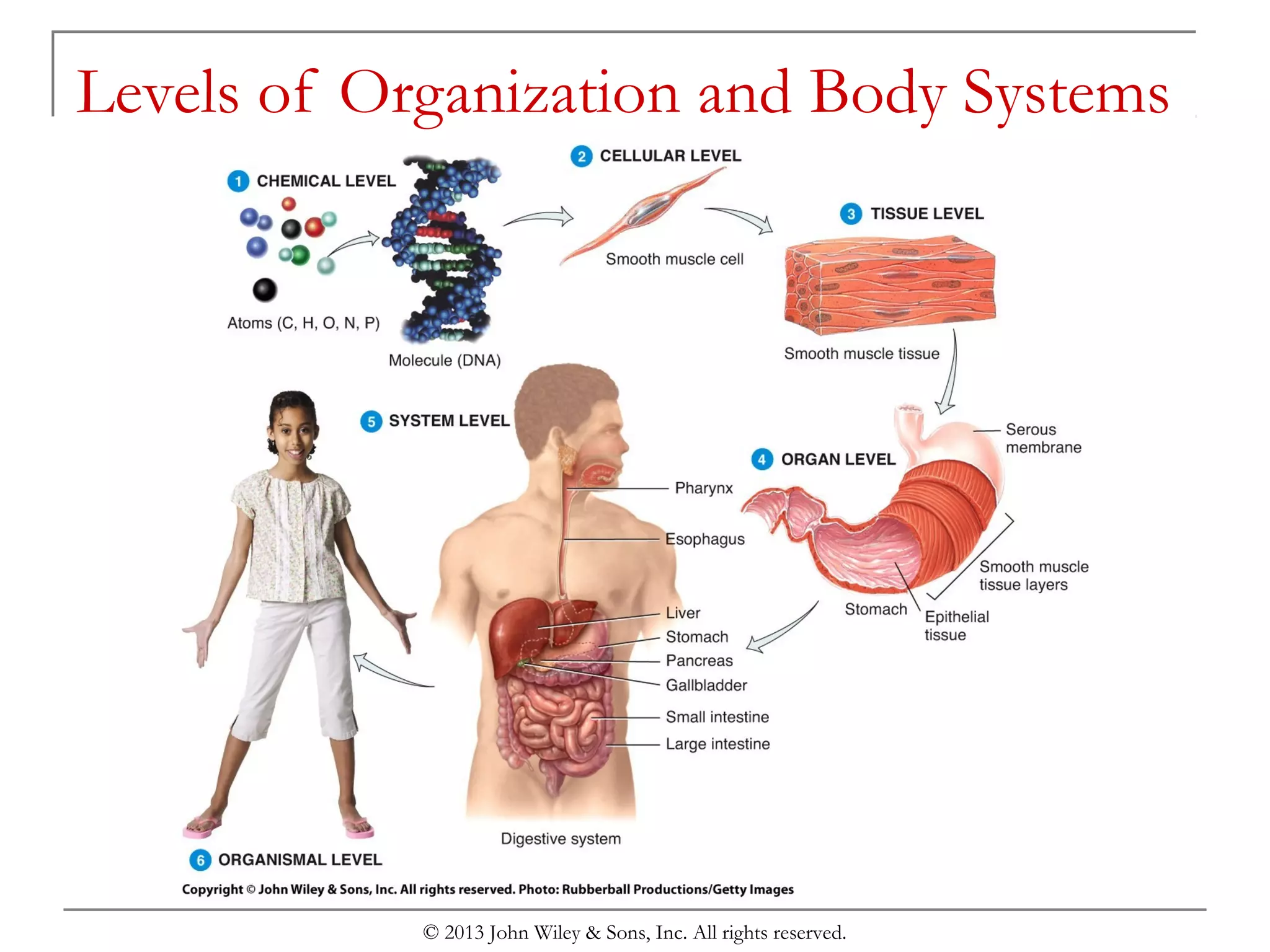
Using our analogy, you can think of it this way:
- Chemicals: Raw materials
- Cells: Individual workers
- Tissues: Specialized teams
- Organs: Departments (made of multiple teams)
- Organ Systems: Corporate divisions (made of multiple departments)
- Organism: The entire corporation
Understanding this hierarchy is crucial because it shows that a problem at a lower level (like a cellular defect) can have cascading effects on tissues, organs, and the entire body. This principle will be fundamental as we explore the impact of stress and nutrition.
Conclusion
In this lesson, we established the foundational blueprint of the human body. You learned that the body is organized in a hierarchy of increasing complexity:
- Cells are the basic units of life.
- Groups of similar cells form tissues.
- Different tissues work together as organs.
- Related organs cooperate in organ systems.
- All organ systems together make up the organism.
This structural organization ensures that all the trillions of cells in your body can work together in a coordinated and efficient manner.
In our next lesson, we will zoom in on the most fundamental level: the cell. We will specifically explore the cell membrane, the "gatekeeper" that controls what enters and exits the cell. This is the first step in understanding how nutrients from our food actually get to where they are needed.